


If you’ve ever spent hours crafting a brilliant post only to watch it fade after two days, you’re not creating content, you’re leaking energy.
The secret to consistent visibility isn’t posting more; it’s repurposing smarter.
A Content Repurpose Engine is a structured content repurposing system that transforms one powerful idea into multiple profitable formats, from tweets to carousels to newsletters, without exhausting your creativity or your calendar.
Most creators confuse “repurposing” with “copy-pasting.” However, true content repurposing is strategic engineering: one message, multiple angles, and endless reach.
This guide breaks down the 5 core steps to build your own Content Repurpose Engine, a workflow that helps you multiply content output, stay consistent, and reclaim your time without burnout.
Before we dive in, let’s set the goal:
To work less reactively and more systematically, so every idea becomes evergreen content that keeps working long after it’s published.
Table of Contents
STEP 1: Extract the Core Idea. Find the Evergreen Message
Your best repurposing begins with timelessness. Every strong idea should answer one key question:
“Would this still matter a year from now?”
If not, you’re creating noise instead of assets.
Start by identifying one core transformation your audience repeatedly engages with: a question, challenge, or belief shift that’s at the centre of your niche. This becomes your pillar idea, the seed from which all other formats grow.
Example:
If your audience constantly asks, “How can I create content faster without losing quality?”
Your pillar idea might be: “Quality comes from clarity, not quantity.”
From that one concept, you can create:
- A tweet summarising the quote.
- A 60-second reel breaking down the myth of “posting more = growth.”
- A carousel comparing “content chaos” vs “content systems.”
- A newsletter issue on efficiency.
- A blog exploring productivity psychology.
That’s the foundation of your Content Repurpose Engine.
Read HubSpot’s guide on content repurposing for examples of how top brands build pillar content.
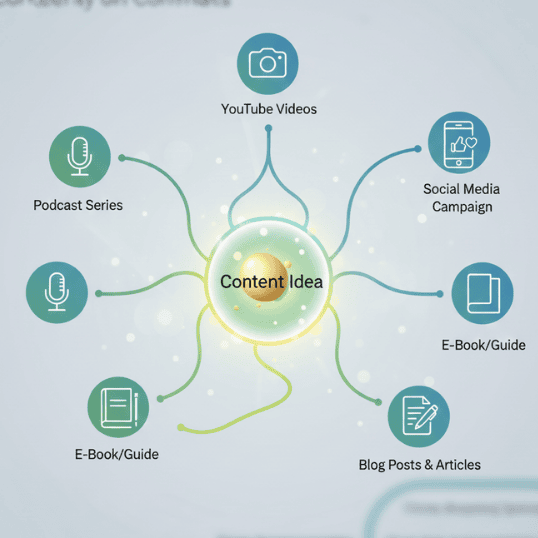
Illustration of a single idea branching into different content formats
STEP 2: Break It Into Micro Angles
Once you have your pillar idea, it’s time to divide it into micro-angles, short, standalone insights that can live independently on any platform.
Each micro-angle = one post, story, or video.
This stage of the repurpose content workflow helps you scale quantity without losing depth.
You can pull micro-angles from:
- Different audience pain points
- Misconceptions about the topic
- Supporting data or case studies
- Behind-the-scenes examples or process insights
- Personal lessons learned
This approach keeps your creator productivity high because you’re not starting from scratch; you’re zooming in on parts of an existing message.
For example, if your pillar idea is “Consistency beats intensity,” your micro-angles might be:
- Why does daily posting burn you out?
- The difference between momentum and pressure.
- How batching content reduces creative fatigue.
- One framework for maintaining output during low-energy days.
- A client story proving the long-term effect of consistent posting.
Each of these can become an entire content piece, tweet thread, carousel, or newsletter segment.
Systemise Creative Workflow: How to Stay Inspired Without Losing Efficiency explains how to streamline this creative breakdown process.

Diagram showing one content idea divided into multiple content formats.
STEP 3: Choose Your Repurpose Formats
Now decide where each micro-angle will live.
Your goal isn’t to be everywhere, it’s to be strategically omnipresent.
Select 3–5 content formats based on what fits your message and platform strengths:
- Carousel or static post (Instagram/LinkedIn)
- Short-form video (Reels, TikTok, YouTube Shorts)
- Tweet thread or X post
- Newsletter paragraph
- Podcast clip or blog snippet
Here’s how to map it:
| Format | Ideal Use | Goal |
| Short video | Emotional hooks, visual stories | Awareness |
| Carousel | Step-by-step guides, frameworks | Authority |
| Blog | Deep dives, SEO | Longevity |
| Newsletter | Personal insights | Relationship |
| Tweet thread | Micro lessons, discussion prompts | Virality |
Use your content repurposing system to assign each micro-angle to a format type. Then automate as much as possible.
Pro tip: You can connect this with Automation Made Human: 5 Practical Tools to Simplify Your Workflow and Save Hours to keep your creative flow uninterrupted.
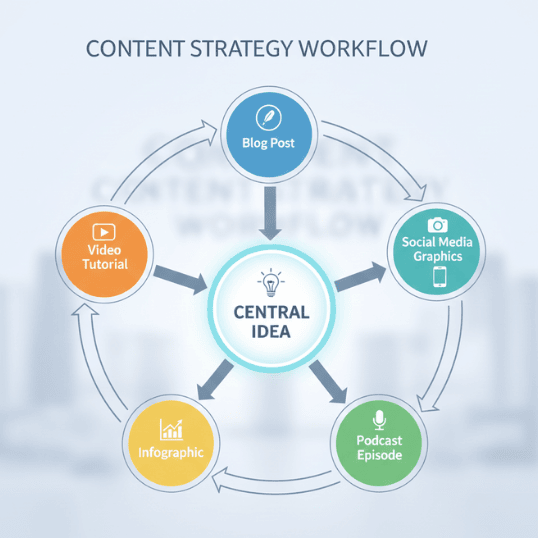
Diagram showing one content idea divided into multiple content formats.
STEP 4: Create Once, Customise Everywhere
Here’s where your Content Repurpose Engine really kicks in.
Create your main piece first, the most comprehensive version of your idea. It could be:
- A 3-minute video
- A 700-word blog
- A long-form podcast discussion
Then adapt it for each format, don’t rewrite, reshape.
Examples:
- Convert the video transcript into quote posts.
- Turn the blog intro into a Twitter thread.
- Pull key paragraphs into a carousel.
- Clip soundbites for short-form videos.
- Use the core framework for a newsletter deep dive.
This step not only boosts creator productivity but also ensures content batching, producing multiple posts from one creative burst.
Use templates or automation tools like Notion, Trello, or Airtable to track each format’s progress and publishing date.

Creator repurposing one piece of content into different formats
STEP 5: Automate, Track, and Refine
A Content Repurpose Engine isn’t just about creation; it’s about sustainability.
You need automation and analytics to make your workflow repeatable and data-driven.
- Automate Publishing:
Use batch scheduling tools like Later, Metricool, or Buffer.
Create templates for captions, hashtags, and CTAs to save time. - Track Results:
Measure saves, reach, engagement, and conversion rates.
Look for high-performing themes that can become new pillar ideas. - Refine the System:
Every 30–60 days, review what’s working.
Remove formats that drain energy and double down on high-ROI ones.
You can even connect this process to your wider creator business systems.
Explore The Growth Engine Blueprint: 5 Leverage Systems Every Modern Creator Needs for templates and system optimisation strategies.

Analytics dashboard showing repurposed content performance
Build Once, Profit Often
When you build your Content Repurpose Engine, you stop chasing algorithms and start building assets.
You shift from “content treadmill” to “content ecosystem.”
Every idea becomes a system.
Every system multiplies reach.
Every repurposed piece keeps working long after you’ve moved on to the next one.
That’s the magic of a well-built content repurposing system: you’re no longer creating more, you’re creating smarter.
If you want to take this further:
- Revisit Decision Fatigue Fix: Cut Choices in Half and Focus on What Actually Moves the Needle to simplify your workflow decisions.
- Explore The Sustainable Creator: How to Build Momentum Without Burning Out for balancing creative energy.
Because in the end, repurposing content isn’t recycling, it’s refining leverage.
You’re not making more; you’re making meaning last.