



Every ping, scroll, and swipe pulls at the edges of your attention. The modern workday is engineered for reaction, not reflection, and the result is what many professionals now call digital chaos. You may call it busyness, but it’s actually fragmentation: the inability to sustain focus on what truly matters.
The average professional switches tasks over 1,200 times a day. Notifications are not neutral; they’re engineered triggers. Over time, this environment creates what psychologists call attention fatigue, the cognitive erosion that drains your ability to think deeply or prioritise effectively.
This isn’t about deleting your apps or escaping the internet. It’s about building digital focus systems; structures that give you back control, clarity, and mental bandwidth in an economy addicted to distraction.
Table of Contents
Understanding the Digital Addiction Loop
We don’t lose focus by accident; we’re trained to. Every platform you use, from email to social media, is designed to reward instant engagement. This creates a dopamine-based feedback loop that mirrors addiction patterns.
According to a 2022 study published in Harvard Business Review, workers toggle between apps and websites roughly 1,200 times a day, costing them nearly four hours a week just reorienting their focus. The real cost isn’t lost time; it’s lost depth.
The more fragmented your attention becomes, the harder it is to engage in meaningful work or creative problem-solving. The brain, overstimulated and under-rested, begins to crave novelty instead of progress.
That’s why The Distraction Detox begins not with removal but with awareness, identifying your triggers and designing systems that prevent relapse.
Why Traditional Digital Detoxes Fail
Many “digital detox” strategies fail because they treat symptoms, not systems. Turning off notifications or deleting apps can create temporary relief, but the underlying behaviours remain unchanged.
Sustainable change requires reprogramming the digital environment itself. You can’t rely on willpower in a world optimised for distraction. What you need is a distraction management framework that helps you systematically control inputs, not react to them.
That means building intentional rituals for focus, communication, and consumption.
Read the Productivity Systems for Remote Workers: 7 Ways to Streamline Your Workflow for more insight on how to streamline your workflow.
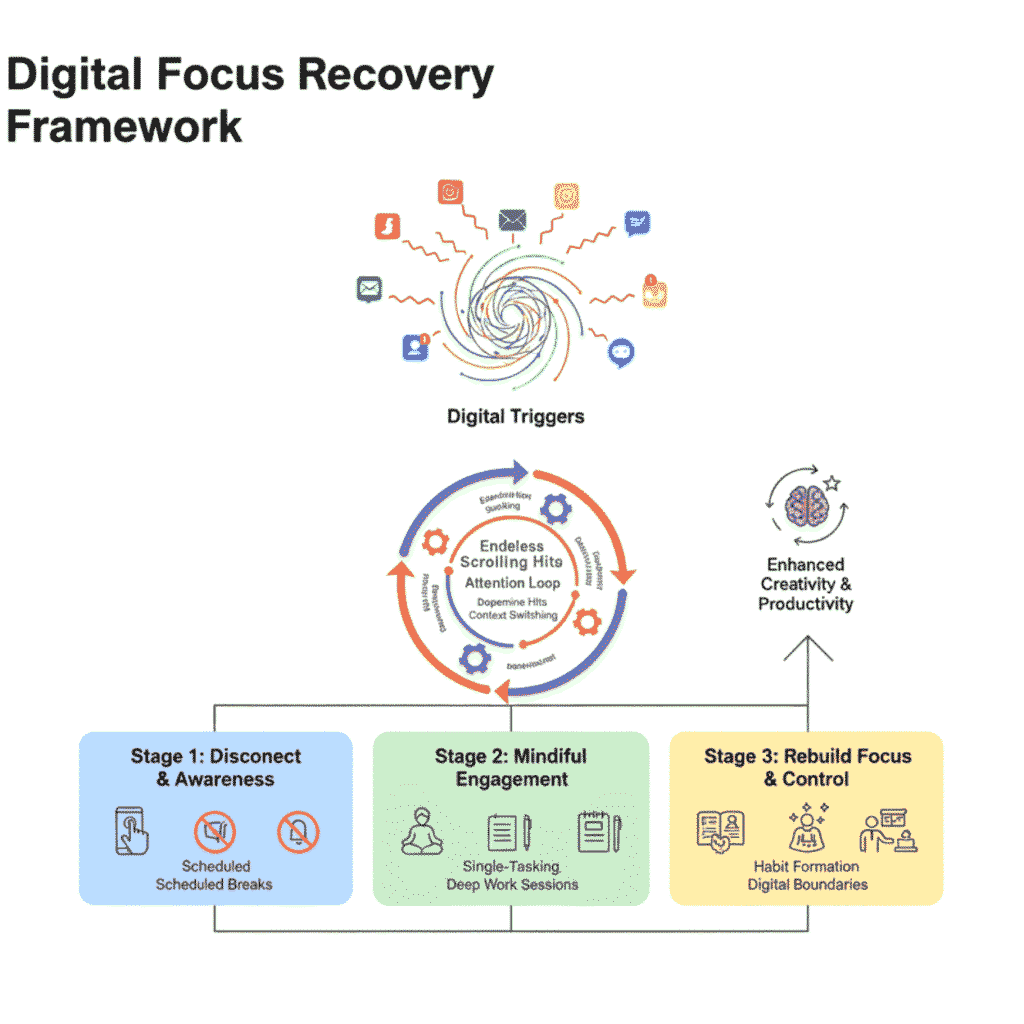
Illustrated framework showing digital triggers
The Digital Attention Reset
Before installing new systems, you must perform a digital attention reset: a 7-day process that recalibrates your mental baseline.
- Audit your inputs. List every app, platform, or communication channel that demands your attention.
- Measure your noise. Track how many times you check messages, notifications, or dashboards daily.
- Simplify your workspace. Use tools like RescueTime or Toggl Track to visualise distractions in real time.
- Create a shutdown ritual. End each workday with a single focus summary, the one thing you’ll start with tomorrow.
This reset doesn’t restrict you; it rewires you. Within a week, you’ll start noticing improved mental clarity and faster context switching.
Building a Focus System (The Framework)
The core of this detox lies in creating digital focus systems: a repeatable structure that balances deep work and digital engagement.
The 3-Layer Framework:
- Clarity Layer – Define your single metric of focus (e.g., strategic output, design hours, client results).
- Control Layer – Use apps intentionally. Block, mute, or batch. You control the dashboard; it doesn’t control you.
- Continuity Layer – Build sustainable rituals: weekly planning, task batching, and intentional downtime.
For example, Cal Newport’s Deep Work approach emphasises “attention constraint”, designing your environment to make focus easier than distraction. It’s not about removing technology, but aligning it with purpose.
The Cognitive Cost of Multitasking
Multitasking is the digital illusion of progress. Studies from the American Psychological Association show that switching between tasks can reduce productivity by up to 40%. Each switch costs your brain recovery time, attention residue, and decision fatigue.
Your brain was designed for sequencing, not splitting. The only true productivity lies in monotasking, doing one cognitively demanding thing at a time with full engagement.
A structured attention optimisation strategy involves creating “protected focus zones.” These are blocks of time (typically 60–90 minutes) where all digital interference is intentionally paused.
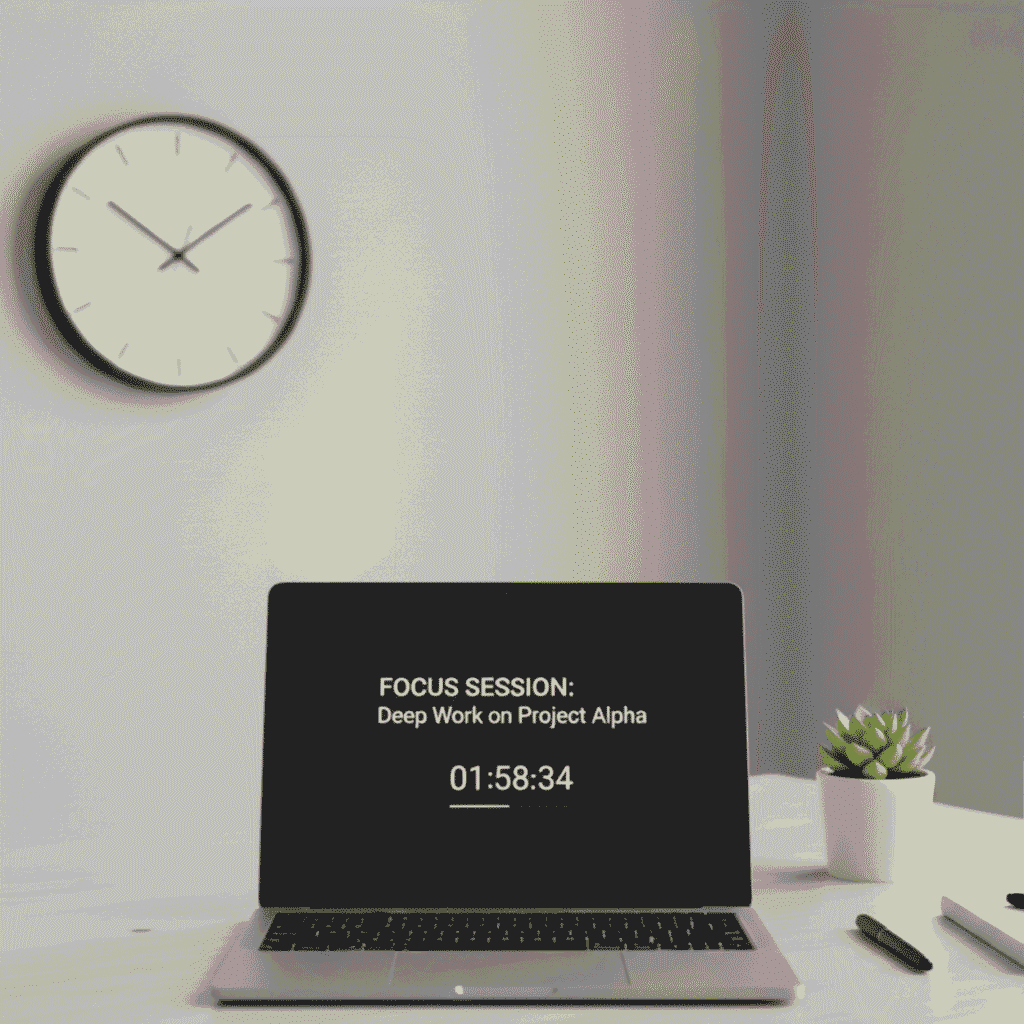
Minimalist workspace
Read on how to Scale Without Burnout: Process Systems for Sustainable Growth.
Designing Sustainable Focus Habits
Your detox is only as effective as your daily rhythm. Sustainable focus comes from merging structure + energy management.
Here’s how to reinforce it:
- Morning mapping: Start your day with one “non-negotiable focus block.”
- Digital boundaries: Keep communication tools in defined time zones (e.g., 10 am–12 pm).
- Micro-breaks: Reset your mental load every 90 minutes; move, breathe, step away.
- End-of-day reflection: Close loops, note wins, and log distractions for tomorrow’s reset.
External validation can also reinforce consistency. Behavioural design expert and Indistractable author Nir Eyal notes that traction (not restriction) drives real focus. Build systems that pull you toward what matters, instead of merely pushing distractions away.
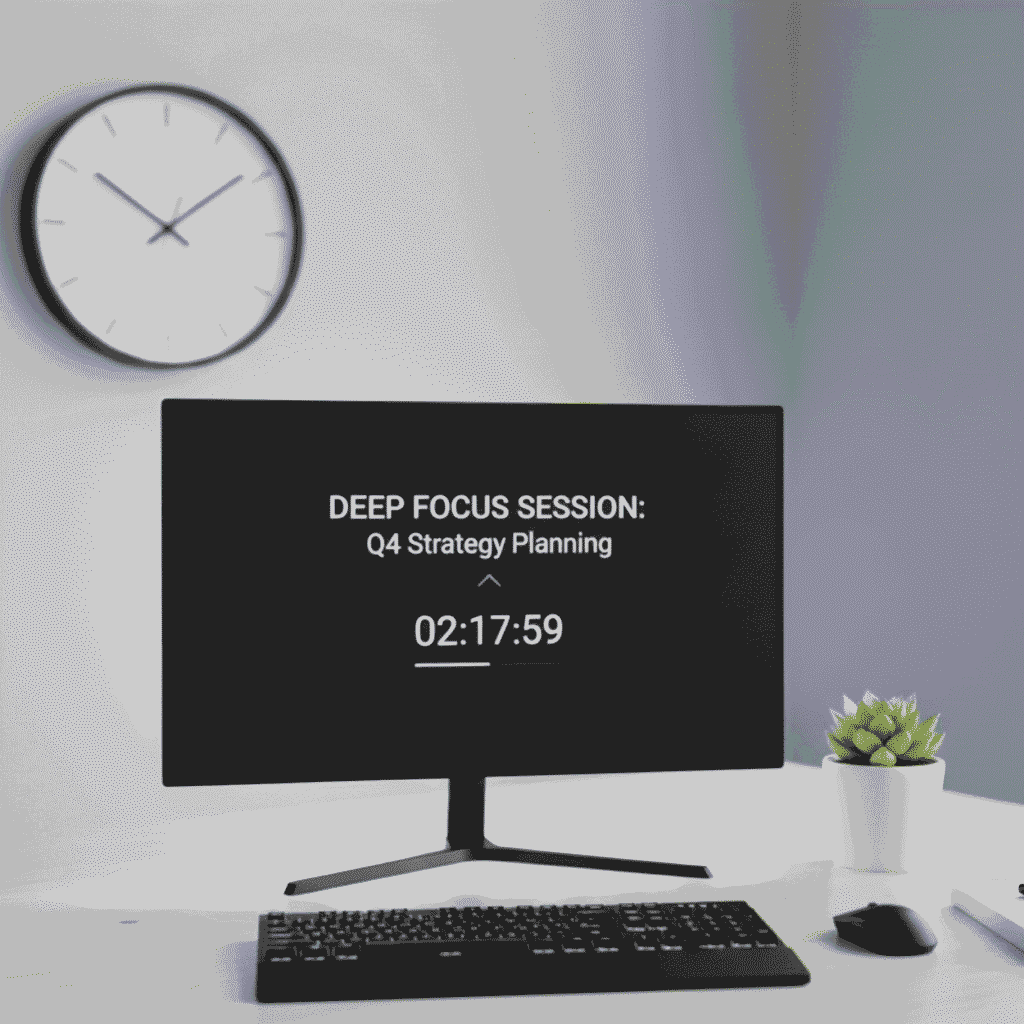
Minimalist workspace showing a single tab
Measuring Your Focus ROI
Focus is measurable. Use simple data points to track progress:
- Average daily task depth: how many meaningful outputs per focus session
- Distraction intervals: how often you switch tasks unintentionally
- Cognitive energy curve: your optimal mental performance window
Tools like HubSpot Productivity Hub or internal dashboards can visualise your attention performance. Over 30 days, you should see patterns of recovery, more flow time, less fatigue, and stronger engagement with high-impact tasks.
The Discipline of Digital Stillness
Digital focus systems aren’t about deleting your apps or living offline. They’re about redefining your relationship with digital tools. The goal is simple: use technology as leverage, not a leash.
In a world where constant connectivity masquerades as productivity, your greatest edge will always be attention, the ability to stay centred while the world scrolls by.
The detox begins with awareness, but mastery comes with design. When your digital systems align with your goals, clarity becomes automatic, and chaos becomes obsolete.