


Imagine waking up at 2 a.m. to the roar of your neighbour’s generator. You’ve already spent three days without power; your fridge has been running warm since Tuesday, and your children can’t iron their uniforms for school. You’ve burned through over ₦35,000 in fuel this week alone. Sound familiar?
This is not a movie scenario; it is the daily reality for millions of Nigerians in 2026. According to the Energy for Growth Hub, each grid feeder in a typical Nigerian city experiences an average of 640 power outages per year, roughly 160 days of total blackout. In March 2026, the national grid plummeted to just 3,940MW, and as recently as December 2025, generation crashed to near zero, plunging the entire country into darkness simultaneously.
Currently, Nigeria’s grid averages just four hours of daily supply, and that is only in the relatively better-served areas. Rural communities and secondary cities often go days without any supply at all. Meanwhile, Nigerian households and businesses collectively spend an estimated $14 billion annually on private petrol and diesel generators to plug the gap. That is money that should be staying in your pocket.
That is exactly why I switched to a hybrid inverter system. My family and I use a modest, lower-rated system that provides at least eight solid hours of power with minimal consumption. It keeps our lights, fans, phones, and internet running through the night without noise, without fuel, and without stress. It has transformed my daily routine in ways I didn’t expect. While my setup has its limits, there are far more robust options for those with higher energy demands.
This guide is the most comprehensive resource available in 2026 for Nigerians evaluating solar and inverter systems. Whether you need to power a single bedroom, a three-bedroom apartment, or an entire office block, you will find everything here: from how the technology works to which brands to trust, what it costs, and how to ensure your system lasts for decades.
Table of Contents
Disclosure: Our content is engineered to help you make informed, data-driven decisions. Digital Solutions Edge is reader-supported; when you engage with our recommendations or click certain links, we may receive a commission. This support allows us to continue delivering the digital solutions you rely on. Thank you for being part of our community.
Nigeria’s Power Crisis in 2026: The Numbers That Should Alarm You
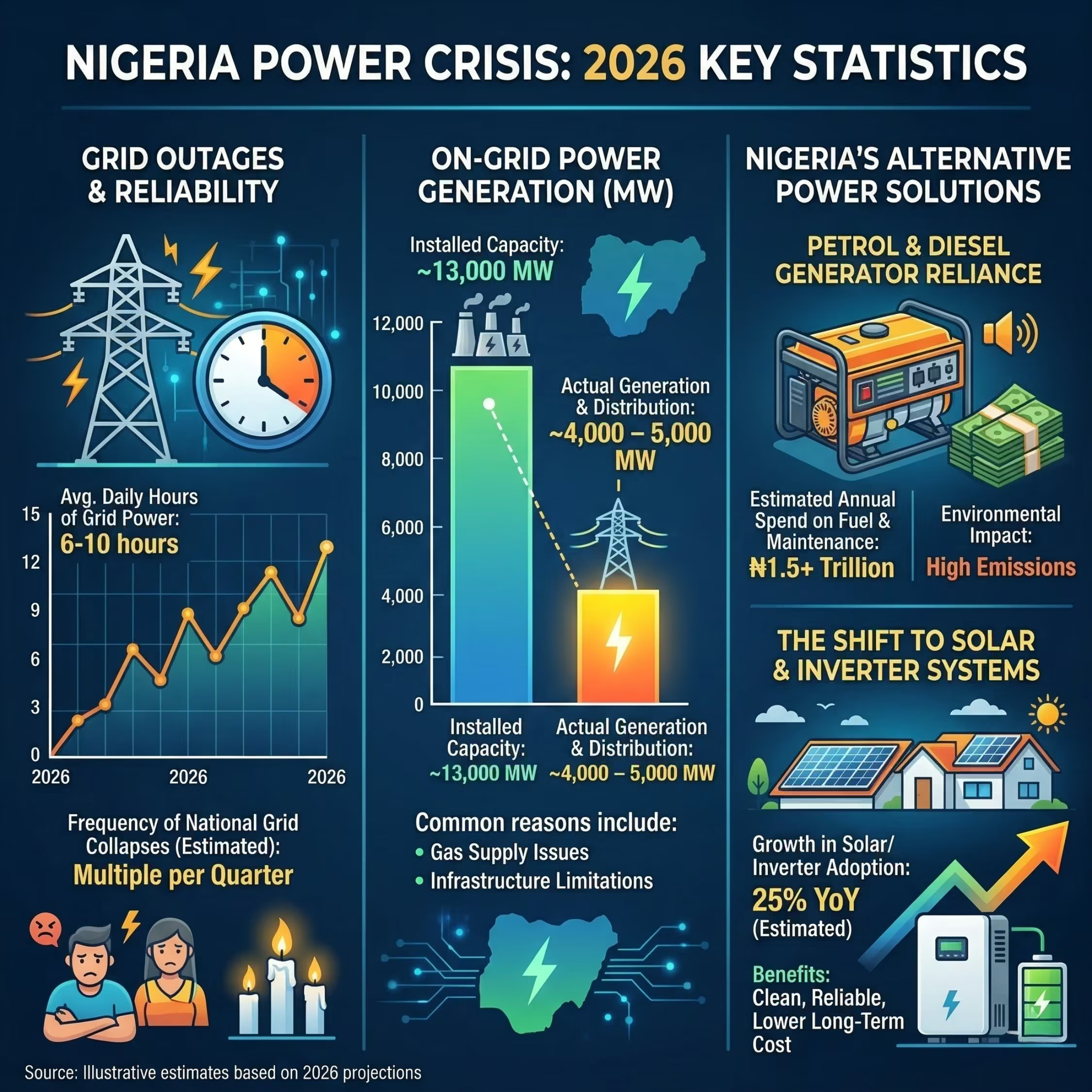
Nigeria sits on enormous natural resources – oil, gas, hydro potential, and one of the highest solar irradiance levels anywhere on Earth. Yet by every measurable standard, the country’s electricity sector is among the most unreliable on the continent.
Here are the figures that define the challenge:
• Average daily grid supply: approximately four hours in better-served areas, often zero in others
• Grid outages per year per feeder: approximately 640, equating to around 160 days of blackout annually (Energy for Growth Hub)
• Percentage of time Nigerians experience power difficulties: approximately 85% (Wikipedia, Nigerian Energy Supply Crisis)
• National grid generation in March 2026: fell to 3,940MW against a population of over 220 million people – South Africa generates 40,000MW for roughly 60 million people
• Private generator spending: an estimated $14 billion annually, much of it on petrol and diesel
• Off-grid energy share for industry: 96% of industrial energy consumption comes from private generators
• Grid collapse frequency: the national grid has suffered repeated full collapses in 2024 and 2025 alone
The 2023 Electricity Act empowered state governments to build their own generation and distribution networks, and ten states had begun doing so by mid-2025. Reforms are genuinely in progress. But the honest outlook for 2026 is that grid supply will remain deeply unreliable for the foreseeable future.
That context matters for every decision in this guide. Any system you invest in must survive Nigeria’s specific conditions: extreme heat, voltage fluctuations, dusty environments, and the reality that grid supply, when it does arrive, is often unstable. The good news is that solar irradiance levels across Nigeria are outstanding – averaging 4.5 to 7.0 peak sun hours daily depending on location – which means your panels will generate significant power even in months when cloud cover is more common.
How Solar and Inverter Systems Work
Before you spend a single naira, you need to understand what you are actually buying. Too many Nigerians get oversold or undersold simply because they don’t understand the fundamentals. Let’s fix that.
How Solar Panels Generate Electricity
Solar panels use photovoltaic (PV) technology. Each panel contains dozens or hundreds of photovoltaic cells made from silicon – a semiconductor material. When sunlight strikes these cells, it excites electrons and causes them to move, creating direct current (DC) electricity.
The amount of electricity produced depends on:
• The wattage rating of the panel (e.g., a 400W panel in full sun produces approximately 400 watts per hour)
• The intensity and angle of sunlight hitting the panel
• The temperature of the panel – panels actually lose efficiency in extreme heat, which is why ventilation in mounting matters
• Whether shadows from trees, rooftop structures, or neighbouring buildings fall on any part of the panel
The DC electricity from your panels cannot power your household appliances directly. It must first be converted to alternating current (AC) – and that is the inverter’s job.
Types of Solar Panels
Three main panel types are sold in Nigeria, and understanding the difference will help you make a better purchase:
Monocrystalline Panels
Made from a single continuous crystal of silicon. These are the most efficient panels available, typically reaching 20-22% efficiency, and they perform better in low-light conditions such as overcast mornings. They are more expensive but require less roof space to achieve the same wattage. In 2026, monocrystalline dominates new installations in Nigeria.
Best for: Homes with limited roof space, installations where maximum output per square metre matters, and anyone who wants the best long-term value.
Polycrystalline Panels
Made from multiple silicon crystals melted together. They are slightly less efficient (15-17%) and visually distinct by their bluish, fragmented appearance. They are more affordable than monocrystalline and have a strong track record in Nigeria’s market. If budget is tight and roof space is not a constraint, polycrystalline panels remain a practical choice.
Thin-Film Panels
Produced by depositing photovoltaic material on a substrate like glass. They are the least efficient type (10-13%) and less common for residential use in Nigeria. Their flexibility makes them suitable for some commercial or industrial rooftop applications. Generally not recommended for standard household installations.
| Panel Type | Efficiency | Cost (Relative) | Best Use Case | 2026 Market Share (NG) |
| Monocrystalline | 20-22% | Highest | Homes, businesses, limited space | Dominant |
| Polycrystalline | 15-17% | Medium | Large rooftops, budget installs | Declining |
| Thin-Film | 10-13% | Lowest | Industrial, specialist uses | Niche |
How Inverters Work
Your solar panels produce DC power. Your home runs on AC power – the same type supplied by the national grid. An inverter converts DC into AC at the correct voltage and frequency (240V, 50Hz in Nigeria).
Modern inverters do far more than simple conversion:
• They regulate and stabilise voltage output to protect your appliances
• They communicate with batteries to manage charging and discharging cycles
• They monitor solar panel input via a Maximum Power Point Tracker (MPPT) to extract the maximum possible energy at any given moment
• They switch seamlessly between power sources – solar, battery, grid – often in milliseconds
• They provide protection against overload, short circuits, overvoltage, and over-temperature
When evaluating inverters for Nigeria, the output waveform matters greatly. You want a pure sine wave inverter – not a modified sine wave. A pure sine wave replicates the smooth, rolling waveform of mains electricity. Modified sine wave inverters produce a rougher, stepped approximation that can damage sensitive appliances like air conditioners, refrigerators with induction motors, medical equipment, and certain laptop chargers. Every quality inverter sold for home use in Nigeria should be pure sine wave. Always confirm this before buying.
Types of Inverters
Standard (Conventional) Inverters
These work only with batteries. When the battery bank is charged – either from the grid or a separate charge controller – the inverter converts stored DC power to AC. They have no built-in solar input management. You need a separate solar charge controller to add panels. These are older technology, relatively cheap, and increasingly being replaced by hybrid units.
Solar Charge Controller Inverters (PWM)
These include a built-in Pulse Width Modulation (PWM) charge controller that connects directly to solar panels and batteries. PWM controllers are effective but less efficient than MPPT. They are common in smaller, budget systems.
MPPT Inverter-Chargers
Maximum Power Point Tracking (MPPT) is a smarter charging algorithm that constantly monitors the voltage-current relationship of your solar panels and adjusts to extract the highest possible power at every moment of the day. An MPPT controller can harvest 20-30% more energy from the same panels compared to a PWM controller. For any serious installation in Nigeria, an MPPT-based unit is the standard recommendation.
Hybrid Inverters (The Current Gold Standard)
A hybrid inverter manages solar input, battery storage, and grid connection simultaneously. It decides in real time which source to use and in what combination – drawing from solar first, topping up from batteries when solar falls short, and using the grid or a generator as a last resort. When the grid is present and your battery is already full, some hybrid units feed excess solar back to the grid.
For Nigeria, the hybrid inverter is the most practical and future-ready choice. It handles the country’s irregular grid without fuss, integrates with whatever battery bank you choose, and gives you a clear upgrade path as you add more panels or storage over time.
Grid-Tie (Grid-Connected) Inverters
These are designed exclusively for on-grid use. They feed solar power directly into the grid and shut down automatically during outages (for safety reasons). Without battery backup, they provide no power during blackouts – making them largely impractical for most Nigerian users given the grid’s unreliability. They are relevant only in commercial contexts where continuous grid connectivity can be ensured.
Battery Storage Explained
Batteries store the energy your solar panels produce during the day so you can use it at night or during cloudy periods. Battery capacity is measured in kilowatt-hours (kWh) – how much total energy the battery holds. The battery’s voltage (typically 12V, 24V, or 48V) determines how it integrates with your inverter.
A critical concept for batteries is Depth of Discharge (DoD). This refers to how much of a battery’s capacity you can safely use before damage occurs. Using a battery below its recommended DoD shortens its lifespan significantly.
Lead-Acid Batteries
The traditional choice – flooded lead-acid and sealed (VRLA/AGM/GEL) variants have been the Nigerian market standard for years. They are affordable upfront but carry significant long-term costs: typical lifespans of two to three years under regular cycling, a maximum recommended DoD of 50%, and the need for periodic water top-ups in flooded variants.
Tubular (OPzS) lead-acid batteries represent the premium end of lead-acid technology. They offer better cycle life – up to five years with proper care – and tolerate deeper discharge better than standard lead-acid. Many Nigerians still use tubular batteries as a cost-effective middle ground.
Lithium Iron Phosphate (LiFePO4) Batteries
LiFePO4 is the future of battery storage in Nigeria, and the transition is accelerating. These batteries offer 80-90% usable DoD (compared to 50% for lead-acid), a cycle life of 3,000-6,000 cycles (compared to 300-500 for standard lead-acid), and a lifespan of 8-15 years. They are lighter, require zero maintenance, perform better in heat, and integrate seamlessly with modern hybrid inverters.
The upfront cost is higher – a 5kWh LiFePO4 battery bank costs approximately ₦61.8M to ₦63.0M in Nigeria as of 2026. A 10kWh bank runs ₦63.5M to ₦66.0M. But the total cost of ownership over a decade is typically lower than replacing lead-acid batteries every two to three years.
| Battery Type | Lifespan | Usable DoD | Maintenance | Upfront Cost | Best For |
| Standard Lead-Acid | 2-3 years | 50% | Regular (flooded) | Lowest | Tight budgets, short-term |
| Tubular Lead-Acid | 4-5 years | 60-70% | Moderate | Medium | Mid-range residential |
| LiFePO4 Lithium | 8-15 years | 80-90% | None | Highest upfront | Long-term value, businesses |
The Full System: All the Components You Need
A complete solar power system for a Nigerian home or business includes:
• Solar panels: convert sunlight to DC electricity
• Mounting structure: holds panels at the correct angle on your roof or ground. Tilt angle should ideally match your latitude for maximum annual yield
• Solar charge controller (or built into hybrid inverter): regulates panel output to charge batteries safely
• Inverter: converts DC to AC and manages power sources
• Battery bank: stores energy for use when panels aren’t generating
• Automatic Transfer Switch (ATS): many modern hybrid inverters include this built-in; it handles seamless switching between solar/battery and grid/generator
• Cables, connectors, and fusing: correctly rated DC and AC cabling is essential for safety and efficiency. Undersized cables cause heat, voltage drop, and fire risk
• Monitoring system: many modern inverters include Wi-Fi or Bluetooth monitoring apps that let you track production, consumption, and battery state in real time
Types of Solar Systems: Off-Grid, On-Grid, and Hybrid
Understanding which system type fits your situation determines everything else – the components you need, the cost, and how much power independence you achieve.
Off-Grid Systems
An off-grid system operates with complete independence from the national grid. Your solar panels charge your battery bank, your inverter converts that stored power for home use, and no grid connection exists. You are entirely self-sufficient.
Off-grid is most appropriate for:
• Rural locations where grid connection is unavailable or prohibitively expensive to establish
• Remote businesses, farms, or institutions
• Households in urban areas who want complete energy independence and are willing to invest in a large enough battery bank and panel array
The trade-off is that an off-grid system must be sized for your worst-case scenario – typically multiple days of low sun. This means a larger, more expensive battery bank. Any extended period of cloud cover or unusual demand will drain your batteries unless you have a generator backup.
On-Grid (Grid-Tie) Systems
On-grid systems connect directly to the national grid and feed surplus solar power back to it. They have no battery storage. During a grid outage, the inverter shuts down for safety reasons – which means no power for you during blackouts.
In a country with Nigeria’s grid reliability, a pure on-grid system makes very little practical sense for most residential users. It is more relevant for large commercial operations or industries with robust backup generator support.
Hybrid Systems (The Most Practical for Nigeria)
A hybrid system connects to both solar panels and batteries while maintaining a grid or generator connection as a supplementary source. This is the configuration that the vast majority of Nigerian households and businesses should be targeting in 2026.
How a typical hybrid system works through a 24-hour cycle in Nigeria:
1. From sunrise (~6 a.m.), panels start generating. The inverter uses solar power directly for your loads and routes surplus to charge the battery bank.
2. By mid-morning, batteries are likely full. The inverter continues running your home entirely from solar during peak sun hours.
3. As the sun drops in the afternoon, solar output decreases. The inverter starts drawing from batteries to supplement.
4. By evening, you are running on stored battery power. Your lights, fans, phones, and TV all continue without interruption.
5. If the grid happens to come on overnight, the inverter can use it to top up the battery bank – so you start the next morning with a full charge.
6. If the grid is absent and batteries run low, a connected generator can provide supplementary input.
This cycle means you may go days, even weeks, with minimal dependence on the grid or any generator – depending on system size. For a well-designed hybrid system, grid power becomes a backup top-up rather than a primary source.
| [MEDIA PLACEHOLDER: DIAGRAM: Hybrid solar system flow diagram showing panels, inverter, batteries, grid, and home loads]Alt Text: hybrid solar inverter system diagram Nigeria 2026 |
Understanding Power Ratings: What kVA, kW, and kWh Actually Mean
This is where many buyers get confused – and where mistakes are costly. Let’s break it down simply.
Watts (W) and Kilowatts (kW)
A watt is a unit of power – the rate at which energy is used or produced at any given moment. 1,000 watts = 1 kilowatt (kW). When someone says their fridge uses 150 watts, it means the fridge draws 150 watts of power continuously while running.
Kilowatt-Hours (kWh)
A kilowatt-hour is energy over time – how much power is consumed in an hour. A 150W fridge running for 8 hours uses 1.2 kWh of energy. This is the unit your NEPA/PHCN prepaid meter measures. It’s also how battery capacity is expressed. A 10kWh battery, fully charged, can theoretically power a 1,000W load for 10 hours – but practical factors like inverter efficiency, battery DoD limits, and temperature reduce that in real use.
kVA vs kW
Inverters are often rated in kVA (kilovolt-amperes) rather than kW. kVA measures apparent power – the total power drawn by your system including any reactive component. kW measures real (usable) power. The ratio between them is called the power factor.
For most residential loads, assume a power factor of 0.8. So a 5kVA inverter has an effective output of approximately 4kW. This means it can handle up to 4,000 watts of simultaneous load. Exceeding that will trigger the inverter’s overload protection.
| Quick Reference: Power Factor5 kVA inverter = approximately 4 kW real power3.5 kVA inverter = approximately 2.8 kW real power2 kVA inverter = approximately 1.6 kW real powerAlways add up ALL your appliance wattages before choosing an inverter capacity.Add a 25-30% safety margin above your expected simultaneous load. |
What Can Different System Sizes Power?
| System Size | Approximate Real Power | Typical Loads Supported | Use Case |
| 1-2 kVA | 0.8-1.6 kW | Lights, fans, phones, Wi-Fi, small TV | Single room, minimal loads |
| 3-5 kVA | 2.4-4 kW | Full apartment: lights, fans, fridge, TV, laptops | Average Nigerian home |
| 7.5-10 kVA | 6-8 kW | Above + 1 small AC unit, additional appliances | Larger home, small office |
| 15-30 kVA | 12-24 kW | Multiple ACs, heavy commercial loads | Business, factory, hospital |
Top Solar Inverter Brands in Nigeria 2026: Full Reviews with Pros, Cons, and Prices
The Nigerian market has matured significantly. These are the most recommended, widely available, and best-supported brands as of early 2026.
| [MEDIA PLACEHOLDER: IMAGE: Collage or comparison table of top inverter brands available in Nigeria – Victron, Sunsynk, Growatt, Felicity, SRNE, Luminous, Mercury]Alt Text: top solar inverter brands Nigeria 2026 comparison |
1. Victron Energy – The Premium Standard
Victron Energy is the top choice when budget is not the primary constraint. This Dutch brand is used globally in yachts, hospitals, telecoms infrastructure, and high-end residential systems – which tells you something about its build quality.
Key features:
• PowerAssist technology: blends battery and grid power to handle peak loads without tripping
• Highly modular – systems can be expanded over time without replacing core components
• VRM (Victron Remote Monitoring) portal: arguably the most detailed monitoring available
• Exceptional surge capacity: handles start-up spikes from compressor-based appliances
Pros: bulletproof reliability, outstanding monitoring, modular design, 5-year standard warranty
Cons: highest price point in the market, requires professional installation
Price range: ₦6800,000 – ₦67,200,000 depending on model and capacity
Best for: mission-critical applications, businesses, premium residences, and anyone who cannot afford downtime
2. Sunsynk and Deye – True Hybrid Leaders
Sunsynk (UK-designed, manufactured in South Africa) and Deye (China) share core technology and have become the go-to recommendation for mid-to-high range hybrid systems in Nigeria. Both offer seamless blending of solar, battery, grid, and generator inputs via intuitive touchscreen interfaces.
Key features:
• True hybrid operation with built-in MPPT charge controllers
• Compatible with both lithium and lead-acid batteries
• Detailed real-time monitoring via smartphone app
• Generator start/stop automation on some models
Pros: excellent feature set, relatively competitive pricing, strong installer community in Nigeria
Cons: after-sales support varies by distributor; buy from a reputable dealer with a clear warranty process
Price range: ₦6600,000 – ₦65,000,000
Best for: medium and large homes, offices, SMEs needing reliable hybrid operation
3. Growatt – Efficient Residential Choice
Growatt is a Chinese manufacturer that has established strong presence in Nigeria’s residential market. Its systems are notable for a wide MPPT voltage range – meaning panels start charging earlier in the morning and continue later into the evening, squeezing more daily energy from the same panels.
Pros: strong efficiency, competitive pricing, good warranty terms
Cons: fewer local technicians specialised in the brand compared to more established names
Price range: ₦6350,000 – ₦64,000,000
Best for: residential installations where efficiency per naira is the priority
4. Felicity Solar – Durable and Africa-Focused
Felicity Solar has deliberately targeted the African market and designed its products for conditions like Nigeria’s. Its inverters feature heavy-duty transformers built to handle Nigeria’s notorious voltage fluctuations without damage.
Key features:
• Robust transformer design handling input voltages from 90V to 280V without battery support
• Strong compatibility with a wide range of battery types
• Wide product range from 1.2kVA to 15kVA+
Pros: built for African grid conditions, durable, broad range
Cons: monitoring features less advanced than premium brands
Price range: ₦6317,700 – ₦64,000,000
Best for: areas with severe voltage instability, budget-conscious buyers who want proven durability
5. Luminous – The Most Accessible Choice
Luminous is arguably the most widely purchased brand in Nigeria’s mass market. Its strength is distribution – Luminous products and qualified Luminous technicians are available virtually everywhere in the country, from Lagos Island to Zaria.
Pros: widest service network in Nigeria, affordable entry point, user-friendly
Cons: lower-end models use modified sine wave (check specifications carefully); premium models needed for sensitive appliances
Price range: ₦6180,000 – ₦65,000,000
Best for: first-time buyers, anyone prioritising local service availability, budget-constrained households
6. SRNE – High Performance in Harsh Conditions
SRNE is a Chinese manufacturer with a strong track record in tropical markets. Their HESP and HFP series are widely deployed across Nigeria and are praised for stable performance in high-temperature environments. SRNE has also partnered with Nigerian financial institutions to offer installment payment plans.
Pros: excellent tropical performance, good pricing, financing options available
Cons: brand recognition still growing among non-specialist buyers
Price range: ₦6350,000 – ₦64,500,000
Best for: tech-savvy buyers seeking performance and financing options
7. Mercury – The Nigerian Brand
Mercury is one of the few brands with strong local roots in Nigeria. It is especially known for its transformer-based hybrid inverters that are extremely tolerant of Nigeria’s variable grid conditions. Mercury’s local assembly and service network make repairs relatively straightforward.
Key features:
• Built-in MPPT for solar integration
• Pure sine wave output
• Designed specifically for the Nigerian grid environment
Pros: locally supported, widely understood by technicians, built for Nigerian conditions
Cons: fewer advanced features than premium international brands
Price range: ₦6250,000 – ₦62,500,000
Best for: buyers who want Nigerian brand support and broad technician availability
8. Schneider Electric – The Industrial Option
Schneider is the choice for hospitals, factories, data centres, and other high-load commercial operations. Its massive surge capacity and industrial-grade build quality are unmatched for heavy-duty applications, but the pricing reflects that premium positioning.
Price range: ₦61,000,000 – ₦612,000,000+
Best for: commercial and industrial applications, critical infrastructure
9. MUST Power – Budget Accessibility
MUST Power has become extremely popular in Nigeria for its affordability and genuine reliability at the entry and mid level. It is widely available and commonly recommended for first-time buyers who need a functional system without a large upfront outlay.
Price range: ₦6150,000 – ₦61,200,000
Best for: households starting their solar journey with a limited budget
Top Solar Panel Brands in Nigeria 2026
Your panels are the energy source of the entire system. Buying weak or counterfeit panels means your battery never fully charges, your inverter works harder, and the whole system underperforms. These are the most trusted panel brands currently stocked by Nigerian dealers.
Jinko Solar
One of the world’s largest panel manufacturers, Jinko consistently delivers outstanding heat performance – a critical factor in Nigeria’s climate. Its Tiger series monocrystalline panels are widely available at 400W-550W ratings and represent a strong balance of price and performance.
LONGi Solar
LONGi is the global leader in monocrystalline panel production. Their Hi-MO series panels combine high efficiency (up to 22.3%) with excellent temperature coefficients – losing less performance on hot days. Increasingly popular with quality-focused Nigerian installers.
Canadian Solar
A trusted mid-premium brand with a 25-year performance warranty. Canadian Solar panels handle Nigeria’s humidity and dust well and have earned a strong reputation for durable, consistent output over many years.
Trina Solar
Trina’s Vertex series panels push into the 500W-600W range, meaning fewer panels for the same total wattage. Excellent low-light performance makes them a good choice for locations that see more cloud cover.
JA Solar
JA Solar offers strong low-light output and good durability at competitive prices. A reliable mid-range option for residential and commercial installs, widely stocked across Nigerian dealers.
| Brand | Key Strength | Efficiency Range | Common Sizes Available (NG) | Price Est. (550W Panel) |
| Jinko Solar | Heat performance, availability | 20-22% | 400W-560W | ₦680,000-₦6140,000 |
| LONGi Solar | Top efficiency, temperature coeff. | 21-22.3% | 400W-550W | ₦685,000-₦6150,000 |
| Canadian Solar | Durability, warranty | 20-21% | 380W-545W | ₦680,000-₦6140,000 |
| Trina Solar | High wattage, low-light output | 20-21% | 450W-600W | ₦680,000-₦6150,000 |
| JA Solar | Low-light, competitive price | 20-21% | 400W-550W | ₦675,000-₦6130,000 |
Battery Options: Lead-Acid vs Lithium – Which Should You Choose?
This decision will shape your system’s performance, maintenance demands, and total 10-year cost more than almost any other. Here is how to think through it for your specific situation.
The 10-Year Cost Comparison
Lead-acid batteries typically last 2-3 years under regular deep cycling in Nigerian conditions. If you replace them every 2.5 years over a 10-year period, you will buy four battery sets. A decent lead-acid bank sized for a mid-range home might cost ₦6400,000-₦6700,000. Over 10 years, that is ₦61.6M-₦62.8M in batteries alone, plus the time and cost of disposal and reinstallation each time.
A LiFePO4 lithium battery bank for the same application costs ₦61.8M-₦63.0M upfront but lasts 8-12 years with zero maintenance. In most scenarios, the total cost over a decade is comparable or lower than repeated lead-acid replacement – with better performance throughout.
When Lead-Acid Still Makes Sense
• Your total budget for the system is very tight and you need to get started
• You plan to upgrade the system significantly within three years anyway
• A certified technician will manage the system and check fluid levels regularly
• Your discharge cycles are light (battery rarely goes below 60% charge)
When to Choose Lithium (LiFePO4)
• You want the system to last 10+ years without major intervention
• You have limited ventilation space (lithium batteries are safer and don’t off-gas hydrogen)
• You need maximum usable capacity – lithium gives you 80-90% of rated capacity vs 50% for lead-acid
• You run a business and cannot afford system downtime or maintenance disruptions
| Important Safety Note on Lithium BatteriesNot all ‘lithium’ batteries are equal. Lithium Iron Phosphate (LiFePO4) is the safest and most appropriate chemistry for stationary storage.Avoid NMC or NCA lithium batteries for home storage – they carry higher thermal runaway risk.Always check for certifications: IEC 62619, CE marking, and ISO 9001 from the manufacturer.Buy from authorised distributors with clear warranty documentation. |
My Personal Experience: What a Low-Rating Inverter Can (and Cannot) Do
I want to be upfront about my own setup because it makes an important practical point. I use a lower power-rated solar inverter system – and it consistently delivers at least eight hours of uninterrupted power supply on minimal load consumption. That means my nights run on silent, clean power: lights stay on, my fan keeps running, phones charge, and my internet connection holds steady, regardless of what AEDC is doing.
Living in Nigeria’s Federal Capital Territory, where outages are frequent and grid supply can disappear for days, this has been transformative. The peace of mind of knowing I will have power to read, to work, to communicate – without the noise and expense of a generator – is genuinely difficult to overstate.
That said, I am clear-eyed about what my system cannot do. Because of its lower power rating, it does not run heavy appliances. No air conditioner, no electric cooker, no large refrigerator compressor running simultaneously. My system is sized for light loads, and that is fine for what I needed at the time. It does the job perfectly within those parameters.
But if you have greater energy needs – a full family home with a fridge, multiple fans, television, and work equipment running simultaneously, or a business with even moderate power demands – you need a larger, more capable system than mine. The good news is that the market in 2026 has excellent options at every tier.
My experience confirms one thing clearly: even a modest solar inverter system in Nigeria is worth having. It changes your daily rhythm in the most practical ways. And once you have experienced reliable power – however modest – the case for upgrading to a more capable system becomes very easy to make.
| What My Low-Rating Inverter Handles (8+ Hours Daily)LED lighting throughout the homeCeiling fans and standing fansSmartphone and laptop chargingWi-Fi router (24/7)Small televisionNOT recommended for: air conditioners, refrigerators with large compressors, electric kettles, or electric cookers |
How to Size Your System Correctly: A Step-by-Step Approach
Getting the sizing right is the most important technical decision in the entire process. Undersizing leaves you frustrated. Oversizing wastes money. Here is how to approach it properly.
Step 1: Complete a Load Audit
List every appliance you want the system to run. For each one, note its wattage (on the label or in the manual) and how many hours per day you use it.
| Appliance | Wattage (W) | Hours/Day | Daily kWh |
| LED lights (x6) | 60W total | 8 hours | 0.48 kWh |
| Ceiling fans (x2) | 120W total | 10 hours | 1.20 kWh |
| Refrigerator | 150W (avg) | 24 hours | 3.60 kWh |
| 32-inch TV | 60W | 5 hours | 0.30 kWh |
| Laptops (x2) | 90W total | 6 hours | 0.54 kWh |
| Wi-Fi router | 15W | 24 hours | 0.36 kWh |
| Phone charging | 25W | 4 hours | 0.10 kWh |
| TOTAL | 6.58 kWh/day |
Step 2: Calculate Required Battery Capacity
If you want 6.58 kWh daily from batteries and you are using LiFePO4 with 85% usable capacity and 95% inverter efficiency, your required battery bank size is approximately:
6.58 kWh ÷ 0.85 ÷ 0.95 = approximately 8.15 kWh of rated battery capacity.
For lead-acid with 50% usable DoD: 6.58 kWh ÷ 0.50 ÷ 0.92 = approximately 14.3 kWh rated capacity.
This illustrates why lithium requires a significantly smaller (and eventually cheaper) battery bank for the same usable energy.
Step 3: Calculate Required Solar Panel Capacity
Your panels must charge the battery bank AND run daytime loads. Nigeria averages 4.5-6.5 peak sun hours daily. Using 5 peak sun hours as a conservative estimate:
Required panel output = Total daily kWh ÷ Peak sun hours ÷ System efficiency (0.75-0.80)
For 6.58 kWh daily: 6.58 ÷ 5 ÷ 0.77 = approximately 1.7 kW of panels. Round up to 2 kW (e.g., four 500W panels) to allow margin for cloudy days.
Step 4: Select Inverter Capacity
Add up the maximum simultaneous load you ever expect to run. Add 25-30% safety margin. Choose an inverter with an apparent power (kVA) rating that comfortably covers this.
For the example above with a fridge, fans, TV, and laptops running simultaneously at peak: approximately 500W. A 2kVA inverter covers this with margin. If you plan to add a 750W air conditioner later, a 5kVA unit gives you room to grow.
How to Leverage Your System for Maximum Efficiency
Installing the system is just the beginning. How you use it day to day determines whether it thrives for 15 years or deteriorates in five. These are the most impactful practices.
Prioritise Energy-Efficient Appliances
Every watt you save is a watt your battery doesn’t need to provide. Replace incandescent bulbs with LED equivalents. Use inverter-type air conditioners, which consume 30-50% less power than conventional models for the same cooling output. Choose A or A+ energy-rated appliances when replacing older units.
Use Heavy Loads During Peak Solar Hours
Electric kettles, blenders, washing machines, electric irons – these high-wattage appliances should be used between 10 a.m. and 3 p.m. when your panels are producing at full capacity. Running them during this window means they draw directly from solar rather than depleting your battery bank.
Configure Battery State of Charge (SoC) Thresholds Correctly
Most hybrid inverters allow you to set the minimum battery SoC before the system switches to grid or generator backup. For LiFePO4, a 20% minimum SoC is appropriate. For lead-acid, set it no lower than 50%. Letting the battery discharge below these thresholds repeatedly causes accelerated degradation.
Use Smart Monitoring
Most modern inverters (Victron, Sunsynk, Growatt, SRNE) offer free smartphone monitoring apps. Check yours regularly. Monitoring catches faults early – a panel producing 20% less than expected, a battery not charging to full, or an inverter running unusually hot. Catching these issues early prevents expensive failures.
Configure Hybrid Charging Priority Correctly
Set your inverter to prioritise solar charging over grid charging. When the grid is available and batteries are below target, configure the inverter to use grid supplementary charging only at off-peak hours (typically midnight to 5 a.m.) if your electricity tariff structure makes this relevant.
Run the System at Higher Voltage Where Possible
If you are designing a new installation, choose a 48V system over a 24V or 12V configuration. Higher voltage systems carry the same power with lower current, which means less heat loss in cables and greater overall efficiency. The energy loss difference between a 12V and 48V system of the same size can reach 30-50%.
Installation, Maintenance, and Longevity: Making Your System Last
A well-installed and properly maintained solar system can serve you for 20-25 years. A poorly installed system can fail dangerously within months. This section covers both.
Installation: What to Demand from Your Technician
• Panel mounting angle: ideally 10-15 degrees in tropical Nigeria to balance annual energy yield and self-cleaning from rainfall. Do not mount panels completely flat – water pooling accelerates degradation
• Cable sizing: DC cables must be appropriately rated for the panel current. Under-rated cables overheat and create fire risk. Ask your installer to show you the cable specifications before work begins
• Earthing and surge protection: essential in many parts of Nigeria where lightning is common. A proper earth connection and DC surge protection devices on the panel string protect the entire system
• Battery ventilation: lead-acid batteries off-gas hydrogen during charging. They must never be installed in sealed spaces or near open flames. LiFePO4 is much safer in this regard but still benefits from ventilation and a cool location
• Inverter placement: inverters generate heat and should be installed in ventilated, shaded locations. Direct sun exposure shortens inverter lifespan significantly
Routine Maintenance Schedule
Solar systems are low-maintenance, but not zero-maintenance. Follow this schedule:
Monthly
• Visual inspection of panels for bird droppings, dust, or shading obstructions
• Check battery terminal connections for corrosion (especially lead-acid)
• Review monitoring app data for any anomalies in production or consumption
Quarterly
• Clean panels with clean water and a soft cloth (avoid abrasive materials or detergents that could damage anti-reflective coating)
• Check all cable connections are secure and undamaged
• For flooded lead-acid batteries: check electrolyte levels and top up with distilled water if necessary. Never use tap water
Annually
• Full system inspection by a certified technician
• Check inverter cooling fans are clean and functioning
• Test battery capacity against rated specification (most monitoring systems can do this automatically)
• Inspect mounting structure for corrosion, loose bolts, or storm damage
Extending Battery Life
Batteries are typically the most replaced component in a solar system. These practices extend their lifespan:
• Avoid regular deep discharge below the recommended DoD threshold
• Keep batteries cool where possible – heat is the primary accelerant of battery degradation. Aim for a battery room below 30 degrees Celsius
• Ensure batteries reach full charge at least once a week – partial cycling without ever reaching 100% accelerates stratification in lead-acid batteries
• Use a quality battery management system (BMS) – all modern LiFePO4 batteries include one built-in, and quality lead-acid chargers include multi-stage charging profiles
Extending Panel Life
Quality solar panels from reputable manufacturers come with 25-year performance warranties. In practice, they should produce meaningful power well beyond that. Keep them clean, unshaded, and properly mounted and they will outlast virtually every other component in your system.
Full Cost Breakdown and Long-Term ROI
Understanding the full cost picture – both upfront and over time – is essential for making a confident investment decision.
Entry-Level System (Lights, Fans, Phones, Wi-Fi)
| Component | Specification | Approximate Cost (2026) |
| Inverter | 1.5-2kVA hybrid, MPPT | ₦6180,000 – ₦6350,000 |
| Solar Panels | 2 x 400W monocrystalline | ₦6120,000 – ₦6200,000 |
| Battery | 100-200Ah tubular lead-acid OR 2.5kWh LiFePO4 | ₦6150,000 – ₦6800,000 |
| Mounting & Accessories | Structure, cables, breakers, connectors | ₦660,000 – ₦6120,000 |
| Installation | Certified technician | ₦650,000 – ₦6120,000 |
| TOTAL | ₦6560,000 – ₦61,590,000 |
Mid-Range System (Full Apartment Including Fridge)
| Component | Specification | Approximate Cost (2026) |
| Inverter | 5kVA hybrid with MPPT | ₦6450,000 – ₦6900,000 |
| Solar Panels | 6-8 x 400W monocrystalline | ₦6360,000 – ₦6800,000 |
| Battery | 10kWh LiFePO4 | ₦63,500,000 – ₦66,000,000 |
| Mounting & Accessories | ₦6150,000 – ₦6250,000 | |
| Installation | ₦6100,000 – ₦6200,000 | |
| TOTAL | ₦64,560,000 – ₦68,150,000 |
The Generator Cost Comparison
The typical Nigerian household running a generator spends approximately ₦660,000-₦6150,000 monthly on fuel alone, plus maintenance and eventual generator replacement costs. Over five years, that is ₦63.6M-₦69M in operating costs – without the generator itself or any capital return.
A quality solar system in the same period operates with near-zero fuel cost and minimal maintenance. Most systems break even within three to five years against generator operating costs and continue delivering value for another 15-20 years.
| ROI ExampleScenario: Mid-range system, total cost ₦66MMonthly generator saving: ₦680,000Break-even point: 75 months (6.25 years)15-year total saving vs generator: approximately ₦614.4M in fuel costs avoidedNet 15-year benefit: approximately ₦68.4M after system costThis does not include rising fuel costs, which have increased every year since 2020. |
Government Incentives, Tax Relief, and Financing Options
The Nigerian government has taken several steps to reduce the financial barriers to solar adoption, and private financing options have expanded significantly.
Federal and State Incentives
• Import duty exemptions on solar panels, inverters, and batteries: the federal government has maintained import duty waivers on specified renewable energy equipment categories
• VAT exemption on solar equipment: solar panels and related equipment are zero-rated for VAT purposes under existing provisions
• Rural Electrification Agency (REA) grants: the REA provides funding and support for off-grid and mini-grid solar projects, particularly in underserved communities
• 2023 Electricity Act: empowers state governments to create their own renewable energy incentive structures. By mid-2025, several states had introduced their own frameworks
Private Financing Options
• SRNE Nigeria: partners with local financial institutions for installment plans on system purchases
• Lumos Nigeria: operates a Pay-As-You-Go (PAYG) model primarily for residential rooftop solar
• Arnergy Solar: offers lease and financing options for businesses and larger residential installations
• Commercial bank solar loans: several Nigerian commercial banks now offer dedicated renewable energy financing products – enquire with your primary bank
• Cooperative financing: some employer cooperatives and community groups have begun pooling resources for group solar procurement, reducing per-unit costs
Common Mistakes That Cost Nigerians Money
After speaking with installers, buyers, and reviewing the market, these are the errors that appear most frequently – and are most expensive.
Buying the Inverter Separately from a Coherent System Plan
Many Nigerians buy an inverter first, then try to build a system around it. The inverter’s battery voltage compatibility, MPPT input range, and maximum solar input all constrain what panels and batteries you can use. Plan the whole system before purchasing any component.
Choosing Lead-Acid Batteries for Heavy Daily Cycling
If you are running the system heavily every day – which is almost every Nigerian household – standard lead-acid batteries will not last more than two years. The frustration of replacing them frequently and the total cost over five years almost always exceeds the lithium premium.
Under-Sizing the Panel Array
Many buyers minimise panel count to cut costs, then discover the battery never reaches full charge. An under-powered panel array is the most common cause of premature battery failure in Nigerian solar systems. Size your panels generously – they are the least expensive part of the system relative to what they deliver.
Ignoring Shading
Even partial shading on one panel can reduce the output of the entire string by 30-50% depending on system configuration. Before installation, study your roof for shading from trees, water tanks, or adjacent buildings at different times of day. If unavoidable shading exists, a microinverter or power optimiser setup can mitigate its impact.
Skipping Professional Installation to Save Money
This is the single most dangerous and costly mistake. Incorrectly wired DC systems start fires. Improperly earthed systems are struck by lightning. Batteries installed without adequate ventilation produce explosive hydrogen gas. Professional installation is not optional – it is the foundation of a safe, performing, long-lasting system.
Buying from Unauthorised Dealers Without Warranty Documentation
The Nigerian market has counterfeit solar components. Fake panels, relabelled batteries, and cloned inverter brands do exist. Always buy from authorised dealers, request warranty cards, and verify the manufacturer’s serial numbers where possible. If the price seems significantly lower than the market, it probably is not the genuine product.
Frequently Asked Questions
How long do solar panels last in Nigeria’s climate?
Quality monocrystalline panels from established manufacturers (Jinko, LONGi, Canadian Solar, JA Solar) come with 25-year linear performance warranties. In real conditions, most panels continue producing usable power well beyond 25 years, though efficiency declines gradually – typically around 0.5-0.7% per year. Nigeria’s heat can slightly accelerate this, but the overall lifespan remains excellent with proper installation and maintenance.
What is the minimum system I need to power my apartment in Nigeria?
For a two-bedroom apartment running lights, fans, television, phone charging, and a medium-sized refrigerator, plan for a minimum of a 3-5kVA hybrid inverter, 6-8 x 400W solar panels, and at least an 8-10kWh battery bank (LiFePO4 recommended). This configuration should give you 18-24 hours of backup on a well-charged system. Your installer should conduct a formal load audit to confirm specifications for your specific appliances.
Can a solar inverter power an air conditioner in Nigeria?
Yes, but it requires careful planning. A standard 1HP (750W) split air conditioner has a startup surge of 2,000-3,000W. Your inverter must handle that surge without tripping. You will also need significantly more panel capacity and battery storage to sustain air conditioning for extended hours. A minimum of a 7.5-10kVA hybrid inverter with a 20kWh+ battery bank and 8-12 panels of 400W+ is a reasonable starting point for running one AC unit through the night.
How do I maintain my solar inverter system in Nigeria?
The main tasks are: clean panels monthly during harmattan (dust season) and quarterly at other times; inspect battery terminals and cable connections quarterly; check electrolyte levels monthly for flooded lead-acid batteries; review your monitoring app data weekly for any performance anomalies; and have a certified technician inspect the full system annually. Inverters and lithium batteries are largely self-maintaining, but the physical installation components need periodic attention.
Is a solar inverter system worth it in Nigeria given the high upfront cost?
For the vast majority of households and businesses currently spending on generator fuel, yes. Most well-sized systems break even within three to seven years against generator operating costs alone. Beyond that point, the system is essentially generating free electricity. The more you currently spend on fuel and generator maintenance, the faster the payback period. The key is sizing the system correctly and choosing quality components with documented warranties.
What is the difference between a hybrid inverter and a regular inverter?
A regular inverter converts battery power to AC but has no built-in solar input management – you need a separate charge controller to add panels. A hybrid inverter integrates solar panel input, battery management, and grid/generator connectivity in a single unit. It manages all power sources simultaneously and automatically, making it significantly more practical and efficient for Nigerian conditions. Hybrid inverters are the current standard recommendation for any new installation.
Which is better: lead-acid or lithium batteries for my solar system in Nigeria?
Lithium Iron Phosphate (LiFePO4) batteries win on almost every performance and longevity metric. They last 8-15 years versus 2-4 years for lead-acid, have 80-90% usable capacity versus 50% for lead-acid, require zero maintenance, and are safer. Lead-acid has only one advantage: lower upfront cost. If you can stretch the budget to lithium, the total 10-year cost is typically lower and the experience significantly better. If budget is the hard constraint, start with quality tubular lead-acid batteries and plan to upgrade to lithium in your next battery replacement cycle.
Can I expand my solar system later?
Yes, this is one of the most important reasons to choose a hybrid inverter with room to grow. Most quality hybrid inverters allow you to add more solar panels up to the inverter’s MPPT capacity limit, and to expand your battery bank up to the inverter’s maximum battery voltage/capacity. When buying an inverter, look at the maximum solar input (PV input wattage) and buy one that allows 50-100% more than your current panel capacity, so you have expansion room without replacing the inverter.
What happens to my system during a thunderstorm in Nigeria?
Lightning and power surges are a genuine risk in many parts of Nigeria. A proper installation should include DC surge protection devices (SPDs) on the panel strings, AC surge protection at the inverter output, and proper system earthing. These are non-negotiable components, not optional extras. A direct lightning strike on unprotected panels can destroy the inverter, the battery bank, and connected appliances. If your installer quotes you a system without these protections, walk away.
Key Takeaways and Your Next Step
Nigeria’s energy reality in 2026 is not changing quickly. The national grid remains deeply unreliable, generator operating costs continue to rise, and the gap between what the grid supplies and what households and businesses need grows wider each year.
Solar and inverter systems are no longer a luxury option for wealthy Nigerians. They are a practical, cost-effective, and increasingly accessible infrastructure investment – one that pays for itself through fuel savings, protects your appliances from voltage damage, and quietly transforms the quality of daily life in ways you will feel from the very first night.
I know this from my own experience. My lower-rated system is modest, and I am clear-eyed about what it cannot do. But those eight or more hours of clean, silent power every day have made a real difference. For anyone with greater energy needs, the options available in 2026 are outstanding – across every budget tier, from entry-level configurations to whole-home systems that eliminate generator dependence entirely.
Key Takeaways
• Nigeria’s grid averages approximately four hours of daily supply, making solar the most practical long-term energy strategy for most households and businesses
• Hybrid inverters are the right choice for virtually all Nigerian use cases – they manage solar, battery, and grid inputs simultaneously with no manual switching
• Pure sine wave output is non-negotiable – it protects your appliances
• MPPT charge controllers extract 20-30% more energy from the same panels compared to PWM – always confirm MPPT in your inverter specs
• LiFePO4 lithium batteries outperform lead-acid on every metric except upfront cost, and often win on total 10-year cost too
• Proper sizing of panels, batteries, and inverter is the most important technical decision – always start with a thorough load audit
• Professional installation, surge protection, earthing, and proper cable sizing are not optional – they protect your investment and your family
• The break-even period against generator costs for most well-designed systems is three to seven years, with 15-20 years of subsequent near-free operation
| Your Action Plan: Three Steps to Start Today1. Calculate your load: List every appliance, its wattage, and daily hours of use. Total your daily kWh requirement.2. Get three quotes: Contact at least three reputable local installers. Ask each to provide a written proposal with brand names, model numbers, capacity, and warranty documentation.3. Verify before you buy: Confirm warranty terms directly with the brand’s Nigerian distributor. Check that your installer is certified and has verifiable references. |
If this guide has helped you think more clearly about your energy options, share it with a friend or family member facing the same decisions. Drop a comment with your questions or your own solar system experience – real-world feedback from Nigerian users is valuable for everyone in this community.
For more in-depth guides on digital solutions that help you thrive in Nigeria – from productivity tools to business technology – explore the Digital Solutions Edge blog and subscribe to stay ahead.


