



If effort alone got people hired, you would already have your dream job. Something else is missing, and it has very little to do with how many applications you send.
Most jobseekers are taught to focus on volume: apply more, wait patiently, and hope for approval. The problem is that modern hiring does not work that way. Employers rarely hire professionals they cannot clearly see, trust, or justify to others. This is why so many capable people remain stuck, despite doing everything they were told to do.
This article is about shifting that dynamic. Instead of wishing to be employed, you will learn how to position yourself for jobs using proactive job search strategies that work in today’s market. These are practical, strategic moves you can apply online and offline to increase visibility, credibility, and momentum.
Inside, you will discover:
- Why the traditional “apply and wait” approach keeps you invisible.
- How to make employers recognise your value before you ever submit a CV.
- Seven concrete moves that turn effort into opportunity, not exhaustion.
This guide is written for unemployed jobseekers and career switchers who want clarity, not clichés. Each section focuses on actions you can take immediately, with frameworks and examples that reflect how hiring actually happens. Start with one move, apply it well, and you will already be positioning yourself instead of hoping to be noticed.
Table of Contents
Strategic Move 2: Use Platforms as Proof, Not Just Profiles
Strategic Move 3: Network for Context, Not Favours (Online and Offline)
Strategic Move 4: Align Your Skills With Hiring Signals, Not Trends
Strategic Move 5: Craft a Career Narrative Employers Can Retell
Strategic Move 6: Practice Targeted Outreach Instead of Mass Applications
Strategic Move 7: Reverse Recruit by Making Yourself Easy to Hire
What Strategic Positioning Looks Like in the Real World (Global Examples)
From Invisible to In-Demand: Your Next Strategic Move
Frequently Asked Questions About Positioning for Jobs
Conclusion and Call to Action
Why Wishing to Be Employed Keeps You Stuck
By the time most people start applying for jobs, they are already playing the weakest position in the hiring process. They are responding to demand rather than shaping it. When you treat the job search as a numbers game, you hand control to algorithms and to the people who already have the networks you’re trying to enter. This language of ‘hoping to be hired’ quietly places all the power on the employer’s side, even though hiring decisions rarely begin with applications.
Modern hiring runs on context long before it runs on CVs. Roles are scoped internally, names are mentioned in quiet conversations, and recruiters search for people who already look like a fit. When you rely only on public adverts, you are entering the process at the final and most crowded stage, where differentiation is hardest and visibility is lowest.
Volume Hides the Problem; Positioning Forces Clarity
Applying at scale delays a necessary diagnosis. When you receive only silence or auto-responses, you get no feedback on what isn’t working.
- Is your positioning unclear?
- Are your skills misaligned with current hiring signals?
- Is your narrative unconvincing?
Mass-applying masks these questions with busyness. True positioning forces you to answer them early. At a practical level, employers make hiring decisions they can explain. They need to be able to say, “This is who this person is, this is why they make sense, and this is why hiring them is a defensible choice.” If your profile does not make that explanation easy, even strong candidates get passed over.
The shift is not from unemployment to employment; it is from passivity to intent. It is the move from waiting to be selected to actively shaping how you are perceived.
How to Shift Your Strategy Today
| STOP | START |
| Mass-applying with the same generic CV and/or cover letter. | Selecting fewer roles and making each application a defensible story. |
| Treating job boards as your only channel. | Showing up where hiring conversations happen (LinkedIn, alumni networks, meetups). |
| Waiting for a yes to prove your value. | Producing one concrete proof item (a case study, portfolio, or micro-project) you can share now. |
The Goal: Move from the end of the line to the start of the conversation.
In the next section, we’ll break down exactly how modern hiring actually works and why applying more rarely fixes the real problem.
How Modern Hiring Actually Works (And Why Applying More Is Not the Answer)
Hiring is a process that balances risk, fit and justification. Recruiters and hiring managers want to minimise risk: they prefer candidates they can defend to others, who have evidence of competence and who fit the role quickly. The channels that generate hires are varied, but referrals and internal sourcing convert at much higher rates than cold applications. Estimates suggest a large share of roles are filled outside public listings. Figures often cited range from roughly 30–80% depending on sector and region. That uncertainty is precisely why proactive positioning pays off: you put yourself in channels with higher conversion.
Practical evidence matters. Many organisations report that careers pages and referrals lead to more hires than broad job boards. For example, company career pages often produce fewer applicants but a higher hire rate, meaning direct and internal channels are more effective when the candidate fits. In short, showing up where decision-makers look or talk increases conversion dramatically.
Strategic Move 1: Build a Clear Professional Position Before You Apply
Why visibility beats volume
Your LinkedIn profile, portfolio and public work are the first “interview” most recruiters perform. Profiles that are clear, keyword-optimised and focused act like a signpost: they make it quick for someone to understand what you do and whether you merit a conversation. Recruiters increasingly use search and outreach on platforms like LinkedIn — being findable matters.
Practical checklist
- Headline: Replace job titles with value statements (e.g. “Product marketer who grows trial conversion by 30%”).
- About / summary: Two short paragraphs: what you do, who you help and one concrete result.
- Featured section: Add 1–3 proof items (case study PDFs, portfolio link, short project).
- Experience bullets: Use metrics — outcomes, not duties.
- Skills & endorsements: List target keywords that appear in your job ads.
- Public activity: Comment thoughtfully once or twice a week. Recruiters notice consistent signals.
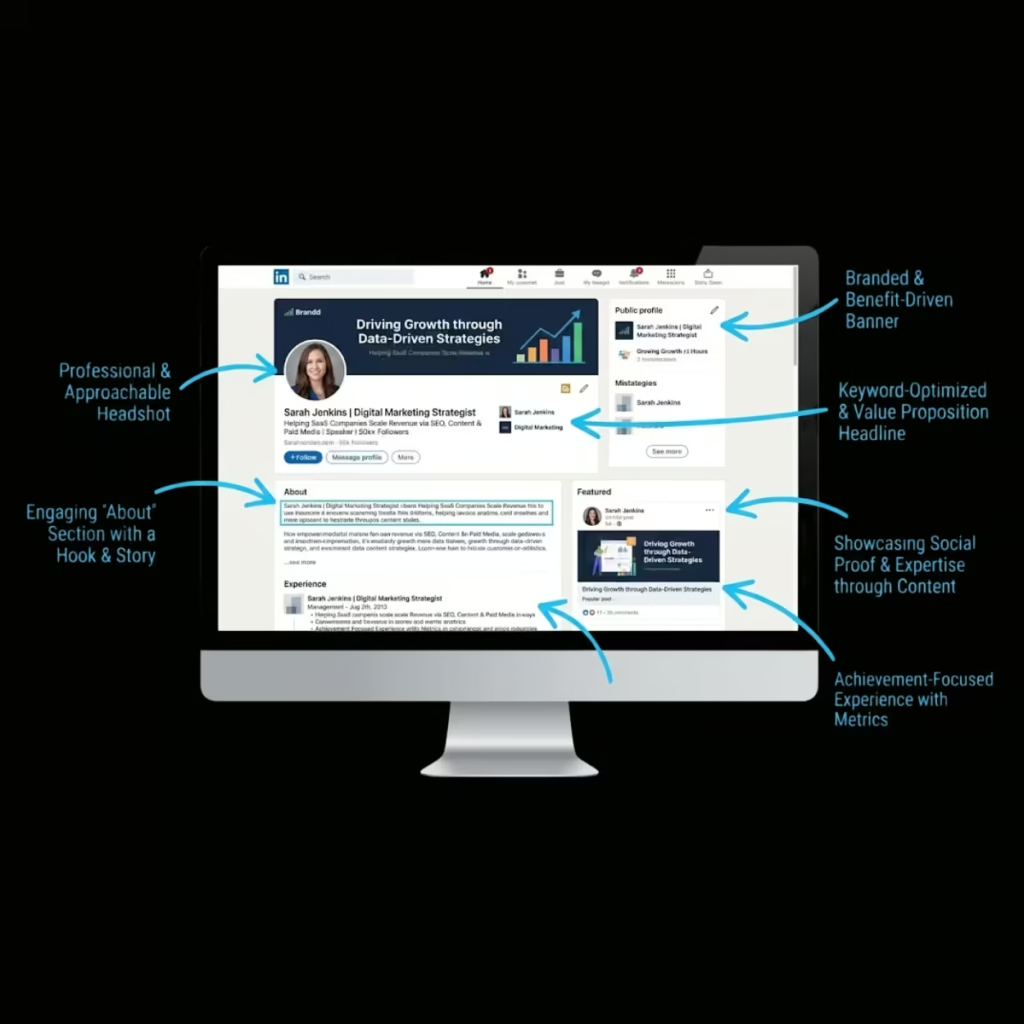
Copy templates
- LinkedIn headline: “Customer success manager | Reduced churn 18% through onboarding improvements.”
- About-opening: “I help SaaS teams keep high-value customers by turning onboarding into repeatable success.” (Then a 1-line proof.)