


Have you ever opened your wardrobe, scrolled endlessly for lunch options, or hesitated between five emails, and felt drained before your real work began? That’s decision fatigue, the silent drain on your productivity and creativity.
In this decision fatigue fix, you’ll learn how to cut choices in half and focus on what truly moves the needle. Backed by psychology and workflow research, this guide offers seven decision fatigue strategies for creators, entrepreneurs, and educators. You’ll regain clarity, consistency, and control, without depending on more willpower.

person struggling with decision fatigue
Table of Contents
What Is Decision Fatigue, and Why It’s a Problem
Every decision drains mental energy. Over time, your ability to choose wisely erodes even for critical tasks. The fatigue fix begins by acknowledging that not all decisions require equal mental effort.
A study published in the Proceedings of the National Academy of Sciences revealed that judges granted parole more often after breaks, highlighting how depleted decision reserves alter outcomes (source).
In creative and business contexts, micro-decisions, fonts, emails, and meetings chip away at mental bandwidth. The more trivial choices you make, the less capacity you have for big, strategic thinking. This is why adopting decision automation tactics and structured systems is essential to reduce decision overload and preserve creativity.
The Cost of Too Many Choices
Decision fatigue fix principles show that excess choices trigger mental weariness. It manifests in ways you might overlook:
- Analysis paralysis: Too many options create paralysis.
- Short-term bias: You default to easy, low-impact actions.
- Reduced creativity: Constant micro-decisions push your brain into survival mode.
- Stress and irritability: Mental depletion triggers emotional fatigue.
Research published in the Journal of Personality and Social Psychology found that the more choices a person makes, the more likely they are to lose willpower, give up, and struggle with endurance. The more decisions you make without structure, the more your clarity erodes, and the harder every next choice becomes.
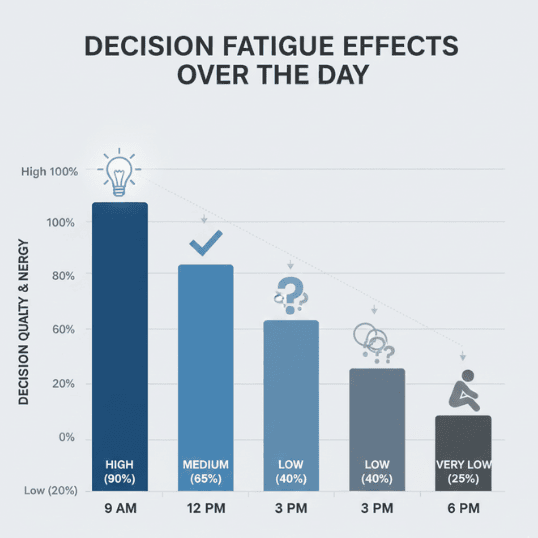
Data visualisation showing productivity decline
The “Half-Choice” Framework: Why Cutting in Half Works
One of the strongest decision fatigue strategies is the “Half-Choice” Framework, the idea of cutting decisions by 50%. Cutting choices in half might sound simplistic, but it’s grounded in cognitive science.
The fewer options you juggle, the more focus you preserve for high-impact thinking. Here’s why this decision fatigue fix works:
- Less friction: Fewer paths = faster clarity.
- Better trade-offs: You’re forced to prioritise impact.
- Confidence in action: With fewer options, execution follows naturally.
- Decision boundary: Everything outside your top 50% is instantly filtered out.
Digital productivity experts often call this the Rule of Reduction: limit decisions to double your momentum (source). It’s one of the simplest decision automation tactics that instantly helps reduce decision overload.
The 7 Smart Strategies to Fix Decision Fatigue
Below are seven proven decision fatigue strategies to help you simplify choices, boost focus, and create lasting balance.
Automate Low-Value Choices
Why it helps: Automation removes decisions entirely, freeing energy for strategy and creativity. It’s one of the most effective decision automation tactics in any fatigue-fixing system.
How to apply:
- Automate repeating tasks using Zapier, IFTTT, or native app rules.
- Use scheduling software to pre-plan meals, bills, and emails.
- Establish “if-then” rules for common scenarios.
Example:
Instead of deciding what to eat daily, plan five weekday lunches every Sunday.
Pro Tip:
Don’t over-automate. Maintain control where human oversight matters.
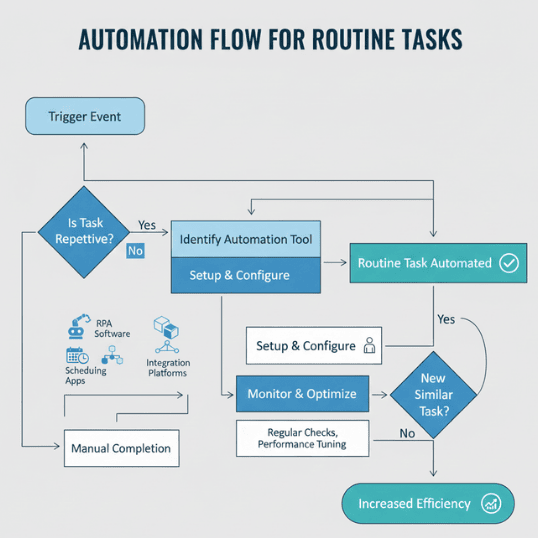
visual of workflow automation
Use the Two-Choice Rule
Why it helps: Limiting yourself to two options reduces decision loops and analysis paralysis, a core part of the decision fatigue fix process.
How to apply:
- When faced with a project, shortlist two viable routes.
- Document both briefly, evaluate, and decide quickly.
Example:
Instead of reviewing five marketing tools, narrow it down to two and decide within a day.
This method helps you cut choices in half while maintaining control.
Time-Block High-Impact Decisions
Why it helps: Your cognitive energy peaks at certain hours. Reserving that time for key decisions ensures quality. This is a core fatigue fix tactic that prevents energy drain.
How to apply:
- Schedule strategy-level decisions early in your productive window.
- Block 60–90 minutes exclusively for decision-making.
- Avoid meetings or multitasking during these windows.
Cal Newport, author of Deep Work, argues that time-blocking a 40-hour week produces the same output as an unstructured 60-hour week because it eliminates the attention residue that accumulates every time you switch tasks. Structure doesn’t just save time; it protects cognitive capacity. (Cal Newport, Deep Work).
Batch Similar Decisions
Why it helps: Grouping similar choices reduces context-switching overhead. Batching is another way to reduce decision overload in daily routines.
Example:
Set aside one block weekly for all design decisions, layouts, colours, and templates instead of spreading them across days.
Action Tip:
Label tasks by “decision type” and batch accordingly using your project manager (e.g., Asana, Trello). This aligns with many decision automation tactics in modern productivity systems.
Delegate & Define Decision Rights
Why it helps: Delegation removes medium-priority decisions from your plate. This is a smart decision fatigue fix move for leaders and teams.
How to apply:
- Define who decides what, budgets, schedules, and creative calls.
- Empower your team with clear guardrails (“You decide under £100”).
Leadership Insight:
Delegation doubles decision throughput across teams without compromising accountability. It’s one of the most scalable decision fatigue strategies for organisations aiming to reduce decision overload.
Use Decision Frameworks & Checklists
Why it helps: Frameworks standardise recurring decisions, reducing cognitive friction and improving consistency.
How to apply:
- Use RICE (Reach, Impact, Confidence, Effort) for prioritising projects.
- Create checklists for repetitive processes, launches, posts, and campaigns.
- Build visual trees to simplify complex trade-offs.
Case Note:
Pilots use checklists not because they forget, but to eliminate micro-decisions. The same logic boosts mental bandwidth in business. Applying these decision fatigue strategies provides a structured fatigue fix across multiple workflows.
Build Recovery Zones & Downtime
Why it helps: Your decision quality depends on recovery. Mental rest replenishes executive function.
How to apply:
- Take scheduled 5-minute micro-breaks every 25 minutes.
- Build “no-decision” evenings, preset meals, and pre-planned routines.
- Include physical resets like walks or stretching to recharge.
According to Harvard Health, short breaks allow the brain to consolidate information and restore cognitive capacity, making them essential not just for productivity but for sustained decision quality and mental clarity throughout the day.

Restoring focus
Implement Without Overwhelm (Plan + Pilot)
Follow this five-step fatigue fix implementation method:
- Audit: Track decisions that drain you for one week.
- Pilot Two Strategies: Try automation + the two-choice rule.
- Measure: Note clarity improvements and saved time.
- Scale: Add one new tactic per month.
- Refine: Adjust based on outcomes and stress levels.
This progressive approach helps you reduce decision overload without creating new pressure.
Case Study: Creator Workflow Overhaul
Case:
Jane, a digital educator producing weekly courses, spent two hours daily deciding on topics and designs.
She:
- Automated templates for slides and visuals.
- Used the Two-Choice Rule for course titles.
- Reserved mornings for strategic planning.
Result:
Her weekly decision load dropped 45%, freeing time for creative expansion. This real-world decision fatigue fix shows the power of applying small, consistent decision automation tactics to cut choices in half and maintain creative flow.
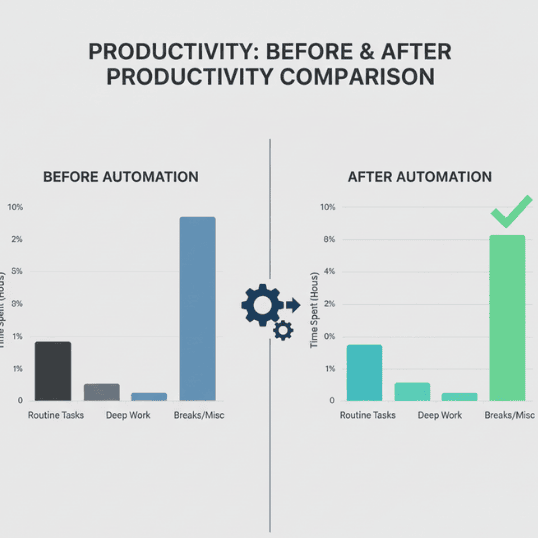
visual of reduced decision overload
Common Mistakes & Pitfalls
- Trying to eliminate all decisions is unrealistic and restrictive.
- Over-automation can reduce oversight.
- Ignoring rest, fatigue returns if you skip recovery.
- Delegating without clarity causes confusion instead of relief.
Avoiding these ensures your decision fatigue fix plan remains effective and sustainable.
FAQs
Q1. Is decision fatigue the same as burnout?
No. Burnout is long-term exhaustion; decision fatigue is temporary depletion, though chronic fatigue can lead to burnout.
Q2. How many decisions do we make daily?
Roughly 35,000, most subconscious. Tracking major ones helps identify patterns and apply targeted decision fatigue strategies.
Q3. Will limiting options stifle creativity?
Quite the opposite. Boundaries promote creative focus and serve as an essential decision fatigue fix.
Q4. What’s the best starting point?
Automate minor choices and enforce the two-choice rule; both are simple decision automation tactics to reduce decision overload.
Q5. What if I lead a small team?
Use frameworks and time blocks first, then scale delegation through SOPs for a team-level fatigue fix.
Key Takeaways
- Decision fatigue fix is about working smarter, not harder.
- Reducing trivial choices frees mental clarity.
- Seven proven decision fatigue strategies help you focus on high-impact work.
- Gradual adoption of decision automation tactics beats perfection.
Now it’s your turn, pick two strategies and start tomorrow. Notice how your energy and focus shift.
Subscribe to Digital Solutions Edge for more research-backed strategies that help you thrive with clarity.
💬 Comment: Which tactic will you try first?
🔗 Share: Help someone battling daily decision overload.