




Picture this. You sit down to write, pull up your AI assistant, start generating, and something feels off. The prose is technically correct but flat. The characters speak like chatbots. The plot suggestions loop back on themselves. You spend more time editing AI output than you would have spent writing the first draft yourself.
Here is what most writers do not realise: the problem is not Claude. The problem is that they chose the wrong Claude model for the task.
In 2026, Anthropic offers three distinct models, each engineered for a different kind of work. Claude Opus 4.6 thinks deeply. Claude Sonnet 4.6 drafts at pace. Claude Haiku 4.5 moves fast and is cheap. Knowing when to reach for each one is the difference between an AI that frustrates you and one that quietly doubles your creative output.
This guide breaks down all three models with practical, real-world clarity. You will leave with a clear framework for matching the right Claude model to your specific writing project, whether that is a novel, a blog post, a short story, or a content series.
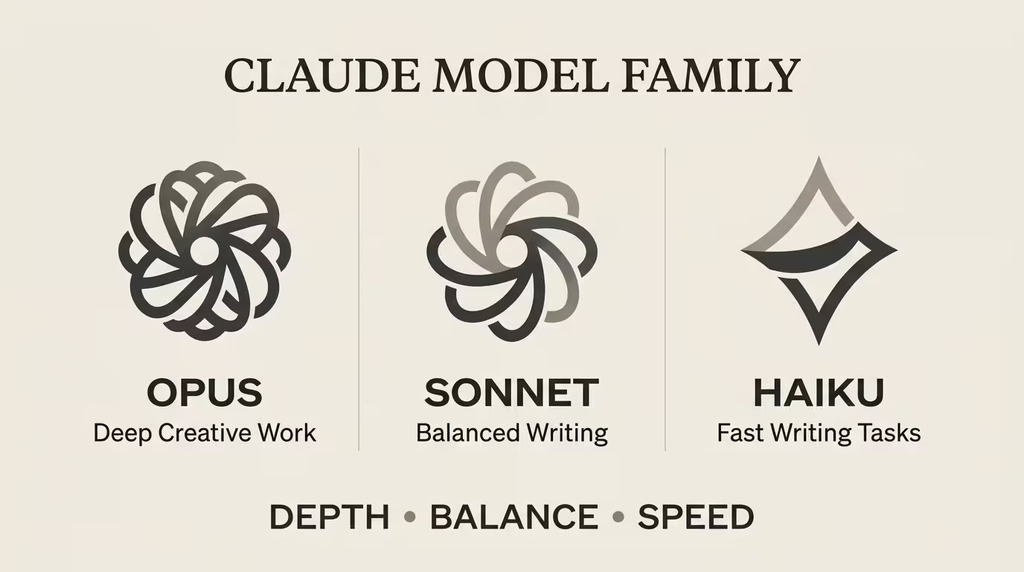
Table of Contents
Disclosure: Our content is designed to help you build transformative leverage across your areas of interest and needs. Digital Solutions Edge is reader-supported; when you engage with our recommendations or click certain links, we may receive a commission. This support allows us to continue delivering the digital solutions you rely on. Thank you for being part of our community.
The Claude Model Family in 2026: A Quick Overview
Before comparing each model, it helps to understand where the lineup stands today. As of April 2026, Anthropic’s current model family comprises three active options:
Claude Opus 4.6 was released in February 2026 alongside Claude Sonnet 4.6. It carries Anthropic’s most powerful reasoning architecture and sits at the top of the pricing tier at $25 per million output tokens. It supports a 1 million token context window, making it capable of holding an entire manuscript in memory.
Claude Sonnet 4.6 arrived at the same time and represents Anthropic’s flagship balance model. It runs at $15 per million output tokens and also supports a 1-million-token context window. It is the default model on most platforms and developer tools for good reason.
Claude Haiku 4.5 launched in October 2025 and occupies the fast, affordable tier at $5 per million output tokens. It has a 200,000-token context window and 64,000 maximum output tokens, and it was the first Haiku release to include extended thinking capabilities.
For writers using the paid Claude. ai interface rather than the API; these models map to different subscription tiers. Opus access typically requires the Pro or Max plan, while Sonnet and Haiku are accessible on standard plans.
Claude Opus 4.6: The Deep Creative Thinker
Claude Opus 4.6 is not just a more expensive version of Sonnet. It operates differently. Where Sonnet executes, Opus deliberates.
Independent testing from Cosmic AI in February 2026 showed a clear pattern: when given a creative brief, Opus makes stronger editorial decisions without needing explicit prompting. It treats a creative project holistically, considering structure, pacing, and reader experience rather than responding sentence by sentence. Writers working on the Cosmic AI Platform reported that Opus delivered “elevated design quality, cohesive brand identity, and editorial-grade presentation” compared to earlier models.
For fiction writers, this distinction is felt immediately. Claude Opus 4.6 excels at:
- Character depth and subtext. It understands what is left unsaid. When a character is meant to be hiding something, Opus will write around it rather than state it. That subtlety matters in literary fiction, thrillers, and any genre where interiority counts.
- Emotional pacing. Opus has a stronger intuition for when a scene needs to slow down and when it needs to accelerate. It reads the arc, not just the paragraph.
- Long-context consistency. On Anthropic’s 8-needle MRCR v2 benchmark, Opus 4.6 scored 76% against Sonnet 4.5’s 18.5%, a qualitative difference in how much of a manuscript the model can genuinely hold in mind while writing. For novelists uploading an entire book, a bible or a chapter history, this gap is real.
- Nuanced voice mimicry. When you feed Opus a sample of your prose and ask it to continue in your style, the results require significantly fewer rewrites.
Anthropic’s Claude Model Documentation
The honest drawbacks: Opus is slow. At $25 per million output tokens, sustained drafting sessions become expensive quickly. For writers generating thousands of words per session, the cost compounds fast. One content team reported spending approximately $300 more per month using Opus versus Sonnet for 500 pieces of content, with no detectable quality difference in general writing tasks. If your work is fiction-heavy, character-driven, or structurally complex, the premium is worth evaluating. For blog writers and content marketers, it is almost certainly not.

Claude Sonnet 4.6: The Workhorse Writers Actually Love
Ask a professional content strategist which Claude model they use daily, and the answer is almost always Sonnet.
Claude Sonnet 4.6 is fast, capable, and consistent. It handles creative writing, structural reasoning, tone adaptation, and long-form drafting without the latency penalty of Opus. At 40 to 60 tokens per second, it generates a 1,000-word article section in roughly 30 seconds. For writers producing at volume, that speed matters.
A real-world test published by Every.to in late 2025 found that Sonnet 4.5 (the generation just before 4.6) had already become the default drafting model inside their editorial workflow. The reviewer noted that it followed complex stylistic instructions, adapted to editorial voice, and maintained consistency across long documents, all without the overthinking tendencies of Opus.
For blog writers and content creators, Sonnet 4.6 excels at:
- Sustained long-form drafting. Blog posts, guides, content series, and white papers. Sonnet produces clean, structured output that holds up across thousands of words without losing the thread.
- Tone calibration. Feed it a brand voice guide, and it will execute it reliably. Feed it a writing sample, and it will approximate your style without forcing it.
- Instruction-following at scale. When you have a complex content brief, audience, keyword targets, structure, and word count, Sonnet executes systematically. It does not drift off-brief the way less capable models do.
- Speed and iteration. Because responses come quickly, you can afford to iterate. Try four versions of an introduction. Test three opening hooks. Rewrite the same paragraph from different angles. Sonnet’s speed makes rapid-cycle editing viable in real time.
Lisa Peyton, a content marketing strategist, ran the same newsletter prompt through Opus and Sonnet in a direct comparison. Her finding: Sonnet dropped metaphors when they served the point and moved on when they did not. Where Opus produced creative energy and bold ideation, Sonnet delivered tighter synthesis and sharper strategic clarity. She concluded that for professional writing, newsletters, thought leadership, and analysis, Sonnet performs better.
The honest assessment: Sonnet 4.6 is not going to write the literary fiction equivalent of Kazuo Ishiguro. It is excellent at what professional, purpose-driven writing demands. If you are writing for an audience, building content with a business objective, or operating under a content calendar, Sonnet 4.6 is your primary tool.

Claude Haiku 4.5: The Fast Brainstormer
Claude Haiku 4.5 gets misunderstood. Writers either dismiss it as a toy or overload it with tasks it was never designed to handle. The truth sits squarely between both reactions.
Haiku 4.5 is the fastest Claude model by a significant margin. It was built for rapid iteration, lightweight reasoning, and high-throughput workflows. At $5 per million output tokens and a 200,000-token context window, it dramatically reduces the cost of exploratory work. For a writer generating ten different plot directions before committing to one, or brainstorming 30 headline variations for a single article, Haiku is the right tool.
Haiku 4.5 works best for:
- Brainstorming and ideation sprints. Generate 20 chapter title options. Map out three different narrative structures. Test five possible character backstories. Haiku produces options quickly without the cost of burning Sonnet or Opus tokens on exploratory work.
- Outline generation. Initial structural passes, scene-by-scene breakdowns, and chapter summaries are all comfortably within Haiku’s lane.
- Transitional scenes and filler content. The low-stakes connective tissue that links major scenes, travel sequences, setting transitions, and recap moments does not need Opus-level reasoning. Haiku handles them efficiently.
- Multi-agent pipelines. For writers and developers building automated content workflows, Haiku serves as a low-cost router or pre-processing layer before handing complex tasks off to Sonnet or Opus.
DataCamp’s Claude Haiku 4.5 Review
The honest drawbacks: Haiku 4.5 is weaker on nuanced creative content. Independent testers found it “middle-of-pack” on open-ended creativity, and reviewers noted that it can occasionally be wordy on loosely specified tasks. Sudowrite’s own model documentation flags that Haiku “can occasionally double word counts during rewrites.” It also struggles with complex logical deductions across multiple documents, which matters for writers managing large series bibles or interconnected worldbuilding documents.
The rule of thumb is simple: Haiku is your brainstorming intern. Give it a clear task with clear constraints, and it will deliver. Give it an open creative brief and expect mixed results.

Side-by-Side Comparison: Which Model Wins for What?
The table below gives you the practical breakdown across the writing tasks that matter most.
| Writing Task | Best Model | Why |
| Literary fiction/novels | Opus 4.6 | Deeper character nuance, emotional pacing, long-context consistency |
| Long-form blog articles | Sonnet 4.6 | Sustained quality, speed, instruction-following at scale |
| Content marketing series | Sonnet 4.6 | Volume, cost efficiency, tone calibration |
| Scriptwriting and dialogue | Sonnet 4.6 or Opus 4.6 | Depends on complexity; Opus for layered subtext |
| Brainstorming and ideation | Haiku 4.5 | Fast, cheap, generates options rapidly |
| Chapter outlines | Haiku 4.5 | Structural generation at low cost |
| Editing and rewriting | Sonnet 4.6 | Strong instruction-following for precise revision instructions |
| Voice matching/style mimicry | Opus 4.6 | Superior at reading and reproducing the author’s voice |
| Newsletter and thought leadership | Sonnet 4.6 | Synthesis, structure, strategic clarity |
| Rapid iteration / A/B testing copy | Haiku 4.5 | Speed and cost for exploratory testing |
The Practical Workflow: Using All Three Like a Pro
The smartest writers do not pick one model and stay there. They build a tiered workflow that uses each model where it creates the most value.
Here is a practical three-pass creative workflow that works for both fiction writers and content creators:
Pass 1: Ideation with Haiku 4.5
Open a Haiku session. Give it your topic, genre, or brief. Ask for five different structural approaches, ten potential chapter titles, or three alternative narrative angles. Let it run fast and loose. You are not asking for quality here; you are generating options. Extract what is useful. Discard the rest.
Pass 2: Drafting with Sonnet 4.6
Take your chosen structure from Pass 1 and draft section by section in Sonnet. Upload your brand voice guide, style sample, or content brief. Let Sonnet execute the body of the work. For blog writers, this is typically where 80% of the article gets written. For fiction writers, this is where the chapters get drafted before any deep revision.
Pass 3: Depth Review with Opus 4.6 (for complex or high-stakes work)
If the piece requires deep refinement, literary fiction, a flagship piece of content, a book chapter you plan to publish, or a piece where voice authenticity is critical, bring it into Opus. Ask it to review for emotional consistency, tighten dialogue, deepen characterisation, or audit structural coherence across the full piece. This targeted use of Opus keeps costs manageable while accessing its superior reasoning for the tasks that actually need it.
This is not just a theory. In 2026, the most sophisticated production writing workflows use exactly this model: Haiku for routing and rapid generation, Sonnet for the bulk of the work, and Opus for the 10 to 15% of tasks requiring deep reasoning or creative polish.
Choosing by Writing Type: Your Decision Framework
If you prefer a simpler decision path, use this framework:
Are you writing fiction, especially long-form or character-driven fiction? Start with Sonnet 4.6 for drafting. Upgrade to Opus 4.6 for scene refinement, character voice work, and any sequence where subtext and emotional depth carry the narrative weight.
Are you writing professional content? Blogs, articles, guides, newsletters? Claude Sonnet 4.6 is your primary model. Use Haiku 4.5 for brainstorming phases before you commit to a direction.
Are you working on a creative project with a tight budget? Run all brainstorming, outlines, and exploratory drafts through Haiku 4.5. Graduate to Sonnet 4.6 for the sections you actually plan to publish. Reserve Opus 4.6 only if the piece demands it.
Are you building a content team workflow or an automated pipeline? Haiku 4.5 as the router and task classifier, Sonnet 4.6 for primary generation, Opus 4.6 for quality gates on high-value output.
Anthropic’s Model Selection Guide for Developers
What the Writing Community Is Saying
Real writers using Claude in production have a clear consensus on a few things.
The Reddit writing communities lean strongly toward Sonnet models for daily work. A thread on r/ClaudeAI from February 2026 found that experienced users recommended Sonnet as the default drafting model, with Opus reserved for premium or complex work. One commenter described the trade-off plainly: “Sometimes you need the spark, not the polish.”
Sudowrite, one of the most widely used AI fiction platforms, built its core “Excellent Prose” mode on Claude’s Sonnet architecture specifically because of its balance of instruction-following and creative quality. Their documentation notes that Opus variants are “slow and expensive, best reserved for critical work.”
The 2025 Author Guild survey found that 45% of published fiction writers use AI tools in some part of their creative process, primarily for brainstorming and overcoming creative blocks. That number will only rise, and the writers integrating these tools most effectively are the ones who understand the job each model is built to do.
Common Mistakes Writers Make When Choosing a Model
Using Opus for everything. The cost adds up fast, and for most blog content or general creative work, Sonnet delivers equivalent quality at a fraction of the price. Reserve Opus for where it genuinely earns its cost.
Ignoring Haiku entirely. Writers who skip Haiku miss out on a genuinely useful brainstorming layer. Generating 20 bad ideas quickly is more productive than slowly generating three good-ish ones. Haiku’s speed is an asset, not a compromise.
Not giving the model enough context. Every Claude model performs better with a full brief: your audience, your tone, your intended word count, any style references, and what the piece is supposed to accomplish. Vague prompts produce vague output regardless of which model you choose.
Expecting the model to write the whole thing unprompted. Claude can draft chapters based on outlines you provide, but it cannot write a complete book without substantial human direction. The writers who succeed treat Claude as a skilled collaborator, not an autonomous ghostwriter.
Switching models mid-draft without re-establishing context. If you start a chapter in Sonnet and finish it in Opus, the model does not inherit your previous conversation. Always re-upload your brief, style guide, or prior chapters when starting a new session or switching models.
FAQ
Which Claude model is best for writing a novel in 2026? Claude Opus 4.6 is the strongest for literary fiction, character-driven prose, and work that demands emotional nuance and voice consistency. For writers on a tighter budget, Claude Sonnet 4.6 handles novel drafting very well, particularly for genre fiction.
Is Claude Sonnet 4.6 good enough for creative writing? Yes. For the majority of creative and professional writing tasks, blog content, articles, scripts, and even most fiction, Sonnet 4.6 delivers high-quality results at a speed and cost that make it the most practical choice for sustained creative work.
What is Claude Haiku 4.5 actually useful for in a writing workflow? Brainstorming, outline generation, rapid ideation, and any exploratory task where you need volume and speed rather than depth. It is the first-pass tool, not the final-draft tool.
Can I use Claude for book writing without the API? Yes. The claude.ai Pro plan gives you access to Sonnet and, depending on your plan tier, Opus. For book-length work, the Max plan at $100 per month provides significantly higher usage limits that sustain long drafting sessions.
Which Claude model writes the most human-sounding prose? Claude Opus 4.6 produces the most naturally human-sounding prose in blind tests, particularly for fiction. Sonnet 4.6 is close behind and often indistinguishable in non-fiction or content marketing contexts.
How much does it cost to write a full novel using Claude? Using the Claude API: a 100,000-word novel would generate roughly 150,000 to 200,000 output tokens through the drafting process. At Sonnet 4.6 pricing, that is approximately $2.25 to $3.00. At Opus 4.6 pricing, closer to $3.75 to $5.00. API costs are often dramatically lower than subscription costs for high-volume users.
Does Claude maintain consistency across long documents? Opus 4.6 and Sonnet 4.6 both support a 1-million-token context window, meaning you can upload substantial portions of a manuscript to maintain consistency. Opus 4.6 has a measurably stronger recall score on long-context benchmarks, scoring 76% on the 8-needle MRCR v2 test versus Sonnet’s prior-generation score of 18.5%.
What is the best Claude model for blog writing specifically? Claude Sonnet 4.6. It handles structure, tone, keyword integration, and long-form consistency at the speed and cost that make blog production viable at scale.
Should writers use Claude or a dedicated fiction tool like Sudowrite? Both serve different functions. Claude is the more flexible creative collaborator and works well as a standalone tool for brainstorming, drafting, and editing. Dedicated platforms like Sudowrite or NovelCrafter add workflow features, series bible management, timeline tracking, and consistency checking that Claude does not offer out of the box. Most productive fiction writers in 2026 use both.
Can I switch between Claude models within the same project? Yes, but always re-establish context when you switch. Models do not share conversation history, so re-uploading your style brief, character notes, or prior chapters at the start of each session ensures consistent output quality.
The best Claude model for creative writing is not a single answer; it is a system.
Claude Opus 4.6 is the tool you reach for when depth, nuance, and prose quality are non-negotiable. It earns its premium price tag in literary fiction, complex character work, and high-stakes creative projects.
Claude Sonnet 4.6 is the model most writers should be working with most of the time. It is fast, capable, and consistent across the full range of professional creative work, from long-form blog articles to screenplay dialogue to content marketing at scale.
Claude Haiku 4.5 is the brainstorming layer that too many writers skip, and skipping it costs them time and creative momentum. It is not the model for final drafts. It is the model for generating the ideas that lead to them.
The writers getting the most out of Claude in 2026 are not asking which model is best. They are asking which model is right for this task, right now. That shift in thinking changes everything.
Ready to upgrade your writing workflow? Book a Transformation Clarity Call (TCC) with our DSE Consultants to map out a content production system built around your specific goals and output targets. Or explore our related guides below to go deeper into AI-powered writing tools.