


Here is a question worth sitting with: if you finished your book today, would you know exactly where to publish it by tomorrow morning?
Most authors do not. And that gap between completing a manuscript and knowing how to get it profitably into readers’ hands costs authors time, money, and momentum every single year.
The self-publishing landscape in 2026 looks nothing like it did in 2022. Platforms have merged, royalty structures have shifted, AI content policies have tightened, and print costs have risen across the industry. In Africa specifically, two of the most prominent local platforms closed operations entirely, a sobering reminder that authors who build their publishing business on a single platform are one announcement away from losing their income channel.
The options available to authors in 2026 are richer and more diverse than ever. That diversity is the opportunity. This guide sorts it into clarity.
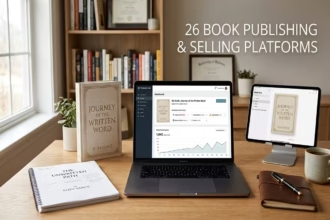
Whether you write ebooks, paperbacks, or hardcovers, whether you are targeting an African audience, a global readership, or both, this guide gives you a current, honest, and deeply practical breakdown of 26 platforms, sorted into five strategic categories, so you can identify your best-fit options immediately and evaluate each one with full confidence.

Table of Contents
Disclosure
Our content is engineered to help you make informed, data-driven, and smart decisions. Digital Solutions Edge is reader-supported; when you engage with our recommendations or click certain links, we may receive a commission. This support allows us to continue delivering the digital solutions you rely on. Thank you for being part of our community.
Why Platform Choice Is a Strategic Decision
Choosing where to publish your book is beyond a technical decision. It is a business strategy with long-term consequences. The platform you select determines your royalty rate, your relationship with your readers, how much customer data you own, how visible your book is to new audiences, and how vulnerable your income is to policy changes by a company you do not control.
According to the Alliance of Independent Authors, independent authors who distribute across multiple platforms earn, on average, 40% more than those locked into a single retailer. The global self-publishing industry generated over $1.25 billion in revenue in the US alone in 2023, and that trajectory has continued into 2026. At the same time, the rise of AI-assisted writing tools has flooded markets with low-quality content, prompting platforms to raise quality thresholds and tighten content policies — creating an environment where well-crafted, authentically written books stand out more than ever.
The author who understands this ecosystem at a strategic level is the one who builds a publishing income that compounds over time rather than collapsing with the next algorithm update.
The 5 Questions to Answer Before You Choose a Platform
1. What format are you publishing? Ebooks, paperbacks, hardcovers, and audiobooks each have different platform requirements. Some platforms are digital-only. Others specialise in print-on-demand. A few handle everything. Know your format before evaluating options.
2. Who is your target reader and where do they buy books? A Nigerian Christian non-fiction author targeting local readers has very different needs from a UK-based romance novelist chasing Kindle Unlimited subscribers. Geography, genre, and reader behaviour all shape the right platform choice.
3. Do you have an existing audience you can sell to directly? If yes, direct-to-reader platforms like Selar, Books.by Payhip and Gumroad are strong starting points. If not, you need marketplace platforms with built-in discovery, such as Amazon KDP, Kobo, and Apple Books.
4. Are you willing to trade exclusivity for perks? Amazon’s KDP Select programme offers higher royalties and promotional tools but requires 90-day ebook exclusivity on Amazon. Every major platform decision involves some version of this trade-off.
5. What is your royalty expectation? Royalties range from 35% to 100%, depending on the platform and format. Running the numbers before you commit will prevent disappointment later and clarify which platforms serve your financial goals.
How to Use This Guide: The 5 Categories Explained
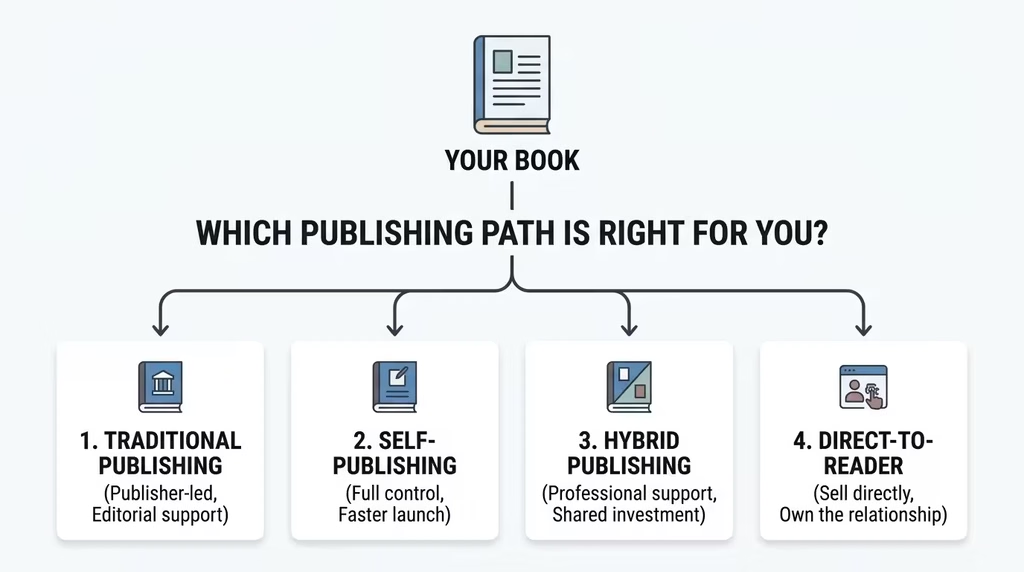
This guide organises all 26 platforms into five categories based on function and strategic use case:
Category 1 — Global Marketplace Giants: Platforms where readers already browse and buy at scale. High built-in traffic, platform-controlled discovery, and competitive royalties. Best for discoverability and reaching cold audiences.
Category 2 — Distribution Aggregators: Services that distribute your book to multiple retailers and libraries from a single upload. Best for wide distribution without managing a dozen separate accounts.
Category 3 — Direct-to-Reader Storefronts: Platforms that let you sell directly to your audience, own customer data, and keep the highest percentage of each sale. Best for authors with an existing audience.
Category 4 — Specialist and Format-Specific Platforms: Platforms built around a particular publishing format, affiliate model, or product type. Best for specific publishing goals — visual books, affiliate-driven sales, or niche digital product marketplaces.
Category 5 — Community, Subscription, and Niche Distribution Platforms: Platforms built around reader communities, subscription access models, or highly specialised global distribution. Best for audience-building, passive subscription income, and multi-store reach without a monthly fee.
Category 1: Global Marketplace Giants
These are the platforms where readers already shop in the millions. Discovery is built into the experience. Your job is to optimise your listing: cover, metadata, pricing, and reviews, and let the platform’s existing audience do the heavy lifting.
1. Amazon KDP (Kindle Direct Publishing)
Best for: Authors seeking the largest built-in global audience, covering ebooks, paperbacks, and hardcovers.
Cost to publish: Free. Formats supported: Ebook, paperback, hardcover. Royalties:
- Ebook: 70% (priced $2.99–$9.99 in supported territories) or 35% (all other prices)
- Paperback: 60% (books priced ≥$9.99) or 50% (books below $9.99), minus printing cost
- Hardcover: 50–60% of list price minus printing cost
- Audiobook via ACX: 40% exclusive, 25% non-exclusive
Amazon KDP is the gravitational centre of self-publishing in 2026. It hosts the world’s largest ebook store, the most active print-on-demand infrastructure for independent authors, and the Kindle Unlimited subscription programme, one of the most lucrative income streams for high-output fiction authors. In February 2026, Amazon paid out $61.7 million to KDP Select authors in a single month (Amazon KDP, 2026).
KDP Select, the exclusivity trade-off
KDP Select enrols your ebook exclusively on Amazon for 90-day renewable periods. In exchange, it enters Kindle Unlimited, where you earn royalties based on pages read by subscribers. It also unlocks Kindle Countdown Deals and Free Book Promotions, two of the most effective promotional tools in the platform’s arsenal.
Key 2026 updates
Amazon now explicitly rejects AI-generated books, showing no evidence of human editing or original contribution. Since June 2025, print royalties operate on a tiered structure: 60% for books priced at or above $9.99, 50% for books below that threshold. Both changes reward quality-focused authors.
What KDP does well:
- Unmatched global reach across 12+ international Kindle stores
- Free publishing with no upfront cost for any format
- Comprehensive sales dashboard and royalty reporting
- Print-on-demand with no inventory risk for both paperback and hardcover
- ACX audiobook integration for distribution to Audible, Amazon, and iTunes
- Author Central profile page for brand presence on Amazon
- KDP Select promotional tools, including Kindle Countdown Deals and Free Book Promotions
Limitations:
- KDP Select exclusivity prevents ebook sales on any other platform for each 90-day enrolment period
- Expanded Distribution (print to bookshops beyond Amazon) yields significantly lower royalties, often under $2 per book.
- Customer data belongs entirely to Amazon; you cannot access buyer email addresses.
- Discovery is increasingly competitive and dependent on advertising spend
- AI-generated content without a clear human editorial contribution now results in listing rejection
Verdict: Amazon KDP is non-negotiable for virtually every self-published author. Even those pursuing a wide distribution strategy should maintain a direct KDP listing. Start here, but do not finish here.
Amazon KDP Digital Pricing and Royalties
2. Apple Books for Authors
Best for: Authors targeting iPhone, iPad, and Mac users with a high-spending, globally distributed readership.
Cost to publish: Free. Formats supported: Ebook, audiobook. Royalties: Flat 70% on all sales at every price point, in every territory
Apple Books offers the simplest royalty deal in the industry: a flat 70% on every sale, with no delivery fees, no pricing windows, and no exclusivity requirements. It is available in over 50 countries, and its reader base skews toward higher-income consumers accustomed to paying for digital content.
What Apple Books does well:
- Consistent 70% royalty regardless of price; even books priced below $2.99 earn the full rate
- No delivery cost deductions, making it especially advantageous for image-heavy or design-rich books
- No exclusivity requirements to publish on Apple, while freely listing on Amazon
- Next-day sales dashboards for quick performance insight
- Audiobook distribution available directly for qualifying authors
- Strong international reach in markets where Apple devices dominate
Limitations:
- Direct publishing requires a Mac computer with Books Producer or Apple Pages; Windows authors must use an aggregator such as Draft2Digital.
- Smaller ebook market share than Amazon, requiring authors to drive additional traffic independently
- Onboarding and approval can be slower than competing platforms
- Limited in-platform promotional discovery tools compared to Amazon’s recommendation engine
Verdict: Apple Books belongs in every author’s distribution portfolio. If you do not own a Mac, publish through Draft2Digital and accept a slightly reduced royalty; the reach is worth the small trade.
3. Google Play Books
Best for: Authors targeting Android users and readers in emerging markets, particularly across Africa, South Asia, and Southeast Asia.
Cost to publish: Free. Formats supported: Ebook. Royalties: Up to 70% in most countries; check regional terms as rates vary
Google Play Books places your ebook in front of billions of Android users across more than 75 countries. This gives it the widest potential geographic footprint of any platform on this list and makes it one of the most strategically important for authors whose readers are in markets where Android dominates smartphone usage, including Nigeria, Ghana, Kenya, India, and Indonesia.
What Google Play Books does well:
- Extraordinary geographic reach via Android’s global market share
- Competitive royalty rates in major markets
- Integration with Google Search, which can surface your book in organic search results
- Promotional discount tools for time-limited deals
Limitations:
- Google’s price-matching algorithm can automatically lower your list price to match a lower price found elsewhere, affecting royalties without prior author consent.
- The Partner Centre interface is less intuitive than competing platforms
- Publisher signup eligibility has been inconsistent at times; some authors report onboarding friction
- Customer data remains Google’s property; no buyer email access
Verdict: Include Google Play Books in a wide distribution strategy, particularly if your audience is in Africa or any Android-dominant market. Manage your pricing carefully across all platforms to avoid triggering the automatic price-matching mechanism.
4. Barnes & Noble Press
Best for: Authors targeting the US reading audience who want a credible presence beyond Amazon.
Cost to publish: Free. Formats supported: eBook, paperback. Royalties: 65% on ebooks priced $0.99 and above; paperback royalties vary based on print cost
Barnes & Noble Press is the self-publishing portal for one of the US’s largest booksellers. Publishing directly gives your book placement on BN.com and access to the Nook ecosystem, a meaningful audience of dedicated readers who actively choose B&N over Amazon.
What B&N Press does well:
- Pre-order functionality up to 12 months before release is excellent for building launch momentum
- Solid 65% royalty on ebooks across most price points
- Featured placement opportunities on BN.com for qualifying titles
- Print-on-demand for paperbacks with distribution through Barnes & Noble’s retail network
Limitations:
- Non-US authors cannot receive print author copies shipped to their address; those authors should use BookVault for print fulfilment instead.
- Nook’s overall market share has declined relative to Amazon and Apple; B&N Press functions as a supplemental rather than primary channel for most authors.
- Royalty terms have changed historically; always verify current rates in the author dashboard before publishing.
Verdict: Worth including for any author with a US readership. The process is straightforward, and B&N’s customer base is loyal to the brand, meaning your listing reaches readers who specifically prefer not to shop on Amazon.
5. Kobo Writing Life
Best for: Authors targeting international readers, particularly in Canada, Australia, New Zealand, Europe, and the Middle East.
Cost to publish: Free. Formats supported: Ebook. Royalties: 70% for books priced $2.99 or above; 45% for books priced below $2.99
Kobo Writing Life is the direct publishing arm of Rakuten Kobo, operating in over 190 countries. Where Amazon leads in the US, Kobo holds significant market share in Canada, Australia, New Zealand, the Netherlands, and parts of Europe and the Middle East. For any author building a serious international readership, Kobo is an important direct relationship, even alongside an aggregator like Draft2Digital.
What Kobo does well:
- No exclusivity requirements; publish on Kobo freely alongside every other platform
- Strong international reach, including markets where Amazon is not the dominant retailer
- Optional library distribution via OverDrive, placing your book in 43,000+ public libraries globally
- No delivery fee deductions from royalties, unlike KDP’s 70% plan
- Accepts pricing in multiple global currencies
- Dedicated promotional tools, including featured deals and Kobo Plus integration
Limitations:
- Less daily organic traffic than Amazon; more author-driven marketing required for consistent sales
- Sales from Kobo’s partner retailers can take weeks to appear in the reporting.
- Ebook-only, no print distribution capability
Verdict: Kobo Writing Life is a high-value direct relationship for authors who take global distribution seriously. Publish directly rather than relying solely on D2D, as direct publishers sometimes access better promotional slots.
Category 2: Distribution Aggregators
Aggregators eliminate the administrative burden of managing a dozen separate platform accounts. You upload your book once; they distribute it to multiple retailers, libraries, and international stores simultaneously. The trade-off is a small commission per sale, a trade most authors find well worth the time they recover.
6. Draft2Digital (including Smashwords Store)
Best for: Authors who want wide distribution to every major ebook retailer and library network from a single dashboard.
Cost to publish: Free (commission-based). Formats supported: Ebook, paperback (D2D Print). Royalties:
- Ebook: approximately 60% of the list price after retailer commission and D2D’s 10%
- Smashwords Store direct: 40% for books under $2.99; 75% for books $2.99 and above (effective January 2026)
- Print: approximately 45% of the list price minus printing cost
Draft2Digital is the gold standard aggregator for indie authors pursuing a wide distribution strategy. Upload your manuscript once, and D2D distributes it to Apple Books, Kobo, Barnes & Noble, Tolino (German-language Europe), Vivlio (France and parts of Africa), Gardners (UK bookshop wholesale), Hoopla, OverDrive, Bibliotheca, Fable, and more. In 2022, D2D acquired Smashwords, integrating that platform’s promotional community and storefront into the D2D ecosystem.
Key 2026 updates
From February 2026, D2D Print prices increased across all accounts, citing increases from its print partner, the same Ingram printing infrastructure used by IngramSpark. Authors should review D2D’s updated Print Price Calculator to adjust list prices accordingly.
From January 2026, Smashwords restructured its royalty rates: books under $2.99 now earn 40% of list price, while books $2.99 and above earn 75% of list price.
What D2D does well:
- Free automated ebook formatting: your Word document becomes a professionally formatted ebook at no cost
- Distribution to 15+ retail partners and multiple library networks from one account
- Universal Book Link via Books2Read: a single shareable URL directing readers to their preferred store
- Royalty splitting feature for co-authored books
- Library distribution via OverDrive, Hoopla, and Bibliotheca
- No exclusivity requirements; fully compatible alongside direct KDP accounts
- Monthly payments around the 15th of each month, minimum threshold of $10
Limitations:
- Authors keep approximately 60% of ebook sales versus 70% when publishing directly on Apple or Kobo.
- D2D Print is paperback-only, no hardcover
- Amazon ebook distribution via D2D is by invitation only; publish ebooks directly to KDP.
- Update propagation to partner stores can be slower than direct publishing
- No KDP Select-equivalent promotional programme
Verdict: D2D is the essential aggregator layer for any author going wide. Pair it with direct accounts on KDP, Apple Books, and Kobo, and you cover virtually every meaningful ebook market globally with minimal ongoing administration.
Draft2Digital Distribution Partners
7. IngramSpark
Best for: Authors who want their print books stocked in physical bookshops and libraries worldwide.
Cost to publish: Free to upload; revision uploads now also free (early 2026). Formats supported: Ebook, paperback, hardcover. Royalties:
- Print: approximately 45–55% of list price minus printing cost and 1.875% market access fee (as of February 2026)
- Ebook: 40–85% depending on the retail partner
IngramSpark occupies a distinct and irreplaceable position in the publishing ecosystem. Where Amazon KDP dominates online retail, IngramSpark dominates the wholesale trade. Bookshops, libraries, and academic institutions order through Ingram Book Group, and IngramSpark is the self-publishing gateway into that same infrastructure.
Key 2026 updates
Two changes took effect in early 2026. IngramSpark removed revision file fees entirely. Authors can now update their book files at any time at no cost, permanently. Simultaneously, the market access fee increased from 1.0% to 1.875% of the book’s list price. This fee is automatically withheld from every sale.
What IngramSpark does well:
- Unmatched distribution to 45,000+ libraries, retailers, and online stores globally
- Both ebook and print, including hardcover, from a single platform
- Global print network that reduces international shipping time and cost
- Simultaneous distribution to Amazon, Apple, Barnes & Noble, Kobo, and independent bookshops
- A professional industry standing with an Ingram listing is recognised by traditional booksellers
- Transparent Print and Ship calculator for accurate cost modelling
Limitations:
- Royalty calculation is more complex than KDP. Authors must understand the wholesale discount structure and the updated market access fee.
- Customer service response times have been criticised as inconsistent
- Higher learning curve than D2D or KDP; not ideal as a first-time author’s starting point
- Non-US authors cannot receive print author copies at their address; consider BookVault for print fulfilment
- Existing Apple Books content must be removed before that same title is distributed via IngramSpark
Verdict: IngramSpark is essential for any author with a print book who wants genuine bookstore distribution. Use it alongside KDP (with KDP’s Expanded Distribution deactivated to prevent duplication). The learning curve is real; the distribution reach is worth it.
8. StreetLib
Best for: Authors targeting non-English-speaking international markets, particularly Southern Europe, Latin America, and Francophone Africa.
Cost to publish: Free plan available; premium plans for advanced features. Formats supported: Ebook, audiobook, print. Royalties: Competitive rates depending on the distribution partner; StreetLib retains a percentage per sale
StreetLib is an Italian-founded global publishing aggregator that distinguishes itself through its strength in markets that other aggregators underserve. While D2D and IngramSpark focus heavily on English-language markets, StreetLib has cultivated strong relationships with European bookstores, Latin American retailers, and key African digital platforms. For authors writing in Italian, Spanish, French, or Portuguese, or targeting non-English-speaking readers, StreetLib often reaches audiences that D2D simply does not.
What StreetLib does well:
- Distribution to 400+ retail and library partners globally, including stores in markets that other aggregators miss
- Strong presence in Italy, Spain, France, Brazil, and parts of Francophone Africa
- StreetLib Direct: a specialised marketing tool enabling authors to distribute ebooks and audiobooks directly to readers via personalised coupon codes and links
- Audiobook distribution is included in the publishing workflow
- Straightforward upload process with multi-format support
Limitations:
- Less familiar to English-language self-publishing communities than D2D or IngramSpark
- The dashboard is functional but less polished than D2D’s interface
- Royalty transparency varies by retail partner; authors should review earnings breakdowns carefully
Verdict: StreetLib is the underrated international aggregator that serious global authors, particularly those writing in languages beyond English or targeting Francophone Africa and Latin America, should add to their distribution stack.
9. PublishDrive
Best for: High-output authors and small publishers who want the widest possible global reach and are ready for a flat-fee subscription model.
Cost to publish: Subscription-based (flat monthly fee instead of per-sale commission). Formats supported: Ebook, audiobook, print. Royalties: Authors keep 100% of royalties on paid plans (flat subscription replaces commission)
PublishDrive has positioned itself on three principles: global reach, platform resilience, and 100% author royalties on paid plans. Rather than taking a percentage of each sale, PublishDrive charges a flat monthly subscription, meaning that once an author’s sales volume reaches a certain level, the economics become significantly more favourable than commission-based alternatives.
What PublishDrive does well:
- Distribution to 400+ stores in 100+ countries, including markets underserved by D2D
- 100% royalties on paid plans, no per-sale commission
- Advanced analytics and sales tracking across all distribution partners in one dashboard
- Audiobook distribution to Spotify, Chirp, and other major platforms
- AI-assisted metadata optimisation tools to improve discoverability
- The subscription model rewards high-volume authors with better per-sale economics as output grows
Limitations:
- The monthly subscription cost means PublishDrive is not cost-effective for authors who are just starting or publishing infrequently.
- Less community presence in the English-language indie author community compared to D2D
- Customer service quality varies based on the subscription tier selected
Verdict: PublishDrive is worth evaluating once your publishing business has grown to the point where a flat subscription fee is more economical than per-sale commissions. It is particularly compelling for prolific authors, small publishers, and anyone prioritising maximum global reach.
10. Publiseer
Best for: African authors seeking global ebook distribution with one of the most author-friendly royalty structures available.
Cost to publish: Free. Formats supported: Ebook. Royalties: Up to 80%; Publiseer takes 0% commission on certain tiers; daily automated PayPal payouts
Publiseer is a Nigerian-founded free digital publishing platform launched in 2017, with over 4,000 books published from 15 African countries, 75% of them from Nigeria. It occupies a unique space: it distributes African authors to local platforms and to 400+ international stores simultaneously, giving African writers a pathway to global readership that respects local realities.
What Publiseer does well:
- Up to 80% royalty per sale, one of the strongest rates available to independent authors anywhere
- Distribution to 400+ global stores from a single upload, including major ebook retailers
- Daily automated PayPal payouts with no minimum threshold are a meaningful advantage for African authors who cannot afford to wait 30–90 days for payment
- ISBN assignment for copyright protection
- Detailed real-time analytics and transparent sales reporting
- Active submission to book review blogs and publications to maximise exposure
Limitations:
- Limited to ebooks; no print distribution
- Less brand recognition than global aggregators outside Africa
- PayPal-dependent for payouts, which may be inconvenient in countries with restricted PayPal access
Verdict: For any African author wanting global ebook distribution with maximum royalties and daily payouts, Publiseer is an exceptional choice. It belongs in every African author’s distribution strategy alongside Selar and KDP.
Category 3: Direct-to-Reader Storefront
These platforms put you in direct contact with your buyer. You set the price, receive payment quickly, and critically own the customer data. No marketplace algorithm controls your visibility. No third party withholds your buyer’s email address. The trade-off: you must drive your own traffic.
11. Selar
Best for: African authors and digital creators selling ebooks, courses, and memberships to local and international audiences.
Cost to publish: Free plan available; Pro, Turbo, and TurboPlus subscription tiers for advanced features. Formats supported: Ebooks (PDF and more), courses, templates, memberships, event tickets, and coaching services. Fees: 4–6% commission on African currency transactions; 7% on USD transactions
Selar is the most strategically important publishing and digital commerce platform built specifically for African creators. Founded in 2016 by Douglas Kendyson, formerly of Paystack and Flutterwave, Selar was built to solve a problem that global platforms ignored: African creators had no reliable, locally integrated way to receive payments from their audiences.
In 2025 alone, Selar paid out over ₦18 billion (approximately $12.86 million) to nearly 400,000 creators. As of 2026, the platform has 2.2 million users across more than 15 African countries. Africa’s e-commerce market is projected to reach $33 billion by 2026, and digital products, such as ebooks, courses, and templates, are among the fastest-growing segments of that market (Selar Blog, 2026).
What Selar does well:
- Local payment methods, including bank transfer, USSD, Verve card, and Paystack: the methods African buyers actually use
- Multi-currency support across 8 currencies, with automatic conversion and payout in the seller’s local currency
- Access to 40,000+ affiliates who can promote and sell your product for commission
- Full digital commerce suite: affiliate marketing, analytics, automated follow-ups, discount codes, upsells, and bundles
- No technical setup required; a creator can be live and selling within five minutes, without a website
- Course hosting with unlimited video uploads, drip content scheduling, student management, and certificates
Limitations:
- Commission structure (4–7%) means high-volume sellers should evaluate whether a paid subscription tier delivers better economics.
- Selar is a direct storefront, not a distributor. Your ebook will not appear on Amazon or Apple Books unless listed there separately.
- International buyers without access to local African payment methods must pay by card.
- No native discovery marketplace. Customers must be directed to your Selar link.
Verdict: For Nigerian, Ghanaian, Kenyan, and African authors broadly, Selar is the most practical, culturally intelligent, and financially effective platform for local digital sales in 2026. Use it as your primary storefront for African audiences, and pair it with KDP or Draft2Digital for global ebook distribution.
12. Books.by
Best for: Authors with an established audience who want 100% royalties, daily payouts, and full ownership of their reader relationships.
Cost to publish: Subscription-based. Formats supported: Ebook, print-on-demand (paperback via global print network). Royalties: 100% after wholesale print cost; no platform commission.
Books.by is the most compelling direct-to-reader platform for print book authors in 2026. Unlike traditional self-publishing platforms, where Amazon or IngramSpark owns the customer relationship, Books.by functions as a fully branded author bookstore where you keep 100% of royalties, receive daily payouts, and most importantly, get the name and email address of every person who buys your book.
This is a fundamental shift in how authors relate to their readers. Amazon’s data policy means you never know who bought your book. Books.by’s model means every sale builds your email list.
What Books.by does well:
- 100% royalties after the wholesale cost of printing, no platform commission
- Daily payouts to your bank account, not the 60–90-day waits common elsewhere
- Full customer data ownership: buyer names and email addresses on every sale
- Global print-on-demand via a network with facilities in the USA, Europe, the UK, and Australia
- Compatible with existing book files from KDP, IngramSpark, or Lulu, no reformatting required
Limitations:
- No built-in marketplace. You bring 100% of your own traffic; rewards authors with an existing audience.
- The monthly subscription cost makes it most economical once you are generating consistent direct sales.
- Less recognised than Amazon or Apple in the eyes of first-time readers discovering your work
Verdict: Books.by is the most powerful direct-to-reader print platform available in 2026. For authors with an email list, an active social media following, or a blog audience, it transforms every book sale into a permanent reader relationship. Pair it with KDP for marketplace discovery and Books.by for direct sales monetisation.
13. Gumroad
Best for: Creators with an existing social media, email, or community audience who want a simple, direct selling experience.
Cost to publish: Free. Formats supported: Ebooks, templates, courses, memberships, any digital file. Fees: 10% + $0.50 per transaction for direct sales; higher for Gumroad Discover traffic
Gumroad has been the creative community’s go-to platform for direct digital product sales since 2011. Its philosophy is deliberate simplicity: upload your file, set your price, share your link. There is no marketplace to rank within, no algorithm to chase. If you have built an audience anywhere, Gumroad converts that relationship into revenue immediately.
What Gumroad does well:
- Product lives and sells within minutes of signing up
- “Pay-what-you-want” pricing option, letting readers contribute what they value above your set minimum
- Built-in affiliate programme to incentivise others to promote your products
- Automatic file delivery after every purchase
- Email capture: you own your buyer’s contact data from the first sale
- Gumroad Discover marketplace provides a secondary organic discovery channel
- No monthly fees; you pay only when you sell
Limitations:
- No built-in primary audience; you drive all traffic independently
- Transaction fees (10% + $0.50) become meaningful at scale; compare against subscription platforms as volume grows
- Limited storefront and product page customisation
- Gumroad Discover carries higher fees than direct sales; read the pricing structure carefully.
Verdict: Gumroad is the ideal first direct storefront for authors monetising an existing audience. As revenue grows, evaluate whether a subscription-based platform with zero per-transaction fees delivers better economics at your output level.
14. Payhip
Best for: Authors who want an embeddable storefront with EU VAT handling and instant payouts, cleanly integrated into their existing website.
Cost to publish: Free plan available. Formats supported: Ebooks, courses, memberships, physical products, digital downloads. Fees: Free plan: 5% transaction fee; Plus ($29/month): 2%; Pro ($99/month): 0%
Payhip is the direct-to-reader storefront designed to enhance what you already have. Rather than replacing your website, it integrates with it to embed a Payhip checkout button directly onto your existing WordPress, Squarespace, or Wix site, and readers can purchase without leaving your domain.
What Payhip does well:
- Instant payouts directly to your Stripe or PayPal account after each sale
- Automatic EU VAT calculation and collection, removing a significant compliance burden for global sellers
- Built-in affiliate marketing, coupon codes, upsells, and email list integrations
- Clean, professional storefront design that increases buyer confidence
- Embeds into any existing website, ideal for authors who already invest in their own web presence
- The free plan is genuinely usable for authors just getting started
Limitations:
- No built-in discovery marketplace; all traffic must be driven by the author
- The 5% free plan fee becomes significant at higher revenue volumes
- Limited community features; Payhip is a transaction platform, not a relationship-building one
- No distribution to third-party retailers
Verdict: Payhip is the smart choice for authors with an established blog or website who want a professionally integrated checkout experience with instant payment and VAT compliance built in.
15. Sellfy
Best for: Digital creators who want a branded creator store with built-in email marketing, upsell tools, and zero transaction fees on paid plans.
Cost to publish: From $22/month. Formats supported: Ebooks, digital downloads, video courses, print-on-demand, subscriptions. Fees: No transaction fees on paid plans
Sellfy gives authors a clean, branded online store with digital delivery, email marketing, and upselling built into a single monthly subscription. Unlike Gumroad’s per-transaction model or Payhip’s tiered approach, Sellfy charges a flat monthly fee and takes nothing per sale, making the economics increasingly attractive as your sales volume grows.
What Sellfy does well:
- Zero transaction fees on all paid plans
- Built-in email marketing campaign tools for product launches and newsletters
- Upsell and cross-sell functionality at checkout
- Print-on-demand integration for physical products alongside digital ones
- Anti-piracy tools: unique download links per purchase reduce unauthorised file sharing
- Clean analytics dashboard showing visits, purchases, conversions, and revenue by product
Limitations:
- Monthly subscription cost means Sellfy is only cost-effective once you have consistent, recurring sales.
- No built-in discovery marketplace; all traffic comes from your own marketing
- Advanced features like checkout abandonment recovery are locked behind higher-tier plans.
Verdict: Sellfy suits authors who are generating steady direct sales and want to move from per-transaction fee models to a subscription platform with richer marketing tools. Its built-in email marketing is one of its strongest differentiators on this list.
16. Podia
Best for: Authors who sell ebooks alongside online courses, webinars, and digital memberships from a single platform.
Cost to publish: From $33/month. Formats supported: Digital downloads, online courses, webinars, memberships, and community. Fees: 5% on Mover plan; 0% on Shaker plan
Podia is the platform for authors who see their ebook as one element of a broader digital education or coaching business. It combines ebook sales, course hosting, community building, webinar delivery, and a website builder into a single product, eliminating the need to stitch together multiple tools for different parts of your business.
What Podia does well:
- Sell ebooks, courses, memberships, and webinars from one dashboard
- Built-in website builder for product landing pages without needing a separate site
- Community feature for hosting a paid membership group
- Email marketing capabilities for product launches and nurture sequences
- Blog functionality that supports SEO-driven content marketing for your products
Limitations:
- The 5% transaction fee on the entry plan makes Podia more expensive than it initially appears; the fee-free Shaker plan is priced higher.
- Course and learning tools are functional but less deep than dedicated platforms like Teachable or Kajabi.
- No distribution to third-party retailers. Podia is a standalone storefront only.
- The learning curve across all features can be steep for authors who just want a simple ebook shop.
Verdict: Podia makes sense for authors who are also educators, coaches, or consultants, people whose ebook is a gateway into a broader paid knowledge product suite. If your sole goal is ebook sales, a simpler option like Payhip or Gumroad is more efficient.
17. Your Own Website (Shopify / WooCommerce)
Best for: Authors building a long-term publishing brand who want complete ownership of every customer relationship and zero platform dependency.
Cost to publish: Shopify from $39/month; WooCommerce plugin is free (hosting and domain costs apply separately). Formats supported: Any ebooks, print (via Lulu Direct or other POD integrations), courses, memberships. Fees: Payment processing fees only (approximately 2.9% + $0.30 per Stripe transaction); you keep everything else
The most underrated publishing strategy in 2026 is owning your own storefront. When a reader buys from your website, you receive payment immediately, you own the customer’s email address, you control every element of the experience, and no platform can change its terms or algorithm and disrupt your income overnight.
Shopify is the most complete standalone solution, with a mature ecosystem of apps handling digital downloads (SendOwl, FetchApp), print-on-demand (Lulu Direct, Printify), and email marketing (Klaviyo, Mailchimp). WooCommerce is the WordPress equivalent, more technical to configure but free as a base plugin, with complete flexibility.
What your own website does well:
- Full ownership of every customer relationship, data point, and sale record is permanent.
- No commission beyond payment processing fees (~2.9%)
- Complete brand control: design, messaging, pricing, checkout flow, and post-purchase experience
- Combine digital and physical sales without platform restrictions
- Integrate freely with any email marketing, CRM, or analytics tool
- No risk of account suspension, policy changes, or fee increases driven by a third party
Limitations:
- No built-in audience; you must drive 100% of traffic through SEO, social media, advertising, or email
- Setup requires more time, technical knowledge, or budget to build and maintain correctly
- Monthly costs (hosting, domain, apps, Shopify subscription) are higher than free-tier alternatives
- Reader trust is lower on an unfamiliar domain than on established platforms like Amazon or Apple
Verdict: Your own website is the ultimate long-term publishing asset. It should not replace distribution platforms; it should complement them. Use the marketplaces to reach new readers, then direct those readers to your own platform, where you own the relationship permanently.
Category 4: Specialist and Format-Specific Platforms
These platforms serve specific publishing use cases: visually rich books, full-service publishing, affiliate-network-driven sales, or niche digital product marketplaces. They are powerful within their lane and often serve needs that broader platforms cannot meet.
18. Lulu
Best for: Authors who need print format diversity hardcovers, coil-bound, large-format, or photo books alongside ebooks and global retail distribution.
Cost to publish: Free (one-time $4.99 Distribution Review fee for retail distribution). Formats supported: Ebook, paperback, hardcover, coil-bound, photo books, large-format. Royalties: 90% of gross profit on direct Lulu Bookstore sales; 90% of net revenue from retailer partner sales
Lulu offers the most format diversity of any self-publishing platform, handling print specifications that KDP and IngramSpark do not support. If you are producing a workbook, a journal, a photo book, a coil-bound course companion, or a large-format title, Lulu may be the only platform on this list built to handle your specifications.
What Lulu does well:
- Format range covering paperback, hardcover, coil-bound, magazine, calendar, and large-format
- 90% royalty on direct Lulu Bookstore sales is among the highest in the industry
- Lulu Direct: integrates your print catalogue directly into Shopify or WooCommerce for selling print books from your own website without inventory
- Global distribution to Amazon, Apple, Barnes & Noble, and Kobo via Lulu’s retail network
- Author copies at production cost are cost-effective for authors who sell in person at events, workshops, or conferences
Limitations:
- A one-time $4.99 Distribution Review fee applies for titles submitted to retail distribution
- Retail distribution review and listing approval can take 6–8 weeks. Planning is essential
- The dashboard is more complex than KDP or D2D, with a steeper learning curve for new authors
- Royalties via partner retailers are lower than direct Lulu Bookstore sales; pricing decisions must account for both channels.
Verdict: Lulu is the specialist platform for authors with print formatting requirements beyond standard paperback or hardcover. Use Lulu Direct to sell print books from your own website with no inventory overhead — it is one of the most underused tools available to self-publishing authors.
19. Blurb
Best for: Authors producing visually rich, design-heavy books, photo books, art books, cookbooks, illustrated journals, and premium coffee-table titles.
Cost to publish: Free publishing tools; print and distribution costs apply. Formats supported: Ebook, paperback, hardcover, photo book, magazine. Royalties: Author sets retail price and keeps the margin above Blurb’s base production cost; distribution to Blurb Bookstore, Amazon, and Apple Books
Blurb occupies a niche that no other platform on this list serves as well: the premium, design-heavy printed book. Where KDP and IngramSpark treat books primarily as text documents, Blurb treats them as designed objects — and its tools, templates, and print quality reflect that philosophy precisely.
What Blurb does well:
- Industry-leading print quality for photo books, portfolios, art books, and illustrated titles
- Proprietary design tools (BookWright) and an InDesign plugin for professional-grade layout control
- Both reflowable and fixed-layout ebook formats are supported
- Distribution to the Blurb Bookstore, Amazon, and Apple Books
- The author sets their own retail price above the base production cost and keeps the difference
Limitations:
- Base production costs are higher than KDP or IngramSpark, reflecting premium quality.
- Optimised for design-rich books; plain text novels or standard non-fiction are better served elsewhere.
- Distribution reach is more limited than IngramSpark’s 45,000+ retailer network.
Verdict: If your book is as much a visual experience as it is a reading one, Blurb is the right tool. For portfolios, travel books, photo journals, cookbooks, and illustrated titles, nothing on this list comes close to matching it.
20. BookBaby
Best for: Authors who want a full-service, done-for-you publishing experience and are prepared to invest in professional outcomes.
Cost to publish: From approximately $149 per ebook; print packages priced higher. Formats supported: Ebook, paperback, hardcover, audiobook. Royalties: 100% on BookBaby Bookshop sales; competitive rates on partner retailer sales
BookBaby sits at the premium end of the publishing service spectrum. Rather than providing a self-service platform, BookBaby offers a team of publishing professionals who handle manuscript formatting, cover design, ISBN assignment, global distribution, and marketing support all under one roof.
What BookBaby does well:
- Full-service approach: your manuscript becomes a finished, distributed book with professional support
- 100% royalties on all sales through the BookBaby Bookshop
- Global ebook distribution to 60+ retail partners, including Amazon, Apple, and Kobo
- ISBN provision included in publishing packages
- Audiobook production services for authors entering the audio market
- One point of contact for all publishing stages
Limitations:
- The upfront investment ($149+ per ebook, significantly more for print packages) is the highest barrier on this list.
- Authors who manage their own formatting and cover design cannot easily access distribution-only pricing.
- Per-book costs accumulate; less suitable for prolific authors publishing multiple titles per year.
Verdict: BookBaby makes sense for authors who view publishing as an infrequent milestone and want professional results without having to learn the technical components. For authors who publish regularly, the economics of self-service platforms are significantly more favourable.
21. Clickbank
Best for: Authors whose ebooks and related information products can be promoted and sold through affiliate marketing at scale.
Cost to publish: One-time account activation fee; percentage-based fees per transaction. Formats supported: Digital products including ebooks, courses, and software. Royalties/Commissions: Authors typically set affiliate commission rates of 50–75%; Clickbank takes a fee per transaction
Clickbank is not a traditional publishing platform. It is an affiliate marketing marketplace where authors list their digital products and a network of approximately 500,000 affiliate marketers promote them in exchange for commission. If your ebook sits within a topic area with strong commercial demand, business, health, personal finance, self-help, or relationship advice, Clickbank’s affiliate army can scale your sales in ways that platform discoverability alone cannot.
What Clickbank does well:
- Access to 500,000+ active affiliate marketers ready to drive traffic to your product
- Flexible affiliate commission structure sets competitive rates to attract the best promoters
- Built-in payment processing, fraud protection, and subscription billing tools
- Custom sales funnel tools for upsells and order bumps
Limitations:
- Clickbank is associated with aggressive direct-response marketing styles; brand-conscious authors should evaluate cultural fit carefully.
- Chargeback and refund rates can be higher than on mainstream ebook platforms.
- Requires a high-converting sales page to attract quality affiliates to your offer
- Strongest for commercially-driven information products; less relevant for fiction or literary non-fiction
Verdict: Clickbank is a specialist tool for authors whose ebook solves a high-demand commercial problem and who want to leverage affiliate marketing at scale. It is not a fit for every author or genre, but within its lane, it remains one of the most powerful sales amplifiers available.
22. DigiStore24
Best for: Authors, particularly those in Europe or targeting European audiences, who want an affiliate-powered sales platform with automated back-office operations and no upfront fees.
Cost to publish: Free to sign up; transaction fees of 7.9% + $1 per sale (for sales up to $400) and 4.9% for sales above $400. Formats supported: Digital products including ebooks, courses, software, and services. Royalties/Commissions: Authors set their own affiliate commission rates; affiliates typically earn 15–75% on digital products
DigiStore24 is a German-founded all-in-one sales and affiliate marketing platform that has operated since 2012 and grown into Europe’s largest affiliate network, with over 8,500 proven offers across multiple categories. It operates in a similar lane to Clickbank; both platforms let authors list digital products and leverage an affiliate network to drive sales, but DigiStore24 differentiates itself through its European regulatory compliance, TÜV-certified data protection, GDPR-compliant infrastructure, and strong foothold in the German-, French-, Spanish-, and Portuguese-speaking markets.
The platform is free to join for both vendors (authors) and affiliates. Costs are only incurred when a sale is made, making it genuinely zero-risk to list your product.
What DigiStore24 does well:
- Europe’s largest affiliate network with 8,500+ active product offers and thousands of affiliate partners ready to promote relevant titles
- Full back-office automation: commission distribution, invoicing, tax management, VAT handling, and refunds are managed automatically
- Customisable sales funnel and cart builder for creating high-converting order forms and upsell flows
- Advanced analytics and built-in split testing (the Conversion Cockpit) for optimising sales pages and pricing
- Localised payment processing in the customer’s currency, which reduces transaction declines in international markets
- GDPR-compliant and TÜV-certified data protection is critical for authors selling to European readers
- Mobile app for managing sales, vouchers, discount codes, and affiliate programmes on the go
- Integrations with major email marketing tools, including ActiveCampaign, Mailchimp, GetResponse, Klaviyo, and Keap
Limitations:
- Transaction fees (7.9% + $1 for lower-value sales) are higher than Clickbank’s flat percentage on comparable transactions; authors should model their margins before listing
- The platform’s strongest community and affiliate base is in Europe; authors primarily targeting US or African audiences may find Clickbank or a direct-to-reader platform more suitable.
- As with any affiliate marketplace, product quality control relies on individual vendor standards; competition within popular niches is significant.
- Limited storefront customisation compared to platforms like Sellfy or Payhip
- Chargeback and refund handling are managed by DigiStore24, which means authors have limited direct control over these processes.
Verdict: DigiStore24 earns its place directly alongside Clickbank for authors who want an affiliate network to drive their ebook sales. Where Clickbank leads in the US and English-language markets, DigiStore24 leads in Europe, and its combination of automated operations, GDPR compliance, and a 12-year track record makes it particularly compelling for authors whose target readership includes Germany, France, Spain, and Portuguese-speaking markets. For African authors targeting European diaspora audiences or building a multilingual product catalogue, DigiStore24 is worth serious consideration.
23. Etsy
Best for: Authors selling niche digital products, planners, workbooks, devotional journals, guides, and study materials — to Etsy’s established buyer community.
Cost to publish: Free to open a shop; $0.20 listing fee per item; 6.5% transaction fee on sales. Formats supported: Digital downloads including PDFs, ebooks, templates, workbooks. Fees: Listing fee + transaction fee + payment processing
Etsy’s marketplace attracts buyers who are actively searching for specific niche products, and digital downloads, including ebooks and workbooks, have become one of the platform’s fastest-growing categories. If your book functions as a functional product, a planner, a devotional journal, a study guide, or a coaching workbook, Etsy buyers are already searching for exactly what you have created.
What Etsy does well:
- Built-in buyer community across millions of active shoppers globally
- Strong performance for niche, creative, and functional ebook formats
- Etsy Ads (internal advertising) for additional visibility within the marketplace
- Familiar, trusted checkout experience for buyers already on the platform
- Good discoverability through Etsy’s internal search engine when listings are keyword-optimised
Limitations:
- Highly competitive within popular categories; Etsy SEO requires consistent effort and research.
- Listing and transaction fees mean margins must be managed carefully, especially for lower-priced items.
- Brand building is limited to your shop living within Etsy’s ecosystem, not your own
- Less suited to narrative ebooks such as fiction, memoir, or standard non-fiction books
Verdict: Etsy is a meaningful distribution channel for functional, niche, and format-specific ebooks and workbooks. For planners, devotional journals, study guides, and templates, it provides access to a buyer community already in purchasing mode. For standard narrative books, look elsewhere.
Category 5: Community, Subscription, and Niche Distribution Platforms
These platforms serve distinct purposes: building an audience before monetisation, reaching readers through subscription access models, or achieving wide multi-store distribution through a one-time fee rather than a recurring subscription. They are valuable not always as primary income sources but as strategic layers in a complete author platform.
24. Wattpad
Best for: Fiction authors, particularly in Young Adult, romance, fantasy, and thriller genres who want to build a readership before, during, or alongside formal publication.
Cost to publish: Free. Formats supported: Serialised story chapters (text); Wattpad Paid Stories for monetisation. Royalties: Revenue sharing through the Paid Stories programme; primarily a launchpad rather than a primary income source.
Wattpad is a social reading and writing platform with over 90 million users globally. It is not primarily a selling platform; it is a community where writers post chapters, receive reader feedback, and grow an audience organically. What makes Wattpad strategically significant is what that audience represents: proven reader demand before a single copy is formally sold elsewhere.
What Wattpad does well:
- Audience-building at scale, with potential exposure to millions of active readers
- Wattpad Paid Stories: a monetisation programme where qualified writers earn through readers buying coins to unlock premium chapters
- A genuine launchpad, multiple Wattpad-discovered authors have secured major traditional publishing deals
- Community feedback during the writing process, enabling authors to refine their work before formal publication
- Brand-building opportunity for fiction authors targeting younger, digitally native readers
Limitations:
- Not a direct revenue platform for most authors; monetisation is limited unless accepted into the Paid Stories programme
- Wattpad retains a licence to your content while it is hosted on the platform. Read the terms of service carefully before uploading.
- Discovery is genre-dependent; non-fiction and business books see far less traction than romance, fantasy, and YA fiction.
Verdict: Wattpad is a long-game platform. Use it to build an audience, test story concepts, and establish a readership, then direct that audience to your Amazon KDP, Selar, or own-website listings when you are ready to monetise directly.
25. Scribd
Best for: Authors who want their books available to a subscription reading audience and are comfortable with royalties based on reader engagement rather than outright sales.
Cost to publish: Via approved distributors, including Draft2Digital and BookBaby, no direct author signup. Formats supported: Ebook, audiobook, documents. Royalties: Payment based on pages read or listening time; rates vary and are processed through your distributor
Scribd is a subscription reading service where members pay a monthly fee to access a library of ebooks, audiobooks, and documents. When subscribers read your book, you earn royalties calculated on reader engagement, similar in principle to Kindle Unlimited but operating independently of the Amazon ecosystem. Direct publishing on Scribd is not available; you access it through an approved aggregator.
What Scribd does well:
- Access to Scribd’s subscriber base of readers who consume broadly across topics and genres
- Audiobook and document formats alongside ebooks, broadening potential reader touchpoints
- Regular royalty payments channelled through your distributor
- Particularly valuable for non-fiction titles that readers reference repeatedly, engagement metrics can generate consistent passive income
Limitations:
- No direct author account publishing access is available through an approved aggregator only
- Page-read royalties are less predictable than per-sale royalties
- Authors with limited Scribd subscriber engagement may see minimal income relative to other platforms
Verdict: Scribd is a passive income layer rather than a primary sales strategy. If you are already distributing via Draft2Digital or BookBaby, ensure your books are opted into Scribd distribution. The incremental revenue from engaged readers costs nothing additional to generate.
26. Feiyr
Best for: Authors who want wide multi-store distribution across 165+ online stores globally at a one-time setup cost with no recurring fees.
Cost to publish: One-time activation fee of €9.90. Formats supported: Ebook, music, audio content. Royalties: Authors keep 90% of the sale price across all stores
Feiyr has operated since 2006 as a paid promotion and distribution service for both ebooks and music. Its distinctive value proposition is the combination of a one-time activation fee with a 90% royalty rate and no monthly subscription or per-sale commission beyond that initial setup. Once activated, your ebook is listed across 165+ online stores globally with no ongoing charges.
What Feiyr does well:
- 90% royalty on all sales is one of the highest royalty rates on any aggregated distribution platform
- Distribution to 165+ stores globally from a single upload
- One-time fee model with no recurring costs or commissions beyond the activation fee
- Combined ebook and music distribution on a single platform, useful for creators with multiple content types
Limitations:
- The upfront €9.90 activation fee, while modest, is a cost that completely free platforms do not charge.
- Less well-known in the English-language self-publishing community than D2D or IngramSpark
- The dashboard and user experience are less polished than those of more modern platforms.
- Limited author-support resources compared to the major aggregators
Verdict: Feiyr offers an unusually strong deal: wide global distribution and a 90% royalty rate for the cost of a single cup of coffee. It is worth including in a wide distribution strategy alongside D2D and direct platform accounts, particularly for authors who want multi-store reach without a monthly subscription commitment.
Platform Comparison at a Glance
Category 1: Global Marketplace Giants
| Platform | Format | Upfront Cost | Ebook Royalty | Print Royalty | Exclusivity |
| Amazon KDP | Ebook, Paperback, Hardcover | Free | 35–70% | 50–60% minus print cost | KDP Select only |
| Apple Books | Ebook, Audiobook | Free | 70% flat | N/A | No |
| Google Play Books | Ebook | Free | Up to 70% | N/A | No |
| Barnes & Noble Press | Ebook, Paperback | Free | 65% | Varies | No |
| Kobo Writing Life | Ebook | Free | 45–70% | N/A | No |
Category 2: Distribution Aggregators
| Platform | Format | Upfront Cost | Ebook Royalty | Print Royalty | Exclusivity |
| Draft2Digital | Ebook, Paperback | Free | ~60% | ~45% minus print cost | No |
| IngramSpark | Ebook, Paperback, Hardcover | Free | 40–85% | ~45–55% minus cost & fees | No |
| StreetLib | Ebook, Audiobook, Print | Free / subscription | Varies by partner | Varies | No |
| PublishDrive | Ebook, Audiobook, Print | Subscription | 100% on paid plans | 100% on paid plans | No |
| Publiseer | Ebook | Free | Up to 80% | N/A | No |
Category 3: Direct-to-Reader Storefronts
| Platform | Format | Upfront Cost | Author Keeps | Audience Built-in | Key Differentiator |
| Selar | Digital, Courses | Free plan | 93–96% | No | African payments, 40K+ affiliates |
| Books.by | Ebook, Print | Subscription | 100% | No | Daily payouts + buyer email ownership |
| Gumroad | Digital | Free | ~89–90% | Discover (partial) | Pay-what-you-want pricing |
| Payhip | Digital, Physical | Free plan | 95–100% | No | Auto EU VAT + instant payout |
| Sellfy | Digital, Print-on-demand | From $22/mo | 100% | No | Built-in email marketing |
| Podia | Digital, Courses | From $33/mo | 95–100% | No | Courses + community in one tool |
| Own Website | Any | From $39/mo | ~97% | No | Full customer data ownership |
Category 4: Specialist and Format-Specific
| Platform | Best Format / Use Case | Upfront Cost | Key Strength |
| Lulu | Speciality print (hardcover, coil-bound) | Free + $4.99 review | Print format diversity + Lulu Direct |
| Blurb | Photo books, illustrated books | Production cost | Premium print quality + design tools |
| BookBaby | All formats (full service) | $149+ | Done-for-you publishing |
| Clickbank | Digital information products (US/global) | Activation fee | 500,000-strong affiliate network |
| DigiStore24 | Digital products (Europe/global) | Free | 8,500+ affiliate offers, GDPR-compliant |
| Etsy | Niche digital downloads, planners, workbooks | $0.20/listing | Engaged niche buyer marketplace |
Category 5: Community, Subscription, and Niche Distribution
| Platform | Best For | Revenue Model | Key Feature |
| Wattpad | Audience-building in fiction | Paid Stories (selective) | 90M+ user community |
| Scribd | Passive subscription income | Engagement-based royalties | Global subscription readers |
| Feiyr | One-time global 165-store distribution | 90% royalty, €9.90 setup | No recurring fees |
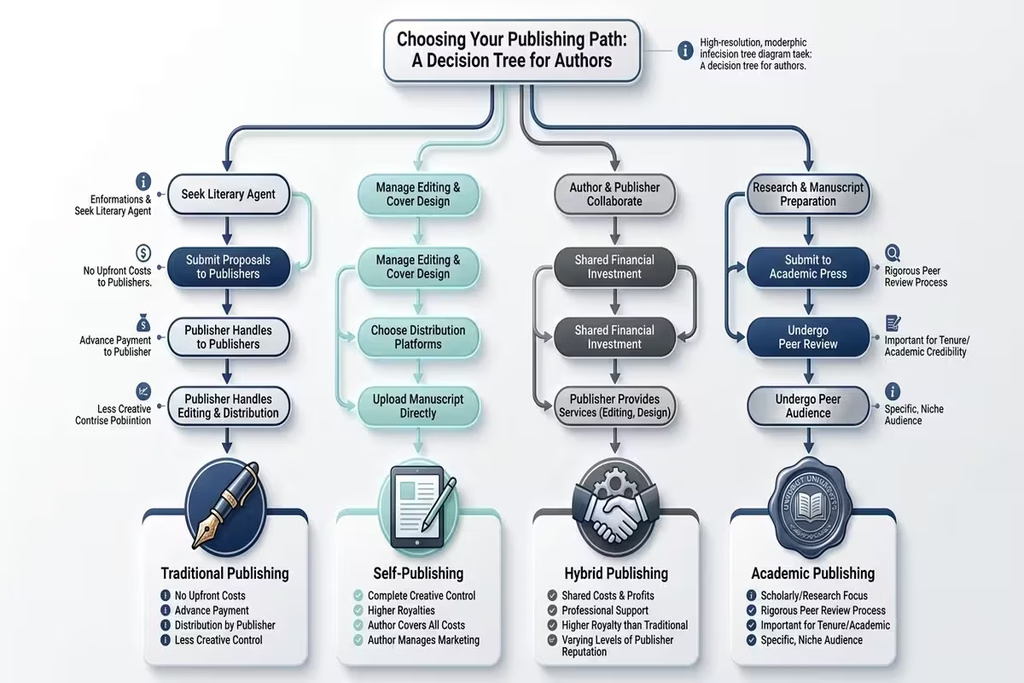
Which Strategy Is Right for You?
The Exclusive Amazon Strategy
Best suited to high-output fiction authors in genres with strong Kindle Unlimited demand: romance, thriller, fantasy, science fiction. Enrol in KDP Select, produce consistently, optimise for pages-read income, and run Kindle Countdown Deals. KDP Select paid $61.7 million to authors in February 2026 alone, but it requires full ebook exclusivity on Amazon.
The Wide Distribution Strategy
Best suited to non-fiction authors, business books, faith-based writing, and authors who prioritise long-term resilience over short-term exclusivity perks. Publish directly on KDP, Apple Books, Kobo, and B&N Press. Use Draft2Digital to reach the remaining 15+ partners and library networks. Add IngramSpark for print bookstore access. Add Feiyr for 165-store reach at zero ongoing cost. Add Publiseer for African and global aggregated distribution at 80% royalties.
The Direct-to-Reader Strategy
Best suited to authors with an existing audience, a newsletter, social media following, or blog. Pair Gumroad, Payhip, Selar (for African audiences), or Books.by with a KDP listing for marketplace discovery. This combination delivers the highest per-sale income and the most resilient reader relationships.
The African Creator Strategy
Start with Selar for local and regional digital sales. Add Publiseer for global aggregated ebook distribution at 80% royalties and daily payouts. Add KDP for international ebook reach. Consider StreetLib for Francophone African and European markets. This four-platform stack covers every meaningful channel for an African author without overcomplicating the workflow.
FAQ
Q: Can I publish my book on multiple platforms at the same time? A: Yes, with one key exception. If you enrol in Amazon KDP Select, your ebook must be exclusive to Amazon for every 90 days. Outside of KDP Select, you are free to publish on as many platforms as you choose simultaneously. Print books have no exclusivity restrictions on any platform.
Q: Which platforms are best for Nigerian authors in 2026? A: For local digital sales, Selar leads on payment infrastructure, local currency support, and community. For global aggregated ebook distribution with maximum royalties, Publiseer is the standout choice. For international reach to the broadest possible audience, add Amazon KDP and Draft2Digital. For European audiences, consider StreetLib or DigiStore24.
Q: What happened to Okadabooks and Bambooks? A: Okadabooks permanently closed its virtual doors on 30 November 2023, citing insurmountable macroeconomic challenges. Bambooks separately announced the suspension of its services with immediate effect, also citing business challenges. Neither platform is currently operating. Authors who had titles on either platform should migrate to Selar, Publiseer, or other active alternatives.
Q: What makes DigiStore24 different from Clickbank? A: Both are affiliate marketing platforms for digital products, but they differ in geography and compliance. Clickbank is strongest in the US and English-language markets with a network of approximately 500,000 affiliates. DigiStore24, founded in Germany, is Europe’s largest affiliate network with 8,500+ offers, GDPR-compliant data protection, TÜV certification, and automated VAT handling for European transactions. For authors targeting European readers or selling to the European diaspora, DigiStore24 often performs better.
Q: Do I need an ISBN to publish my book? A: Not on most platforms. Amazon KDP assigns its own free ASIN. Selar, Gumroad, and Payhip do not require an ISBN at all. An ISBN is essential if you want your print book stocked in bookshops or libraries via IngramSpark or the traditional trade. Purchase your own ISBN from your country’s national ISBN agency for full ownership rights.
Q: What royalty rate can I realistically expect? A: Ebook royalties range from 60% (aggregated via D2D) to 90% (Smashwords direct, Feiyr, Lulu direct). Selling directly from your own website yields approximately 97% after payment processing. Paperback royalties are typically 40–60% of list price minus printing cost. The highest per-sale return comes from direct-to-reader platforms. Books.by delivers 100% after print cost.
Q: Should I use an aggregator or publish directly to each platform? A: The most efficient approach combines both. Publish directly on Amazon KDP, Apple Books, and Kobo Writing Life for the highest royalties and best promotional access at the three most important stores. Use Draft2Digital for the remaining 15+ retailers, library networks, and international partners. The time savings far outweigh the modest royalty reduction on those secondary stores.
Q: What is the impact of Amazon’s AI content policy changes in 2026? A: Amazon now rejects books that are AI-generated without meaningful human editing or original contribution. This has removed a significant volume of low-quality machine-produced content from the Kindle store. For authors who use AI as a writing assistance tool while maintaining genuine creative and editorial involvement, the policy presents no barrier; it actually benefits serious authors by reducing low-quality competition.
Q: How do Wattpad and Scribd fit into a broader publishing strategy? A: Wattpad is best used as an audience-building layer for fiction authors to post chapters to grow a readership, then direct that audience to your paid listings on other platforms. Scribd is a passive income layer accessed through your existing aggregator distribution (Draft2Digital or BookBaby); opt in and earn subscription royalties without additional effort.
The publishing landscape in 2026 rewards strategic authors — those who understand that a platform is a tool, not a destination, and that platform choices are business decisions with compounding consequences.
Amazon KDP gives you scale. Draft2Digital gives you wide reach without administrative burden. IngramSpark gets your print book into bookshops. Kobo and Apple serve loyal international readers. Selar gives African creators the financial infrastructure they actually need. Books.by delivers the most powerful direct-to-reader print experience available. Gumroad and Payhip give simplicity and immediacy. DigiStore24 and Clickbank open affiliate-driven sales channels at scale. And your own website gives you the one thing no other platform can: complete, permanent ownership of every reader relationship.
The closure of Okadabooks and the suspension of Bambooks are a reminder of what happens when authors and platforms build on fragile foundations. The most resilient publishing businesses in 2026 are built across multiple platforms, with owned audience data, direct reader relationships, and income channels that do not collapse when a single company changes its strategy.
Start with the platform that best matches where your readers already are. Build direct reader relationships from the first sale. Expand your platform footprint methodically as your publishing business grows.
Your manuscript deserves to be read. These 26 platforms exist to make that happen. Choose deliberately, deploy strategically, and publish consistently.
Ready to go deeper on your publishing strategy? Book a Transformation Clarity Call (TCC) with our DSE Consultants for a personalised platform recommendation built around your specific book, your audience, and your income goals.
If this guide gave you clarity, share it with a fellow author who is still trying to figure out where to publish. And subscribe to the DSE newsletter to receive our next publishing guide the moment it goes live.