



Imagine getting paid every time someone fills out a form, not when they buy something, not after a 30-day refund window, but the moment they complete a specific action you sent them to. That is CPA marketing in its simplest form, and it is one of the most powerful income models available to anyone building an online business today.
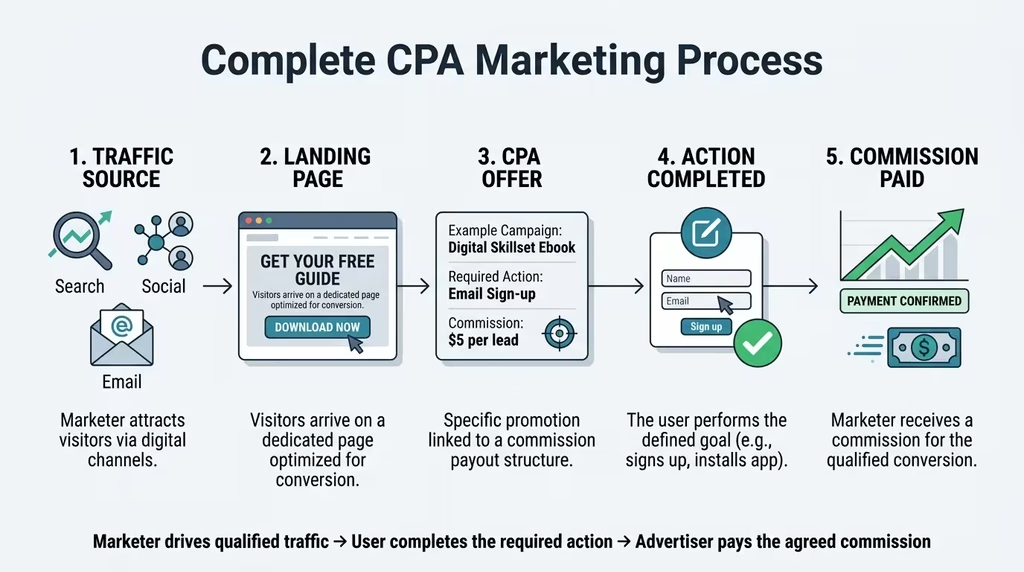
CPA stands for Cost Per Action. It is a branch of performance marketing where advertisers pay publishers for every time a user completes a pre-defined action. That action could be submitting an email address, signing up for a free trial, downloading an app, requesting an insurance quote, or filling out a loan application. The advertiser only pays for results, which is why the payouts are often far higher than standard display advertising.
The scale of the opportunity behind this model is significant. The global affiliate marketing industry, of which CPA is the dominant payment model, reached approximately $18.5 billion in value by 2025, and projections from industry analysts place it above $20 billion in 2026, on a trajectory towards $31.7 billion by 2031 (AffMaven, 2026). According to the Performance Marketing Association, CPA affiliate programmes generate 58% of all affiliate revenue globally, confirming that this model sits at the centre of how performance marketing operates.
What makes it particularly appealing for beginners is the barrier to entry. You do not need your own products. You do not handle shipping, returns, or customer complaints. You do not need a large upfront budget. What you need is a reliable traffic source, a quality offer, and a strategy for connecting the two. Done well, this combination produces income that scales without proportionally scaling your effort.
Table of Contents
Disclosure: Our content is engineered to help you make informed, data-driven, and smart decisions. Digital Solutions Edge is reader-supported; when you engage with our recommendations or click certain links, we may receive a commission. This support allows us to continue delivering the digital solutions you rely on. Thank you for being part of our community.
The Mechanics: How CPA Marketing Actually Works
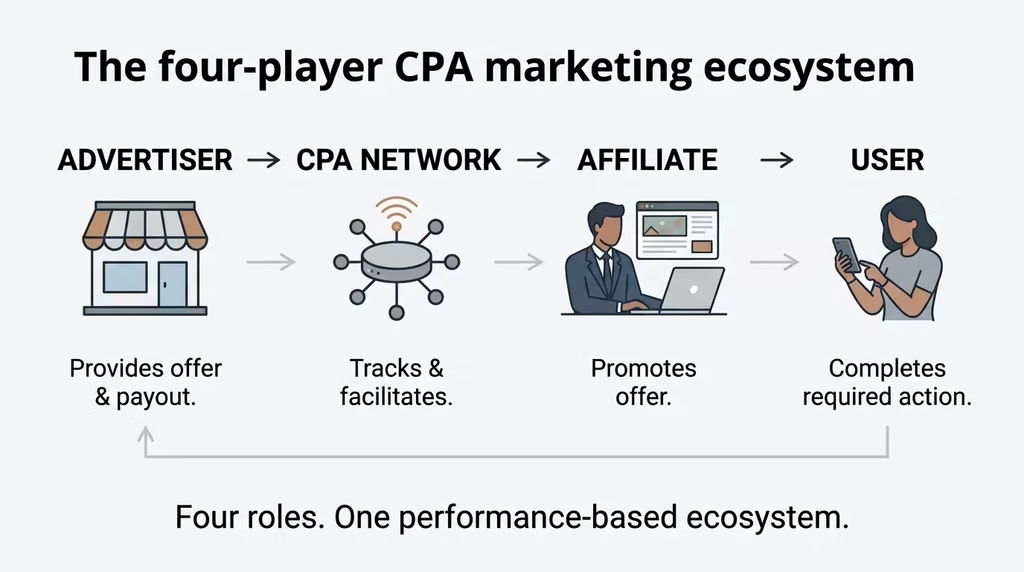
Understanding the mechanics removes the mystery and helps you make better decisions as you build your campaigns. The CPA ecosystem has four core participants: the advertiser, the CPA network, the affiliate (you), and the user.
The Advertiser is a business that wants a specific action completed. A credit card company wants loan applicants. A software company wants free trial sign-ups. A mobile game developer wants app installs. They are willing to pay a fixed commission per action because the value of that action to their business exceeds the payout.
The CPA Network is the intermediary marketplace. It houses hundreds or thousands of offers from different advertisers, verifies traffic quality, tracks conversions through unique tracking links, and handles payment between advertisers and affiliates. Networks like MaxBounty, ClickDealer, and CPAlead each hold thousands of active campaigns.
The Affiliate (You) creates or buys traffic, promotes an offer through a unique tracking link, and earns a commission each time a user completes the required action.
The User clicks your link, lands on an offer page (directly or through your landing page), completes the action, and moves on. They usually receive value in exchange for a free trial, a resource, or a product sample.
The commission you earn is triggered automatically by the tracking system once the action is recorded. Most networks use server-side tracking or pixel-based tracking to attribute conversions to your specific link. Your earnings accumulate in your network dashboard and are paid out according to the network’s schedule. It could be weekly, bi-weekly, or monthly, depending on your network and performance level.
Choosing Your Niche: The Foundation of Every Profitable Campaign
Every beginner wants to know which niche makes the most money. The honest answer is that the most profitable niche is the one where you can create consistent, targeted traffic. That said, certain verticals offer a consistently strong combination of payout, demand, and conversion rate, and understanding these gives you a meaningful starting advantage.
Finance and Insurance
This vertical consistently delivers the highest payouts in CPA marketing. Loan applications, credit card sign-ups, insurance quote requests, and debt relief enquiries can pay anywhere from $20 to $200 per lead (ClickDealer, 2025). The trade-off is that these offers are harder to convert. Users need trust before they share financial information, which means your content and landing pages must demonstrate credibility. Finance is a high-reward, high-effort vertical, ideal for SEO-driven bloggers who build authority content and comparison pages.
Health and Wellness (Nutra)
Weight loss trials, supplement samples, and skincare free trials represent some of the highest-volume CPA offers available. The health and wellness niche brings in an average of $7,194 per month for affiliates who master it, with commission rates ranging from 10% to 50% depending on the offer type (AffMaven, 2026). Native advertising (Taboola, Outbrain) and advertorial-style landing pages tend to perform particularly well in this space.
Sweepstakes and Giveaways
Sweepstakes offer “Win a free iPhone”, “Enter to claim a $500 gift card”, pay lower per lead (typically $1 to $4), but convert at extremely high rates because the action required is minimal. This vertical is beginner-friendly because it suits high-volume, low-barrier traffic from social media. The key here is volume: you need thousands of clicks per day, not hundreds.
Gaming and Mobile Apps
Cost-per-install (CPI) offers pay affiliates when a user downloads and installs a mobile app or registers for an online game. Payouts are modest, typically $0.50 to $5 per install — but conversion rates are high when the traffic is mobile-specific and geo-targeted. Apple Search Ads, for instance, deliver an average CPA of $2.58 for app installs, making them one of the most cost-efficient paid acquisition channels for this vertical (Amra and Elma, 2025).
Software, SaaS, and VPNs
VPN trials, antivirus software, and SaaS free trial sign-ups represent a growing category. These offers align well with SEO content (“best VPN for streaming”, “free antivirus for Android 2026”) and can pay $10 to $40 per lead. They are particularly well-suited to YouTube review content and comparison blog posts.
Niche Selection Checklist:
- Is there consistent search demand for content related to this niche?
- Can you create content that earns trust in this space (reviews, comparisons, tutorials)?
- Are there multiple CPA offers in this niche across more than one network?
- Does the payout align with the effort required to generate a conversion?
- Are there geo-targeting constraints that match your available traffic sources?
If you answer yes to four of the five, you have a viable niche to start with.
Top CPA Networks in 2026: Where to Sign Up and Why
The network you join determines the quality of your offers, the reliability of your payouts, and the level of support you receive. Below is a curated breakdown of the most important platforms for beginners and intermediate marketers in 2026.
MaxBounty
MaxBounty launched in 2004 and has operated as one of the most trusted CPA networks in the world for over two decades. It was named the best CPA platform at the Blue Book Awards and continues to offer over 3,000 active campaigns across finance, insurance, health, gaming, crypto, dating, and sweepstakes. What sets MaxBounty apart is its strict advertiser vetting, which protects affiliates from low-quality offers, and its commitment to weekly payments once you reach the qualifying threshold.
New affiliates begin on a net-15 payment schedule, then move to weekly payments automatically as their performance grows. Payment methods include PayPal, wire transfer, Payoneer, and ACH direct deposit. MaxBounty assigns a dedicated account manager to every affiliate, which is a significant advantage for beginners navigating their first campaigns.
Best for: Affiliates with an established traffic source (blog, YouTube channel, or social media presence). Instant approval requires a brief phone or video interview.
CPAlead
CPAlead offers instant approval, a minimum payout threshold of $10, and daily payment options once conditions are met. It specialises in mobile offers, app installs, and content-locking tools, a format where access to content is gated behind the completion of a CPA offer. This makes it one of the most beginner-accessible networks available in 2026.
Best for: Absolute beginners who want to start earning quickly without a lengthy approval process.
CPAGrip
CPAGrip is similar to CPAlead in its beginner-friendliness and includes content lockers, URL lockers, and offer walls as monetisation tools. It is widely used by affiliates who run incentivised traffic where users complete an offer in exchange for something of value (e.g., free access to downloadable content). It is especially popular with traffic from developing markets.
Best for: Beginners building incentive-based funnels and content monetisation strategies.
ClickDealer
ClickDealer is a premium performance marketing network with a decade of experience, operating across 40+ verticals, including e-commerce, dating, lead generation, iGaming, and mobile apps. It offers SmartLink technology, which automatically routes your traffic to the highest-converting offer based on the user’s country, device, and behaviour, a powerful feature for affiliates running mixed international traffic.
The network’s minimum payment threshold starts at $100 (monthly) and moves to weekly for top performers. ClickDealer is known for its loyalty programme, which rewards affiliates with bonuses and prizes for consistent performance. Payment methods include Payoneer, Paxum, WebMoney, and bank wire.
Best for: Intermediate to advanced affiliates running paid traffic, push ads, or native advertising at scale.
AdWorkMedia
AdWorkMedia is a well-established network known for its advanced content-locking tools and diverse offer types. Its affiliate support is strong, which makes it a reasonable stepping stone between the purely beginner-friendly networks (CPAlead) and the more demanding tier-one options (MaxBounty, ClickDealer). It boasts over 2,500 active offers and welcomes mixed traffic sources, including social media and mobile.
Best for: Affiliates who want content monetisation tools alongside a broader offer catalogue.
Perform[cb] (Formerly PerformLine)
Perform[cb] focuses on outcome-based user acquisition and is highly regarded by both advertisers and affiliates. It is strong in pay-per-call offers and media buying, with a team known for its experience and accessibility. If you are building towards high-ticket finance or insurance verticals, Perform[cb] belongs on your list.
Best for: Experienced affiliates working in finance, insurance, and pay-per-call verticals.
AdCombo
AdCombo specialises in COD (cash-on-delivery) and nutra offers and accepts a broad range of traffic types, including social, mobile, and web traffic. It is particularly effective for affiliates targeting non-English-speaking markets, with geo-coverage across Eastern Europe, Latin America, and Asia.
Best for: Affiliates targeting international markets outside of traditional Tier-1 geos.
How to Get Approved by CPA Networks (Even as a Beginner)
Approval is the first real obstacle most beginners encounter. Networks take their vetting process seriously because fraudulent traffic is a genuine problem in performance marketing. Here is how to maximise your approval chances regardless of your experience level.
Set up a basic web presence. Even a simple WordPress site or a blog with 3–5 published articles demonstrates that you are a legitimate publisher, not a fraudulent account. This is the single most effective signal you can send before applying.
Use a professional email address. A domain email (yourname@yourdomain.com) is ideal. A clean Gmail address is acceptable. A throwaway or unrecognisable email domain is an immediate red flag.
Be honest about your traffic sources. During the application or phone interview, describe the traffic you plan to use (SEO blog, TikTok organic, YouTube, paid ads). Be specific. Saying “I run a finance review blog and plan to use SEO traffic” is far more credible than “I use multiple traffic sources.”
Apply to beginner-friendly networks first. CPAlead and CPAGrip offer instant approval for many offers. Getting your first approvals, tracking your first conversions, and building a performance history make subsequent applications to MaxBounty and ClickDealer significantly easier.
Follow-up. If you do not hear back within 2–3 business days, send a polite follow-up message. It demonstrates initiative and keeps you on the reviewer’s radar.
For MaxBounty specifically, the phone interview typically takes 10–15 minutes and focuses on your traffic sources, your niche experience, and your marketing approach. Being prepared with specific answers, not vague generalities, is the difference between approval and rejection.
How to Choose a Winning CPA Offer
Not all CPA offers are equal. The difference between a campaign that loses money and one that generates consistent profit often comes down to offer selection. Here is a practical framework for evaluating offers before you commit your traffic or budget.
EPC (Earnings Per Click). EPC tells you the average amount affiliates earn per click sent to that offer. A higher EPC suggests a well-converting offer. Use it as a directional signal, not a guarantee, as your EPC will vary based on your traffic quality and targeting.
Conversion Type. Email submit offers (SOI — Single Opt-In) have the highest conversion rates because they require minimal user commitment. Double opt-in (DOI) offers require email verification and pay more, but convert less. Lead forms, free trials, and app installs sit in the middle. Match the conversion complexity to your traffic’s readiness to act.
Payout vs. Conversion Rate. A $50 offer that converts at 1% generates the same revenue as a $1 offer that converts at 50%, but the path to profitability looks very different. High-payout offers require trust-based traffic (blog readers, YouTube subscribers). High-volume, low-barrier offers suit viral social media traffic.
Geo-Targeting. Some offers only accept traffic from Tier-1 countries (US, UK, Canada, Australia). Others are designed for Tier-2 or Tier-3 markets. Always check the allowed geos before running traffic. Sending Nigerian or Indian traffic to a US-only offer wastes every click.
Offer Rules and Allowed Traffic Methods. Every offer specifies which traffic sources are permitted (search, social, email, native, incentive). Violating these rules can result in a commission reversal or account ban. Read the offer terms before you build anything around it.
Offer Freshness. Check when the offer was last updated and whether the EPC has been stable or declining. A freshly launched offer often converts better because the market has not yet seen it repeatedly.
Practical tip from the field: Before scaling any campaign, run 200–500 test clicks to establish your actual conversion rate. Most experienced CPA marketers expect 7 out of 10 initial campaigns to fail. Finding 2–3 consistent winners and scaling those is the actual strategy.
Building Your Bridge: Landing Pages and Pre-Sell Funnels
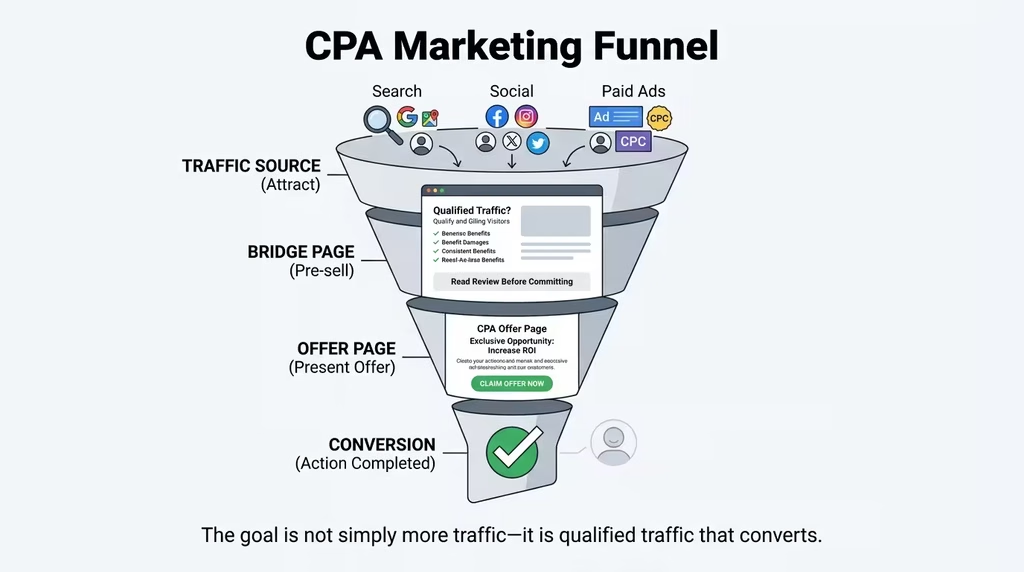
Direct linking, sending traffic straight from your ad or social post to the offer page, is one of the most common beginner mistakes in CPA marketing. Most paid platforms (Facebook, Google, TikTok) restrict direct affiliate links. Even when it is technically allowed, a well-designed intermediate page almost always outperforms direct linking.
The bridge page (also called a pre-lander or pre-sell page) is the intermediate layer between your traffic source and the CPA offer. Its purpose is to warm up the visitor, establish credibility, and prime them to complete the action on the offer page.
What Makes an Effective Bridge Page
A single, focused purpose. Your bridge page has one job: move the visitor closer to the offer. Remove navigation menus, secondary links, and anything that pulls attention away from the intended path.
Benefit-driven headline. Lead with the specific outcome the visitor will gain. “Claim Your Free £200 Gift Card, 3 Minutes to Enter” outperforms a generic “Enter Our Sweepstakes.”
Congruence with your traffic source. If your TikTok video promised a viewer “how to check their credit score for free,” your landing page must deliver exactly that context before presenting the offer. Any disconnect between the ad and the page kills conversions.
Trust elements. Testimonials, security badges, press logos, and real user reviews reduce friction. In finance and health verticals, trust elements are not optional; they are essential.
One clear call to action. Every element on the page should point to a single button or form. Multiple competing CTAs reduce conversion rates. Keep the design clean and the action obvious.
Mobile optimisation. The majority of CPA traffic is mobile. A page that loads in under three seconds and displays correctly on all screen sizes is a baseline requirement, not a bonus.
Bridge Page Builders
- Carrd — Simple, fast, beginner-friendly. Free tier available.
- Systeme.io — Full-funnel builder with email automation. The free plan supports up to 2,000 contacts.
- Landingi — Purpose-built for landing page testing and A/B comparison.
- ClickFunnels — Industry standard for full-funnel building, though pricier at $97–$297/month.
- WordPress + Elementor — Best for SEO-driven CPA campaigns where your pre-sell page doubles as a blog post.
The Lead Magnet Strategy
One powerful variation of the bridge funnel involves collecting the visitor’s email before forwarding them to the CPA offer. You offer a free resource (an eBook, a checklist, a mini-guide) in exchange for their email, deliver the lead magnet, and then redirect them to the CPA offer. This approach builds your email list simultaneously as a long-term asset that generates repeat traffic independently of any ad spend.
Free Traffic Strategies That Work in 2026
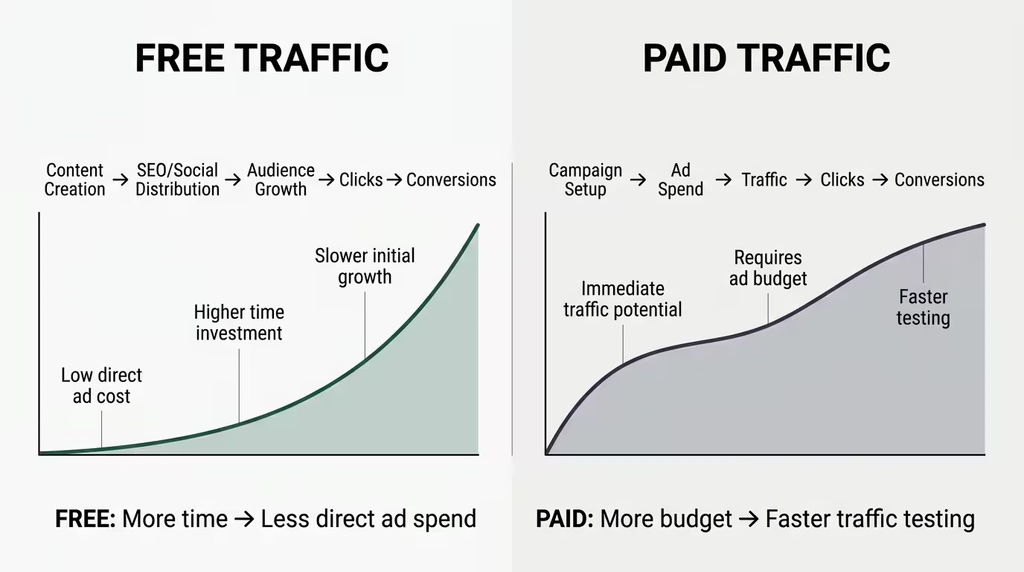
Building traffic without paying for it takes longer than paid methods but creates compounding, long-term assets. The following free traffic channels are the most productive for CPA marketers in 2026.
SEO Blogging
Search engine optimisation remains the most stable and scalable free traffic source available. According to industry data, 78% of marketers list SEO as their top source of qualified traffic, outperforming social (35%) and email (23%) by a significant margin (CIPIAI, 2026). Long-tail keywords drive 80% of organic affiliate traffic, making niche-specific informational content your most valuable SEO asset.
Effective SEO content for CPA marketing takes two primary forms:
Review content — “Best VPN for Android in 2026”, “Honest MaxBounty Review”, “Is [Offer X] Legit?” attracts users in the consideration and decision stage of their journey. These readers are already evaluating whether to take action, which makes them highly convertible.
Comparison content — “[Tool A] vs [Tool B]: Which One Should You Choose?” intercepts users choosing between options. If your offer is one of the options reviewed (or the recommended winner), conversion rates are typically strong.
How-to and tutorial content — “How to Check Your Credit Score for Free in the UK”, “How to Get a Free Trial of [Software X]” attract users ready to act immediately.
SEO takes 3–6 months to generate meaningful traffic. The payoff is sustained, free traffic that compounds over time without ongoing ad spend.
TikTok Organic
TikTok is the fastest-growing free traffic source for CPA affiliates in 2026. Its algorithm rewards relevance and watch time over follower count, which means a brand-new account with zero followers can generate thousands of views on its first posting day if the content is compelling.
TikTok affiliate links deliver an engagement rate of 5.2%, approximately 160% higher than Instagram (CIPIAI, 2026). The platform functions increasingly like a search engine: users actively search for product reviews, tutorials, and recommendations, giving affiliates a discovery channel beyond just the For You Page.
Effective CPA content on TikTok follows a simple format: demonstrate the offer’s value through a 21–45 second video, create curiosity or urgency in the hook (the first three seconds), and direct viewers to the link in your bio. Authenticity performs better than polish. An honest “I tried this app and here is what I found” video outperforms an overly edited promotional clip in almost every test.
Key rule: Always verify that the offer’s terms of service permit TikTok traffic before posting. Some advertisers restrict social media promotion.
YouTube
YouTube sits at the intersection of social media and search engine, offering two discovery pathways for the same piece of content. A well-optimised review video can rank on both YouTube search and Google for years, generating passive CPA conversions long after you stop actively promoting it.
The best-performing YouTube CPA content follows the same search-intent principles as SEO blogging: target users in the evaluation and decision stage of their journey. “Does [App X] actually pay?” and “Best budgeting apps I tested in 2026” attract viewers who are seconds away from taking action, exactly the right moment to present a CPA offer link in the video description.
Video content is projected to account for 55% of all affiliate traffic, making YouTube an increasingly important organic channel for CPA affiliates (Mowdud Ahmed, 2026).
Pinterest is underused by CPA affiliates, which creates a genuine advantage for those who master it. The platform functions as a visual search engine: pins rank and drive traffic for months or years after posting. Finance, health and wellness, home improvement, and lifestyle verticals perform particularly well on Pinterest, and pins can link directly to landing pages without the restrictions common on other social platforms.
Instagram Reels
Instagram Reels expanded their organic reach significantly throughout 2025–2026, following a similar algorithmic approach to TikTok. Short-form video content targeting health, fitness, beauty, lifestyle, and finance niches reaches new audiences beyond your existing followers. Like TikTok, the CTA directs viewers to a link in your bio, which should point to your bridge page rather than a direct offer link.
Email Marketing
Building an email list is the highest-ROI long-term asset in CPA marketing. Unlike social media platforms and search engines, your email list belongs to you. Algorithm changes, platform bans, or account restrictions cannot take it away. Every email subscriber who went through your lead magnet funnel is pre-warmed, pre-qualified traffic you can repeatedly promote offers to.
Even a small list of 2,000 targeted subscribers can generate consistent monthly CPA commissions when managed with relevant, value-led content and well-timed offer promotions. Free email platforms like Systeme.io, Mailchimp, and MailerLite remove the upfront cost barrier for beginners.
Paid Traffic Strategies: When and How to Scale
Paid traffic accelerates results but introduces financial risk. The correct sequence is: validate your offer and funnel with free traffic first, establish your conversion rate, then apply paid budget to a proven system. Spending money on a funnel with an unknown conversion rate is the most common and costly beginner mistake.
When you are ready to add paid traffic, these are the most effective channels for CPA marketing in 2026.
Facebook and Instagram Ads
Facebook remains the most versatile paid traffic platform for CPA marketing because of its unmatched demographic targeting. You can reach users by age, income bracket, interests, behaviour, and life events, making it ideal for finance, health, and lifestyle offers where the target audience is well-defined.
The average cost-per-action on Facebook across all industries is $18.68, though this varies considerably by vertical. Education offers an average of $7.85 per lead on Facebook, while technology offers an average of $55.21 (Amra and Elma, 2025). These benchmarks give you a starting framework for evaluating whether your offer’s payout can support Facebook’s advertising costs.
Critical rule: Facebook prohibits direct affiliate links. Your campaign must point to a compliant landing page. Review the offer’s permitted traffic sources and Facebook’s advertising policies before launching.
Microsoft (Bing) Ads
Microsoft Advertising is consistently undervalued by CPA beginners. Competition is lower than Google Ads, CPCs are typically 30–40% cheaper, and the audience skews older (35+) and higher income, a demographic that converts particularly well on finance and insurance offers. For affiliates who have already validated a campaign on Google, replicating it on Bing is one of the simplest scaling moves available.
Google Search Ads
Google Search Ads capture high-intent traffic at the exact moment a user is searching for information related to your offer. The average CPA for Google Search campaigns is $48.96 across industries (Digital Thrive US, 2026). This is above the Facebook average, but the traffic quality is significantly higher. Users who search “best personal loan UK” are closer to converting than users who see a Facebook ad while scrolling.
The caveat with Google Ads for CPA marketing is strict compliance. Google prohibits direct affiliate links and many finance, health, and subscription-based CPA offers under its policies. Your landing page must add genuine editorial value, not simply redirect users to an advertiser’s form.
Native Advertising (Taboola, Outbrain)
Native ads appear as recommended content widgets on major news sites and publisher networks. They are less competitive than Google and Facebook, and particularly effective for health, nutra, and finance verticals. Advertorial-style landing pages, long-form, story-driven pages that educate before presenting the offer, perform exceptionally well with native traffic.
Native advertising is where many advanced CPA marketers run their highest-volume campaigns. The entry cost is low enough to test (typically $0.01–$0.10 per click), and the targeting options have improved significantly in recent years.
Push Notifications
Push notification advertising platforms (PropellerAds, RichPush, Adsterra) send your ad directly to a user’s device as a notification, even when they are not browsing. CPCs are very low (often $0.01–$0.03), making it a cost-effective channel for high-volume, low-payout sweepstakes and app install offers. The trade-off is lower user intent compared to search-based channels.
Hybrid Traffic Strategy: The Most Effective Approach in 2026
Industry practitioners consistently identify hybrid campaigns, combining organic content with targeted paid retargeting, as the most profitable CPA traffic strategy in 2025–2026 (BlackHatWorld Community Survey, 2025). The logic is straightforward: organic content builds trust and qualifies the audience; paid retargeting converts the warm visitors who did not complete the action on their first visit.
A practical hybrid setup looks like this: a TikTok video or SEO blog post drives initial traffic to your landing page. A Facebook Pixel captures visitors who did not convert. A retargeting campaign on Facebook shows a second, more direct message to those warm visitors at a fraction of the cost of cold traffic. This approach can reduce your effective cost per acquisition by 20–40% compared to cold paid traffic alone.
Tracking, Testing, and Optimising Your Campaigns
Data is the operating system of CPA marketing. Without it, you are guessing. With it, you can eliminate losing campaigns, scale winning ones, and build a system that improves over time.
What to Track
Every CPA campaign should monitor these core metrics:
- Clicks — Total traffic sent to your offer or landing page
- Conversion Rate (CR) — Percentage of clicks that complete the action
- EPC (Earnings Per Click) — Your actual earnings divided by total clicks
- Cost Per Action (CPA) — Your advertising spend divided by conversions (for paid campaigns)
- ROI — (Earnings minus cost) divided by cost, expressed as a percentage
- Geo performance — Which countries are generating your best conversions
- Device breakdown — Mobile vs desktop conversion rates often differ significantly
Tracking Tools
Free tier:
- Google Analytics 4 — Sufficient for beginner-level tracking of blog and landing page traffic
- UTM parameters — Free URL tagging that lets you track which traffic source is driving which conversions in Google Analytics
Dedicated affiliate trackers:
- Voluum — Industry-standard tracker for performance marketers. Real-time reporting, AI-based optimisation suggestions, and integrations with major ad networks. Pricing starts at $99/month.
- RedTrack — Strong alternative to Voluum with competitive pricing starting at $41/month.
- BeMob — Popular among beginners for its free plan (up to 100,000 events per month) and clean interface.
- ClickMagick — Well-suited to link tracking and funnel analysis. Plans start at $37/month.
Once you scale to $500+/month in revenue, investing in a dedicated tracker pays for itself in saved ad spend within the first month.
A/B Split Testing
Split testing, running two versions of a landing page, ad, or funnel element against each other, is the practice that separates profitable campaigns from stagnant ones. The principle is simple: run two versions simultaneously, identify the better performer based on statistical significance (minimum 100–200 conversions per variant), kill the loser, and iterate on the winner.
Elements worth testing in order of impact:
- Headline — The most influential element on any landing page
- Call-to-action text and button colour
- Hero image or video
- Form fields (fewer fields nearly always mean a higher conversion rate)
- Trust elements (testimonials, logos, security badges)
- Offer angle (different benefits emphasised for the same offer)
Audience Segmentation
Your account manager at any quality CPA network sees performance data across all publishers on the platform. They know which offers are converting best in which geos, which creatives are performing, and which traffic sources are producing quality leads. Building a relationship with your affiliate manager and asking these questions directly is one of the most underused optimisation strategies available to beginners.
The $5,000/Month Roadmap: A Realistic Income Breakdown
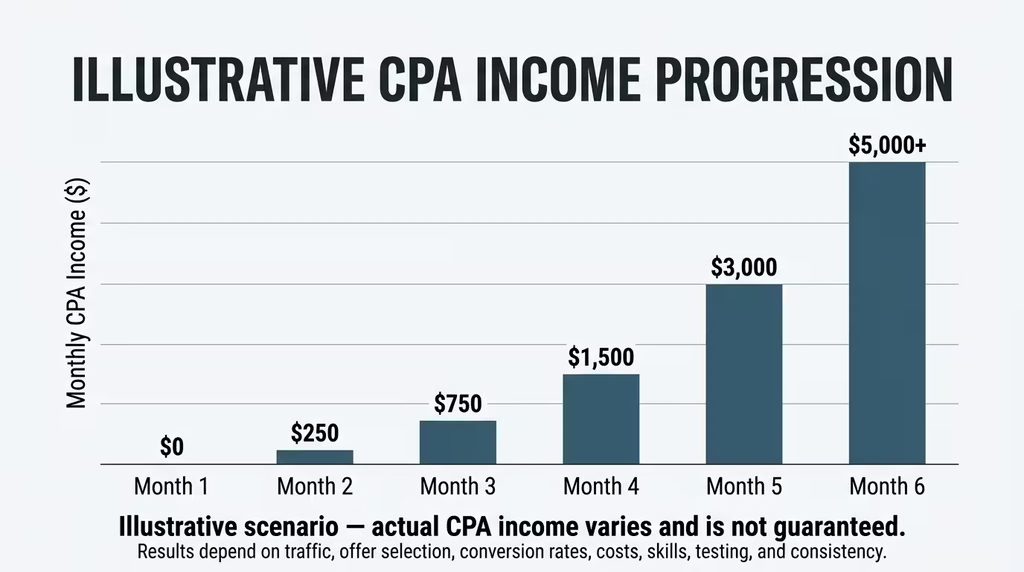
$5,000 per month is an aspirational but achievable target for a CPA marketer who has spent 3–6 months learning and testing. Here is how the numbers actually work at different campaign types, along with a realistic milestone timeline.
The Math Behind $5,000/Month
Scenario A: Email Submit / Sweepstakes ($1–$3 payout). At $2 per lead, you need 2,500 conversions per month, or roughly 83 per day. With a 5% conversion rate on your landing page, you need 1,660 clicks per day. Achievable with a viral TikTok account, a content-locking site at scale, or $50–$80/day in paid traffic once optimised.
Scenario B: Finance / Insurance Leads ($30–$80 payout). At $50 per lead, you need 100 conversions per month, or roughly 3–4 per day. With a 3% conversion rate on a well-targeted blog or landing page, you need 100–130 clicks per day, achievable with an established SEO blog in the finance niche or a modest Facebook Ads budget of $20–$40/day pointed at a validated funnel.
Scenario C: App Installs ($2–$10 payout). At $5 per install, you need 1,000 installs per month. With mobile-targeted paid traffic and a well-matched offer, this requires consistent daily traffic of 500–1,000 mobile clicks.
Scenario D: Free Trial Sign-Ups ($10–$25 payout). At $15 per trial, you need approximately 333 conversions per month. A content-driven YouTube channel reviewing software tools, combined with a lead-capture bridge page, can produce this volume within 4–6 months of consistent publishing.
A Realistic 6-Month Milestone Plan
Month 1: Join CPAlead or CPAGrip. Choose one niche. Build a basic landing page. Create 10–15 pieces of content (blog posts or TikTok videos). Target: $50–$200.
Month 2: Apply to MaxBounty with performance data from Month 1. Test 3 offers. Track with BeMob or Google Analytics. Target: $200–$500.
Month 3: Scale content production. Build your email list with a lead magnet funnel. Identify your best-performing offer. Target: $500–$1,000.
Month 4: Add a second traffic channel. If you started with TikTok, add a basic SEO blog or vice versa. Reinvest 30–50% of earnings into tools and testing. Target: $1,000–$2,000.
Month 5: Introduce a small paid traffic budget ($10–$20/day) on your validated funnel. Test Microsoft Ads or Facebook retargeting. Target: $2,000–$3,500.
Month 6: Scale the paid traffic channel that shows a positive ROI. Optimise your top-performing content for better conversion. Target: $3,500–$5,000+.
The key variable in this timeline is consistency. Marketers who publish content weekly, review their tracking data regularly, and test methodically routinely hit these milestones. Those who post sporadically and treat it as passive income rarely progress past Month 2.
Compliance, Ethics, and Staying on the Right Side of the Line
CPA marketing has a reputation problem in some circles precisely because a minority of practitioners abuse it. Fake reviews, misleading landing pages, unsolicited email campaigns, and fraudulent traffic are real issues that networks and regulators actively work to address. Building a compliant, long-term CPA business requires understanding where the lines are.
Know Your Network’s Rules
Every CPA network publishes a terms of service document, and each offer carries its own specific terms. These documents specify what traffic sources are permitted, what claims can and cannot be made about the offer, and what constitutes a fraudulent conversion. Violating offer terms, even unknowingly, results in commission reversals and account bans. Read the terms before you build a campaign.
Truthful Advertising Standards
Regulatory bodies, including the UK’s Advertising Standards Authority (ASA), the US Federal Trade Commission (FTC), and equivalent bodies in other jurisdictions, have clear rules around affiliate advertising. Endorsements must be disclosed. Claims about product performance must be substantiated. “Results not typical” disclaimers apply when you feature testimonials. Familiarise yourself with the guidelines relevant to your target markets.
The FTC’s endorsement guides, available at ftc.gov, are the clearest public resource for affiliate marketing compliance and are worth reading in full before you build your first campaign.
Content Authenticity
Your reviews, comparisons, and tutorials must be honest. Fabricating personal experience with a product, inventing user testimonials, or making claims you cannot substantiate may generate short-term clicks but create legal exposure and damage your reputation permanently. The most durable CPA businesses are built on content readers trust and return to.
White Hat vs Grey Hat Approaches
White hat CPA marketing refers to fully compliant methods: honest content, disclosed affiliate relationships, permitted traffic sources, and truthful claims. It is slower to monetise but builds sustainable, compounding assets.
Grey hat methods, such as cloaking (showing a different page to Google than to users), incentivised traffic on non-incentive offers, or slightly misleading headlines, generate faster results but carry a real risk of network bans, ad account shutdowns, and platform penalties. Experienced marketers weigh these risks deliberately. For beginners, the potential downside of a network ban early in the journey outweighs any short-term gain.
There is no ambiguity about black hat methods; these involve deliberate fraud, including click bots, fake leads, and stolen creative assets. They result in permanent bans, legal action, and occasionally criminal charges. They are not a viable strategy at any stage of your career.
Common Mistakes That Kill CPA Campaigns
The fastest way to learn CPA marketing is to understand what goes wrong and build your strategy around avoiding it from the start.
Skipping the tracking setup. Sending traffic without tracking is the equivalent of running a business without a spreadsheet. You will not know which offers, traffic sources, or audience segments are profitable. Every campaign, from day one, requires a minimum basic UTM tracking setup.
Overspending before validating. Allocating a large paid advertising budget to an untested offer and funnel is a reliable way to lose money quickly. The correct approach is to test with a small budget ($5–$10/day), validate conversion rates, then scale.
Direct linking on restricted platforms. Facebook, Google, and TikTok prohibit direct affiliate links. Building landing pages is not optional; it is a prerequisite for running paid traffic on any major platform.
Promoting offers that conflict with your traffic. A finance lead offer will not convert an audience of teenagers consuming gaming content on TikTok. Offer-audience alignment is one of the most fundamental determinants of campaign success.
Not reading the offer rules. Some offers prohibit email traffic, incentivised traffic, or certain geographic targets. Sending non-compliant traffic results in your conversions being reversed (meaning you earned nothing for the effort) and can get your account flagged.
Giving up too early. Most CPA beginners abandon their first 3–5 campaigns before finding a profitable one. Industry veterans consistently report that finding 2–3 consistent winners out of 10 tested campaigns is normal; it is the expected process, not a sign of failure.
Ignoring mobile optimisation. The majority of CPA traffic in 2026 is mobile. A bridge page that renders poorly on a smartphone is losing conversions before the visitor even reads a word.
Tools and Resources Every CPA Marketer Needs
Building an effective CPA marketing operation requires a core toolkit. Below is a practical breakdown organised by function.
Research and Offer Intelligence
- Affpaying.com — Affiliate network review site where you can compare CPA networks, check payout terms, and read community reviews before committing
- OfferVault — Aggregates CPA offers from multiple networks, allowing you to compare payouts and find the highest-paying option for a specific niche
- SpyFu / SimilarWeb — Competitive intelligence tools that show you which keywords competitors are targeting and where their traffic originates.
Landing Page Builders
- Carrd — Best free option for simple bridge pages
- Systeme.io — Free plan supports full-funnel builds, including email automation
- WordPress + Elementor — Best for SEO-integrated landing pages and long-form pre-sell content
Tracking
- BeMob — Free up to 100,000 events/month; ideal for beginners
- Voluum — Industry standard for scaling campaigns ($99+/month)
- RedTrack — Strong Voluum alternative at a lower price point ($41+/month)
- ClickMagick — Excellent for link-level tracking and funnel analysis ($37+/month)
Email Marketing
- Systeme.io — Free for up to 2,000 subscribers with automation
- MailerLite — Clean interface, free for up to 1,000 subscribers
- ConvertKit — Creator-focused platform with strong segmentation (free up to 1,000 subscribers)
SEO and Content
- Ahrefs / Semrush — Industry-standard keyword research and competitor analysis platforms
- Surfer SEO — On-page optimisation tool for content creators (from $89/month)
- Ubersuggest — More affordable alternative to Ahrefs, with lifetime plans available
Ad Spy Tools (For Paid Traffic)
- Adspy — Facebook ad intelligence tool showing competitor CPA campaigns
- BigSpy — Multi-platform ad spy covering Facebook, TikTok, Pinterest, and YouTube
- Anstrex — Specialises in native advertising intelligence (Taboola, Outbrain)
Frequently Asked Questions
How much money do I need to start CPA marketing? You can start with zero budget using free traffic methods like TikTok organic content, Pinterest, or SEO blogging. A basic landing page on Carrd is free. Your first CPA network (CPAlead or CPAGrip) is free to join. The genuine costs come when you scale with paid traffic or invest in tracking tools. A realistic starting budget for a serious beginner running small paid tests is £200–£500 over the first 3 months.
Is CPA marketing still profitable in 2026? Yes. The global affiliate marketing industry crossed $18.5 billion in 2025 and is projected to exceed $20 billion in 2026, growing at a compound rate of 15.2% annually. CPA is the backbone of this industry, generating 58% of all affiliate revenue. The opportunity has never been larger, though competition has also increased, making quality content, strategic offer selection, and consistent tracking more important than ever.
How long does it take to reach $5,000/month with CPA marketing? For a dedicated beginner committing 1–2 hours per day, the typical timeline to reach $5,000/month is 6–12 months. This assumes consistent testing, reinvestment of early profits, and a willingness to iterate based on data. Marketers who expect passive income without active learning and optimisation rarely reach this milestone.
Can I do CPA marketing without a website? Yes, but having some form of web presence significantly improves your chances of network approval and campaign performance. At a minimum, a single landing page (free on Carrd or Systeme.io) is required for most paid advertising platforms. For organic traffic via TikTok, Instagram, or YouTube, your bio link serves as the equivalent of a landing page.
What is the best CPA network for complete beginners? CPAlead and CPAGrip are the most beginner-accessible networks in 2026, offering instant approval, low minimum payouts ($10), daily payment options, and a range of beginner-friendly tools, including content lockers. Once you have built a performance history, MaxBounty is the most trusted step-up network.
What are the highest-paying CPA niches? Finance (insurance, credit cards, loans) offers the highest per-lead payouts, typically $20–$200 per action. Health and nutra offer an average of $15–$60 per lead with strong volume potential. SaaS and software trials typically pay $10–$40 per sign-up. Sweepstakes offers pay $1–$4 per lead but convert at high rates, making them viable for high-volume traffic strategies.
Do I need to disclose that I am an affiliate? Yes. In the UK, the ASA requires all affiliate relationships to be disclosed clearly and up front. In the US, the FTC has equivalent guidelines requiring “material connections” to be disclosed. Non-disclosure is not only a regulatory risk, but it also erodes the trust of your audience when they discover the relationship independently.
What tracking tool do you recommend for beginners? Start with BeMob, which offers a generous free plan of 100,000 trackable events per month. It gives you the core metrics you need (clicks, conversions, EPC, geo breakdown) without requiring a subscription. Upgrade to Voluum or RedTrack when your monthly revenue consistently exceeds your tracking platform’s cost.
Can CPA marketing work in Nigeria? Yes. Many CPA networks accept affiliates from Nigeria, including MaxBounty, CPAlead, and ClickDealer. The key consideration is selecting offers whose geo-targeting includes Nigeria or your target markets, or creating content that attracts Tier-1 traffic (UK, US, Canada) through SEO, YouTube, or TikTok. Several Nigerian affiliates successfully run international CPA campaigns by targeting global audiences through English-language content and social media.
What is the difference between CPA, CPL, and CPS? CPA (Cost Per Action) is the umbrella term covering any commission triggered by a user action. CPL (Cost Per Lead) specifically pays for lead form completions: name, email, phone number. CPS (Cost Per Sale) pays when a user makes a purchase. For beginners, CPL and non-purchase CPA offers (email submits, app installs, free trial sign-ups) are easier to convert than CPS offers, which require users to spend money.
CPA marketing is one of the most accessible and scalable performance income models available to digital marketers today. The core proposition is straightforward: connect targeted traffic with relevant offers, use a well-built bridge page to warm up visitors, track every variable, and iterate based on data. Do this consistently, and the income compounds.
The $5,000/month milestone is not a fantasy. It is a mathematical outcome, one that flows directly from choosing the right niche, selecting offers that align with your audience, building a functional funnel, and maintaining the discipline to test and optimise over a sustained period.
What separates CPA marketers who reach that milestone from those who give up at month two is not talent. It is the willingness to treat early campaigns as a learning exercise, to reinvest initial earnings into better tools and more traffic, and to stay methodical when results are slow.
The global performance marketing industry is growing at 15% annually. Advertisers across finance, health, technology, and gaming are competing to pay affiliates for qualified actions. The demand for your traffic is not the problem. The strategy to match it to the right offer, consistently and compliantly, is what this guide has given you.
Your next step is to pick one network, one niche, and one traffic method. Build a simple landing page. Apply to CPAlead today. Create your first five pieces of content this week. Track what happens. That is how every CPA success story begins, not with a perfect strategy, but with a first campaign.
If you want tailored guidance on building a CPA marketing system specific to your traffic strengths and income goals, the DSE team is available for a Transformation Clarity Call (TCC). Book your session here.