


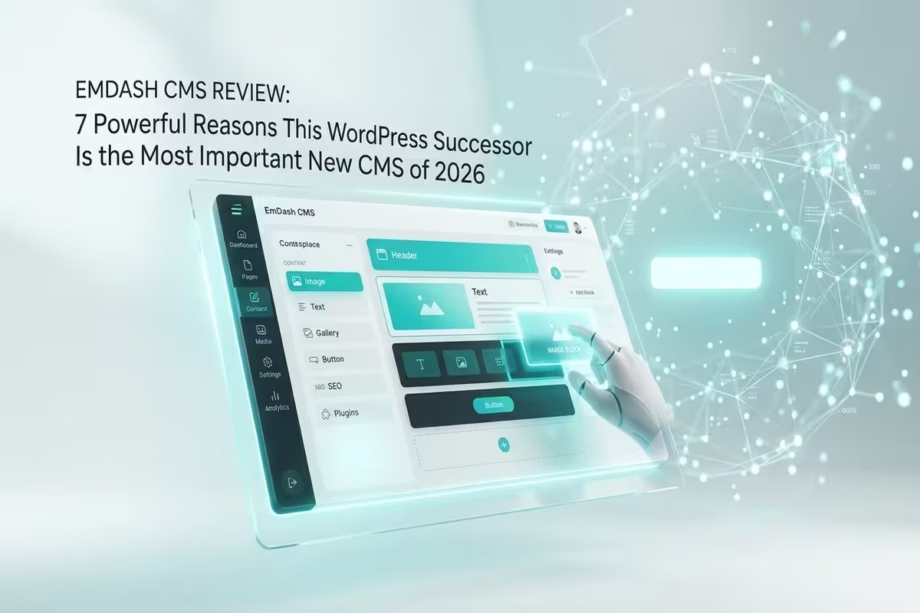
What would happen if you could strip WordPress down to its foundations, keep everything that made it great, and rebuild it for a world where AI agents browse the web, plugins are security nightmares, and serverless infrastructure has made traditional hosting look like a fax machine? That question is no longer hypothetical.
On 1 April 2026, Cloudflare dropped something that sent shockwaves through the CMS world: EmDash, a TypeScript-based, serverless, open-source content management system they are calling the “spiritual successor to WordPress.” The timing raised eyebrows. The architecture raised pulses.
WordPress powers over 40% of the internet and has transformed millions of lives since its launch in 2003. It is the backbone of countless blogs, business sites, e-commerce stores, and media platforms. But 23 years is a long time in technology, and cracks have appeared. Plugin security is in crisis. Hosting complexity is a burden. The AI era has introduced new demands that WordPress was never designed to meet.
EmDash is Cloudflare’s answer to all three.
This article is your complete briefing. You will understand exactly what EmDash is, the seven core features that make it genuinely worth watching, the real limitations you need to know about before touching it, and what it all means for your digital strategy as a creator, consultant, educator, or business owner.
By the end, you will know whether EmDash belongs on your radar, your roadmap, or neither. Let us get into it.
Table of Contents
Our content is engineered to help you make informed, data-driven, and smart decisions. Digital Solutions Edge is reader-supported; when you engage with our recommendations or click certain links, we may receive a commission. This support allows us to continue delivering the digital solutions you rely on. Thank you for being part of our community.
What Is EmDash CMS?
EmDash is a brand-new, open-source content management system built entirely in TypeScript, launched by Cloudflare in April 2026. At its core, it is a serverless CMS designed to run on Cloudflare’s Workers platform, though it also supports any standard Node.js server. It is MIT licensed, meaning developers can use, adapt, and distribute it with far fewer restrictions than WordPress’s GPL license.
The CMS is built on top of Astro, widely regarded as the fastest web framework for content-driven websites, and it ships with an admin panel, a CLI tool, a built-in MCP server, and a sandboxed plugin architecture that fundamentally changes how third-party extensions are handled.
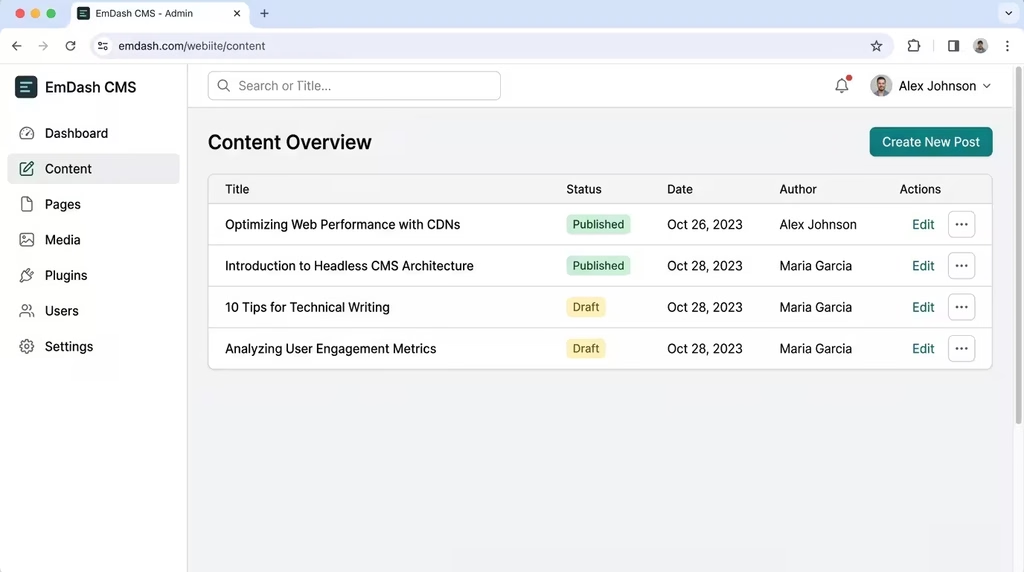
Cloudflare describes it as the “spiritual successor to WordPress,” which is a phrase that carries both ambition and risk. It signals intent, not feature parity. EmDash v0.1.0 is a developer preview, and it is very much in early-beta territory. But the architecture underneath is genuinely interesting, and the problems it is designed to solve are real ones that WordPress has been unable to fix for over two decades.
The WordPress Problem EmDash Is Actually Solving
To understand why EmDash matters, you first need to understand the depth of the problem it is trying to fix.
WordPress plugin security is not just an inconvenience. It is a structural crisis. According to Patchstack’s State of WordPress Security 2025 report, 96% of all security vulnerabilities in WordPress sites originate from plugins. In 2025 alone, more high-severity vulnerabilities were found across the WordPress plugin ecosystem than in the previous two years combined.
The reason is architectural. A WordPress plugin is a PHP script that executes directly inside the WordPress environment. It has unrestricted access to the database, the filesystem, and the web server. When you install a plugin, you are extending total trust to that code. If the plugin has a flaw, an attacker can exploit the entire site.
WordPress.org attempts to manage this risk by manually reviewing every plugin submitted to its official marketplace. The review queue currently stretches to over 800 plugins, with a minimum wait time of two weeks. Despite this gate, vulnerabilities still pass through. The problem is systemic, not procedural.
Beyond security, there is an ecosystem lock-in issue. Because plugins run in the same execution context as WordPress, the community has broadly agreed that plugins should carry the GPL licence, which requires the source code to be made freely available. This creates a bizarre tension: developers who build valuable plugins are effectively forced to give their code away for free everywhere except the official marketplace, creating centralised dependency on WordPress.org as the sole trusted distribution channel.
These two problems, insecure plugins and a locked marketplace, are the direct targets EmDash was built to eliminate.
7 Powerful Features That Make EmDash a CMS Worth Watching
Feature 1: Sandboxed Plugin Architecture
This is EmDash’s defining technical achievement, and it is worth spending time on because it is genuinely different from anything a PHP-based CMS can offer.
In EmDash, every plugin runs inside its own isolated sandbox: a Cloudflare Dynamic Worker. The plugin does not have access to the underlying database, filesystem, or network by default. Access to any resource is explicitly granted through a capability declaration in the plugin’s manifest. A plugin that cannot compile without declaring its capabilities cannot exceed its declared permissions at runtime.
Consider a practical example. An EmDash plugin that sends an email notification when a post is published declares exactly two capabilities: read:content and email: send. That is it. The plugin cannot access the database, call external APIs, or perform any action outside those two declared permissions. The permissions are stated upfront, before installation, similar to an OAuth authorisation flow where a third-party app requests specific, named access to your account.
This is the same sandboxing model that powers Cloudflare’s own serverless platform, and it is 100 times faster than traditional container-based isolation, according to Cloudflare’s Dynamic Workers launch post. The security boundary is enforced at the runtime level, not the policy level.
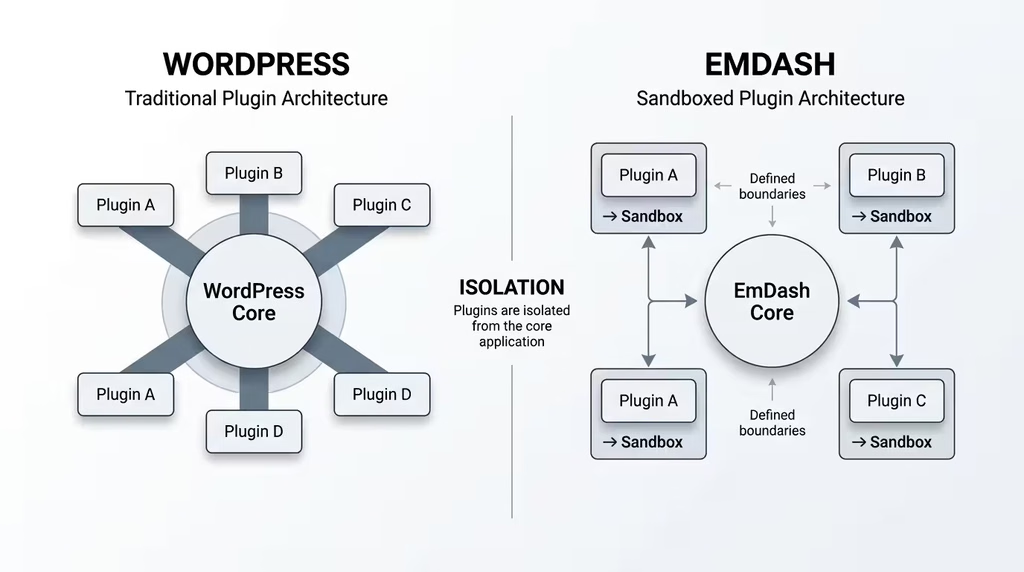
For creators and business owners, this means you can install a plugin and know exactly what access you are granting it before you click install. For developers, it means you can build plugins without worrying that a dependency vulnerability will expose your users’ data.
Feature 2: Breaking Marketplace Lock-In
The sandboxed plugin model has a secondary benefit that is just as significant as the security improvement: it breaks the centralised control that WordPress.org has over plugin distribution.
Because EmDash plugins run independently from the CMS and share no code with it, plugin authors are free to use any license they choose. MIT, proprietary, commercial, anything. There is no architectural or legal pressure to open-source their work. The same freedom that NPM, PyPI, and other package registries offer to their ecosystems is now available to EmDash plugin developers.
The second dimension of this freedom is more subtle but equally powerful. Because the security model enforces constraints at the runtime level, site owners no longer need a centralised marketplace to vet plugins on their behalf. The plugin manifest declares exactly what the code can do. Site administrators can make informed decisions about whether to trust a plugin based on what it actually asks for access to, not based on a marketplace reputation score.
This is a foundational shift. WordPress.org has long operated as the de facto trust authority for the plugin ecosystem. EmDash distributes that trust to the security model itself.
Feature 3: Built-In x402 Payment Support for the AI Era
This feature will matter most to content creators, publishers, and media professionals, and it addresses a problem that the publishing industry has barely started grappling with.
The traditional web publishing business model relies on human visitors viewing pages so that advertising can be served to them. That model is under severe strain as AI agents increasingly access web content on behalf of users. An AI agent retrieving your article to summarise it for a user is not a human visitor. It will not see your ads. It will not click your affiliate links. But it is still consuming your content and deriving value from it.
EmDash ships with native support for x402, an open internet payment standard based on the HTTP 402 Payment Required status code. When an AI agent or any client requests content with an x402 gate, the server responds with a payment request. The client pays for access on demand, the server grants entry, and the creator earns revenue, with no subscription required and no engineering work beyond configuration.
Every EmDash site has this capability built in. Content creators configure which posts or pages require payment, set the price, and provide a wallet address. The infrastructure does the rest. This is not a plugin or an integration. It is part of the core CMS.
For DSE readers building digital publishing businesses, this is worth understanding early. The x402 standard is still emerging, but EmDash’s early adoption positions publishers ahead of a monetisation shift that is already underway.
Feature 4: True Serverless Architecture with Scale-to-Zero
WordPress requires a running PHP server. Even a simple blog needs a compute provisioned and ready to respond to requests at all times. On low-traffic sites, this means paying for idle compute around the clock. On high-traffic sites with unpredictable spikes, it means pre-provisioning excess capacity or risking downtime.
EmDash eliminates this. It is built on Cloudflare’s Workers runtime, which uses V8 isolate architecture to spin up an execution context at the precise moment a request arrives and scale back to zero the moment traffic drops. You only pay for CPU time spent doing actual work.
The practical implications are significant for small business owners and independent publishers. A site that receives intermittent traffic, such as a course landing page, a consulting portfolio, or a niche blog, can run with near-zero infrastructure cost. A site that receives a sudden traffic surge does not require manual scaling decisions. The platform handles it automatically.
For agencies and platform builders managing many client sites, Cloudflare for Platforms allows millions of EmDash instances to run on the same infrastructure, each scaling independently.
Feature 5: Astro-Powered Theming
EmDash uses Astro as its frontend framework, which is a considered and strategic choice. Astro has grown rapidly in the developer community and is particularly well-suited to content-heavy websites because it ships minimal JavaScript by default and generates highly performant static output.
An EmDash theme is an Astro project. Theme developers create pages for rendering content, layouts for shared HTML structure, reusable components, and a seed file that tells the CMS what content types to create. This will be familiar to any developer who has worked with a modern TypeScript framework.
Critically, EmDash themes cannot perform database operations. Unlike WordPress themes, which hook into functions.php and can execute arbitrary PHP, EmDash themes are purely presentational. The risk surface that WordPress themes historically created is absent in EmDash by design.
This also means that LLMs and AI coding agents can work with EmDash themes effectively, since Astro is already part of the training data of major AI models. Building or customising an EmDash theme is something AI coding tools can assist with more reliably than custom WordPress PHP theme development.
Feature 6: AI-Native CMS with MCP, CLI, and Agent Skills
EmDash was designed from the ground up to be operated by AI agents. This is genuinely novel among CMS platforms and reflects the direction the broader developer ecosystem is heading.
Three capabilities make EmDash AI-native:
Agent Skills: Each EmDash instance ships with Agent Skills files that give AI agents structured guidance on how to write plugins, port WordPress themes, and customise the CMS. When you point an AI coding agent at an EmDash codebase, the agent has all the context it needs without requiring you to explain the architecture.
EmDash CLI: The command-line interface allows AI agents to interact with a local or remote EmDash instance programmatically. They can upload media, search content, create schemas, and manage the CMS without needing human-driven UI navigation.
Built-in MCP Server: Every EmDash instance provides a native Model Context Protocol server. MCP is an open standard for connecting AI tools to external systems and data sources. An EmDash site with MCP enabled is a first-class tool in an AI agent’s toolkit, accessible for content management tasks without custom integration work.
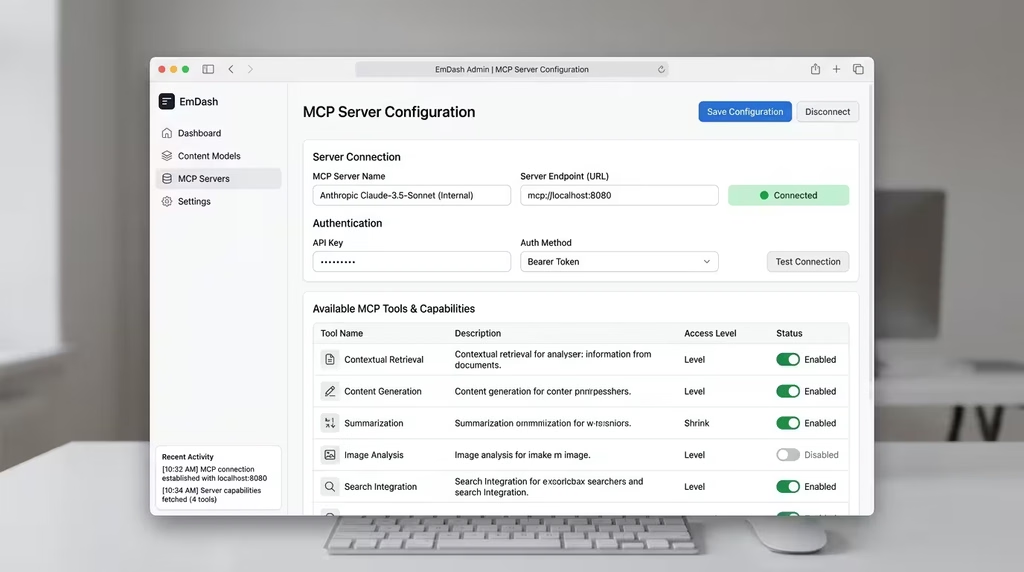
For educators and learning designers who use AI to scale content production, this is a meaningful advantage. Managing a large content library through AI agents rather than manual dashboard navigation is a legitimate productivity leap.
Feature 7: Passkey Authentication and Pluggable Access Control
WordPress sites are routinely targeted by brute-force login attacks. The default username and password authentication model has been a persistent vulnerability for over two decades. Countless WordPress sites have been compromised through stolen credentials or weak password choices.
EmDash ships with passkey-based authentication by default. There are no passwords to leak. There is no brute-force attack surface. Passkeys are hardware-bound cryptographic credentials that authenticate without transmitting any secret that can be intercepted or stolen.
Role-based access control ships out of the box: administrators, editors, authors, and contributors, each restricted to the actions their role requires. Authentication is pluggable, meaning you can connect EmDash to your organisation’s existing SSO provider and provision access automatically from your identity provider’s metadata.
Migrating from WordPress to EmDash
EmDash provides two migration paths for existing WordPress site owners.
The first is a WXR file export from WordPress admin, which EmDash can import directly. The second is an EmDash Exporter plugin for WordPress that creates a secure, password-protected endpoint on your existing WordPress installation. EmDash connects to this endpoint to pull your content and migrate your attached media into EmDash’s media library automatically.
Custom content types that were built in WordPress using Advanced Custom Fields or similar plugins can be recreated in EmDash’s schema builder, which creates properly separated database collections rather than squeezing everything into the WordPress posts table.
For bespoke Gutenberg blocks, EmDash provides an Agent Skill specifically for porting them, which an AI coding agent can use to rebuild them as EmDash-native components.
The migration process is currently designed for developers. It is not a one-click operation, and the level of effort will vary significantly depending on how complex your existing WordPress setup is.
What EmDash Cannot Do Yet: The Honest Limitations
EmDash is version 0.1.0. This is an early developer preview, and the gap between its current capabilities and a production-ready WordPress alternative is wide. Being clear about this is important for anyone considering how to position it in their planning.
There is no plugin ecosystem. EmDash’s sandboxed architecture is elegant in theory, but without a library of ready-built plugins, site owners face a blank slate. WordPress has over 60,000 plugins on its official directory. EmDash has none. Building or commissioning plugins requires development resources.
There is no visual site builder. No drag-and-drop editor. No block library comparable to Gutenberg. No page builder like Elementor or Divi. Editing content is closer to a classic text editor experience than the visual interface WordPress users have come to expect.
Setup requires a command-line interface. The onboarding pathway for EmDash assumes developer comfort. Non-technical users cannot yet install, configure, or operate EmDash without technical assistance. This is a fundamental accessibility barrier for the majority of WordPress’s user base.
It launched on 1 April. Several observers, including experienced WordPress industry commentators, initially assumed it was an April Fools’ joke. The date was unfortunate for a serious product launch, though Cloudflare has confirmed the project is genuine and ongoing.
It is tied to Cloudflare’s commercial interests. Matt Mullenweg, WordPress’s founder, pointed out that EmDash is designed to showcase and sell Cloudflare Workers. That is not disqualifying, but it is worth understanding. The platform’s optimal experience is on Cloudflare’s infrastructure, and the project’s roadmap will reflect Cloudflare’s business priorities.
For the vast majority of content creators, small business owners, and online educators reading this today, EmDash is not yet an alternative to WordPress. It is a very promising early-stage project built on a genuinely superior architecture, and it is worth watching closely.
Who Should Pay Attention to EmDash Right Now?
The answer depends on your role and your time horizon.
Developers and tech leads building new publishing products or CMS-powered platforms should evaluate EmDash seriously. The architecture is sound, the MIT licence removes friction, and the AI-native design aligns with where developer workflows are heading. Contributing to or building on EmDash at v0.1.0 means shaping something with real potential.
Agency owners who manage WordPress sites at scale should monitor EmDash’s progress and begin thinking about what a serverless, sandboxed CMS would mean for their hosting and maintenance overhead. The cost and security benefits of the architecture are directly relevant to their business model.
Content creators and course builders currently on WordPress have no reason to migrate, and every reason to stay and watch how EmDash matures. When and if EmDash develops a plugin ecosystem and visual editing capabilities, the calculus may change. Until then, WordPress 7.0 with its AI integration layer is the more immediately relevant development for your workflow.
Learning designers and educators building content platforms should track the x402 monetisation feature and the MCP integration. These are capabilities with direct practical applications for AI-assisted content delivery and pay-per-access educational content.
FAQ: EmDash CMS Answered
What is EmDash CMS? EmDash is an open-source, serverless content management system built in TypeScript by Cloudflare, launched in April 2026. It is designed as a modern alternative to WordPress with sandboxed plugin security, AI-native features, and native support for internet payment standards.
Is EmDash a replacement for WordPress? Not yet. EmDash v0.1.0 is an early developer preview with no plugin ecosystem, no visual editor, and a CLI-only setup process. It is a promising architecture, not a feature-complete alternative. WordPress powers over 40% of the internet and has a 23-year head start in ecosystem depth.
Why does EmDash claim to solve WordPress plugin security? WordPress plugins run in the same execution environment as the CMS and have unrestricted access to the database and filesystem. EmDash plugins run in isolated sandboxes and can only perform the actions they explicitly declare in a capability manifest. This is a structural security improvement that WordPress’s PHP architecture cannot replicate.
What is x402, and why does EmDash support it? x402 is an open internet payment standard based on the HTTP 402 status code. It allows websites to charge clients, including AI agents, for access to content on a per-request basis. EmDash ships with x402 support built in, allowing content creators to monetise their content in a world where AI agents increasingly access web content without triggering ad impressions.
Do I need Cloudflare to run EmDash? No. EmDash can run on any Node.js server. The optimal experience, particularly for serverless scaling and Dynamic Worker sandboxing, is on Cloudflare’s platform, but the CMS is not locked to it.
Can I migrate my WordPress site to EmDash? EmDash provides migration tools for importing WordPress content via a WXR file export or a direct connection via the EmDash Exporter plugin. Custom content types and media can be migrated. The process currently requires developer involvement.
Is EmDash free to use? Yes. EmDash is MIT-licensed and open source. Cloudflare infrastructure costs apply if you choose to host on Cloudflare Workers, though there is a generous free tier.
What is the EmDash MCP server? Every EmDash instance includes a built-in Model Context Protocol server, which allows AI tools and coding agents to connect to and manage the CMS programmatically. MCP is an open standard developed to standardise how AI tools interface with external systems and data.
How is EmDash different from headless CMS platforms like Contentful or Sanity? EmDash is a full-stack CMS with its own frontend theming layer (via Astro), whereas platforms like Contentful and Sanity are purely content APIs with no opinionated frontend. EmDash is also open source and self-hostable, while those platforms are proprietary SaaS products.
What programming language is EmDash built in? EmDash is written entirely in TypeScript. Plugin development is also in TypeScript.
Should I start a new project on EmDash today? If you are a developer comfortable building on early-stage, pre-1.0 open-source software and interested in contributing to or exploring the architecture, yes. If you need a stable, production-ready CMS for a client or business site, WordPress, Ghost, or a headless CMS is the more practical choice today.
The CMS Landscape Has a New Contender
EmDash is not going to replace WordPress next week, next month, or probably next year. The ecosystem gap is enormous. The user experience is still developer-only. The plugin library is a blank page. Anyone declaring WordPress dead in response to a v0.1.0 developer preview is reacting to a headline, not a product.
That said, what Cloudflare has built deserves a measured assessment rather than dismissal. The sandboxed plugin model is architecturally superior to anything WordPress can offer within its PHP constraints. The AI-native design, from the MCP server to Agent Skills to the CLI, reflects a genuine understanding of where the developer ecosystem is heading. The x402 monetisation layer addresses a content creator problem that will only grow as AI agents become the primary interface between people and web content.
The CMS landscape has a new contender. It is rough, early, and limited. It is also genuinely interesting, structurally sound, and backed by one of the most capable infrastructure companies in the world.
Your move? Watch it. Follow the GitHub repository. Test the playground. Understand the architecture. The creators, educators, developers, and consultants who understand EmDash now will be far better positioned when its ecosystem matures, and the mainstream conversation catches up.
The best time to study a new platform is before it becomes crowded. For EmDash, that time is right now.
Ready to stay ahead of the tools shaping the future of digital publishing? Explore more in our Toolkit and Infrastructure series or book a Transformation Clarity Call with DSE’s consultants to discuss how your content infrastructure maps to where the industry is heading.