


Picture this. You have a validated digital product, a growing audience, and real customers willing to pay. You are based in Lagos, Nairobi, Accra, or Kampala. Yet every time you try to collect payment from international clients, accept investment, or open a proper business bank account in US dollars, you run into a wall. Local business registration does not solve your global ambitions. Hiring an American lawyer to incorporate you costs anywhere from $1,500 to $5,000. The paperwork is endless. The waiting is brutal.
This is the exact problem Stripe Atlas was built to solve.

Since its launch in 2016, Stripe Atlas has helped more than 100,000 founders from over 140 countries incorporate a US company, get their employer identification number (EIN), open a business bank account, and start accepting global payments, all from a laptop, without visiting a single government office. In 2026, it remains one of the most compelling tools for any serious entrepreneur looking to build a globally credible business.
This guide is written for you: the African entrepreneur, the remote founder, the freelance consultant scaling to a product, and the early-stage startup that wants to move fast and build right. We will cover what Stripe Atlas is, how it works, what it costs (including the costs most guides skip), who it truly serves, and the timing considerations you must think through before applying.
By the end of this post, you will be informed, equipped, and empowered to make the right decision for your business.
Table of Contents
Disclosure: Our content is engineered to help you make informed, data-driven, and smart decisions. Digital Solutions Edge is reader-supported; when you engage with our recommendations or click certain links, we may receive a commission. This support allows us to continue delivering the digital solutions you rely on. Thank you for being part of our community.
What Is Stripe Atlas?
Stripe Atlas is a business formation and startup toolkit built by Stripe, one of the world’s leading payments infrastructure companies. It is a technology service, not a law firm, designed to automate and streamline the process of incorporating a US company from anywhere in the world.
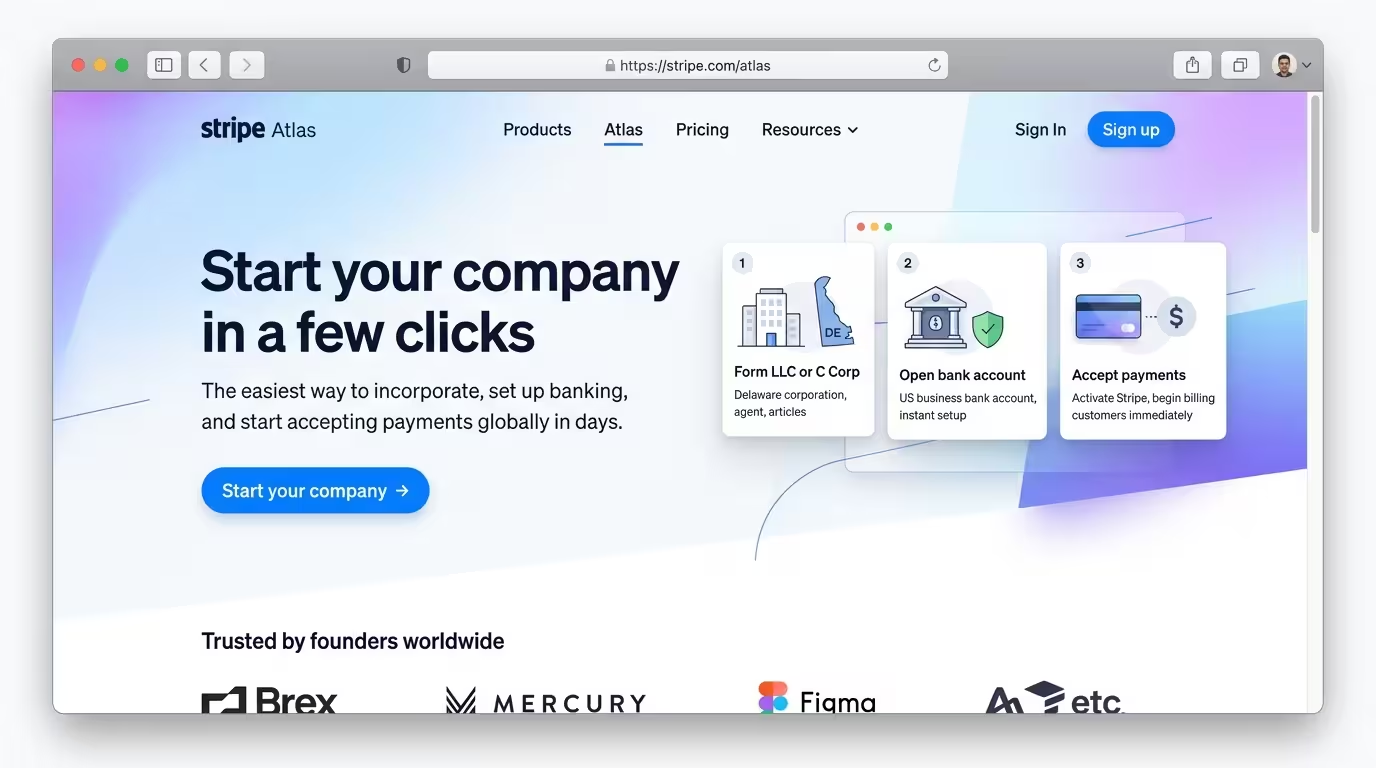
In plain terms, Stripe Atlas does what would otherwise require an American attorney, weeks of paperwork, IRS correspondence, and multiple government filings, all compressed into a digital form you can complete in about ten minutes. Within two business days of submission, your Delaware company exists, your tax ID is in motion, and you are already cleared to open a bank account and accept payments.
Stripe Atlas is what you use when your ambition is global, but your current business infrastructure is local.
It is worth clarifying what Stripe Atlas is beyond a registration tool. It is an onboarding ramp to the global startup ecosystem. Once you incorporate through Atlas, you can raise capital using YC-style SAFE agreements, access over $50,000 in partner discounts, receive $2,500 in Stripe product credits, and operate your business with legal documents created in collaboration with Cooley LLP, one of the most respected startup law firms in the United States.
Who Is Stripe Atlas For?
Stripe Atlas is built for founders who need a legitimate US business presence to operate credibly on the global stage. It is particularly valuable for:
International founders outside the US who want to access the American financial system, attract US-based investors, and collect payments from global customers without friction. Startups in over 140 countries have used Atlas, with a particularly strong uptake across Africa, Asia, Latin America, and Eastern Europe.
Tech startups and SaaS businesses that need investor-grade documents, SAFE agreements for fundraising, and a Delaware entity that venture capitalists actually recognise. The C Corporation structure Atlas offers is the go-to vehicle for startup equity and VC investment.
Digital product creators and online service businesses that need to get paid globally. Whether you are selling a course, a SaaS tool, a design service, or a consulting package to international clients, an Atlas-incorporated company gives you a Stripe account to collect payments from virtually anywhere.
Remote freelancers transitioning to a product or agency model who want to graduate from individual platforms like Fiverr or Upwork to operating as a legitimate business entity with invoicing, contracts, and a proper banking structure.
Entrepreneurs who want speed over complexity. If you want your company set up fast and clean, with paperwork handled by professionals, and you do not want to spend weeks on back-and-forth with lawyers, Atlas delivers.
Who is it not ideal for? Purely local businesses with no international clients, no plans for foreign investment, and no need for a US bank account would likely find the ongoing compliance costs unnecessary. A local food business, brick-and-mortar retail shop, or government-contracted service company in Nigeria does not need a Delaware C Corp. The registration and maintenance costs would be a burden with minimal corresponding benefit.
How Stripe Atlas Works: The Step-by-Step Process
The Stripe Atlas process is handled entirely online through the Stripe Dashboard. Here is how the journey unfolds from signup to your first payment.
Step 1: Create Your Stripe Account and Apply
You start at dashboard.stripe.com/register/atlas. Provide your email, full name, and a password. The application asks for your company name, your desired structure (C Corporation or LLC), your co-founders’ details, and your ownership split. You will also need to supply identification documents.
The entire form typically takes under fifteen minutes to complete. Atlas uses legal document templates developed in collaboration with Cooley LLP, so the documents are investor-grade from day one.
Step 2: Sign Your Incorporation Documents
Once you submit your details, Atlas generates your legal documents digitally. For a C Corporation, these include your certificate of incorporation, bylaws, board and shareholder consents, and stock purchase agreements. For an LLC, they include the certificate of formation and operating agreement. You sign everything online, no printing, no notarisation, no post office visits required.
Step 3: Delaware Incorporates Your Company
Stripe files your paperwork with the State of Delaware. Atlas includes next-day expedited processing in the $500 fee, so your company can be formally incorporated in Delaware within one to two business days. Delaware is the preferred incorporation state for startups globally because of its business-friendly legal framework, specialised courts for commercial disputes, and strong investor familiarity.
Step 4: EIN Obtained, Equity Issued, 83(b) Filed
After incorporation, Atlas applies for your Employer Identification Number (EIN) from the IRS. This is your company’s federal tax ID. Atlas also issues founder equity and files the 83(b) tax election on your behalf. The 83(b) election is a critical IRS filing that allows founders with vesting equity to elect to be taxed based on the value of shares at grant (typically near zero), rather than at vesting (potentially much higher). Missing this filing is an expensive mistake that Atlas prevents by automating it.
Step 5: Open Your Bank Account and Accept Payments
Once incorporated, you can open a US business bank account through Atlas’s banking partners (typically Mercury). Atlas also sets up your Stripe account so you can begin accepting global payments immediately, even before your EIN is finalised. This is a 2025 update: Atlas startups can now accept payments before receiving their EIN, removing a bottleneck that previously delayed revenue generation.
Step 6: Use the Post-Incorporation Checklist
Atlas provides a guided post-incorporation checklist covering banking, payroll, cloud computing, fundraising tools, and access to over $50,000 in partner discounts. This is the ongoing value that extends beyond the incorporation event itself.
Stripe Atlas Company Types: C Corporation vs LLC
Atlas allows you to form one of two company structures. Choosing correctly here has long-term tax, legal, and fundraising implications.
Delaware C Corporation
The C Corporation is the standard vehicle for venture-backed startups. It allows you to issue multiple classes of stock, grant stock options to employees, and raise money from angel investors and venture capital firms using standard investment instruments like SAFEs and convertible notes. Most investors, especially US-based VCs and angel networks, expect to invest in a Delaware C Corp.
For African founders building scalable tech products, SaaS tools, or platform businesses who plan to raise external capital at some point, the C Corporation is almost always the right choice.
The trade-off is compliance complexity. C Corporations are subject to corporate income tax, must file annual reports, and require more administrative overhead than an LLC.
Delaware LLC
The LLC (Limited Liability Company) is simpler to maintain and is often preferred by small businesses, solo operators, and service businesses that are not seeking venture capital. LLCs offer pass-through taxation, meaning business profits and losses pass directly to the owners’ personal tax returns, avoiding the double taxation a C Corp can face.
For a freelancer, consultant, or small agency owner who wants the legal protection and banking access of a US entity but has no plans to raise venture capital, an LLC may be the cleaner option.
The key consideration for non-US residents forming an LLC is the Form 5472 filing obligation. Non-resident LLC owners with foreign ownership must file this IRS informational return annually. Failure to file carries a severe penalty of $25,000 per violation. This is one of the most commonly missed compliance requirements for international founders using Atlas LLCs.
What Is Included in the Stripe Atlas Package?
For the one-time $500 fee, Stripe Atlas delivers the following:
- Company incorporation in Delaware, including next-day expedited processing and state filing fees
- Company Tax ID (EIN) obtained from the IRS on your behalf
- Founder equity issuance and share purchase agreements
- 83(b) election filing for every eligible founder
- Legal document templates for selling, hiring, and running your business (developed with Cooley LLP)
- $2,500 in Stripe product credits for your first year after incorporation (covering payment processing fees)
- Access to over $50,000 in partner perks from companies like Mercury, AWS, Xero, Carta, and more
- Registered agent service for the first year (Delaware requires a registered agent with a physical address in the state)
- SAFE fundraising tools from your Dashboard to raise pre-seed and seed capital
This is what a comparable lawyer-assisted incorporation would cost you: Delaware state fees alone sit around $89 for standard filing and $109 for expedited. Add attorney fees of $1,500 to $3,000 minimum for a proper incorporation package, and the $500 Atlas bundle looks extraordinarily competitive.
Stripe Atlas Costs: Full Breakdown (2026)
Transparency is essential here. The $500 fee is real and comprehensive for what it covers. But your total cost of running a US entity extends well beyond that initial payment. Here is the complete cost picture.
One-Time Setup Fee: $500
This covers your incorporation, EIN, equity, 83(b) filing, first-year registered agent, and legal document templates. It also includes Delaware state fees. You pay this once at the start.
Year Two Onwards: $100 Per Year (Registered Agent)
Delaware law requires every company to maintain a registered agent in the state. After the first year (which is included in the $500), Stripe Atlas charges $100 per year to continue this service. This renews automatically.
Delaware Franchise Tax (Annual, Mandatory)
This is the cost most guides bury in fine print. Every Delaware company must pay an annual franchise tax to the State of Delaware.
- LLCs: Flat $300 per year
- C Corporations: This is variable. Under the Authorised Shares Method, a simple startup with 10 million authorised shares could owe as little as $400. Under the Assumed Par Value Capital Method (used if your company has significant assets), the tax can be higher. Most early-stage startups with minimal assets calculate a bill of $400 to $500. You file an annual report alongside the tax payment by 1st March for C Corps.
Annual Tax Filing (Not Included in Atlas)
Stripe Atlas does not handle your annual tax returns. This is a separate cost. You will need to hire an accountant or CPA to file your federal corporate tax return (Form 1120 for C Corps), state tax returns, and any relevant information returns. Depending on the complexity of your business, CPA fees typically range from $500 to $2,000 or more annually.
For non-US founders owning a C Corporation, additional forms may be required, including Form 5471 (if there are foreign shareholders with reporting obligations). For LLC owners who are not US residents, Form 5472 is mandatory, with a $25,000 penalty for non-compliance.
Stripe Payment Processing Fees
Once you start accepting payments through Stripe, the standard processing rate is 2.9% plus $0.30 per successful card charge. Your $2,500 in Stripe product credits offsets this in your first year. For a business processing $50,000 in its first year, this credit essentially covers approximately $1,450 in processing fees, meaning you net about $1,050 in leftover credits for other Stripe products.
Summary: True Annual Cost of Running a Stripe Atlas Company
| Cost Item | Year 1 | Year 2+ |
|---|---|---|
| One-time setup fee | $500 | $0 |
| Registered agent | Included | $100/year |
| Delaware franchise tax (C Corp) | $400–$500 | $400–$500/year |
| Annual tax filing (CPA estimate) | $500–$2,000 | $500–$2,000/year |
| Total minimum | $1,400–$3,000 | $1,000–$2,600/year |
This means that from Year 2 onward, you are looking at a minimum of approximately $1,000 per year to keep a lean, low-revenue Delaware company alive, and potentially over $2,600 if your situation requires thorough CPA support.
The Hidden and Recurring Costs Most Founders Miss
Several additional costs are frequently overlooked by new Atlas founders. Knowing these upfront protects your budget and your compliance standing.
Form 5472 penalty risk for LLCs: As mentioned, non-resident owners of US LLCs must file Form 5472 annually. The IRS penalty for missing this is $25,000 per occurrence. This is not a minor oversight risk. Budget for a CPA who knows international tax obligations if you are a non-US LLC owner.
State income tax obligations: While Delaware is income-tax-free for companies that do not operate within the state, if you have customers, employees, or nexus in other US states, you may create sales tax or income tax filing obligations in those states. This adds cost and complexity.
Bookkeeping: Atlas does not include bookkeeping. As your company grows, you will need to maintain proper financial records. Cloud accounting tools like Xero (available at a discount through Atlas perks) or QuickBooks are typical options, running $15 to $60 per month.
Payroll setup: If you plan to pay yourself or hire employees, you will need payroll software or a payroll service. Atlas does not cover this.
Banking maintenance: While opening a Mercury account through Atlas is free, Mercury has minimum balance recommendations and certain transaction fees depending on your account tier.
The honest picture is this: Stripe Atlas is an excellent and genuinely affordable tool for what it does. However, the ongoing cost of maintaining a US entity responsibly is a real commitment that sits well above the $500 headline figure.
Stripe Atlas for African Founders: Opportunities and Realities
For entrepreneurs across Africa, Stripe Atlas represents one of the most significant levelling tools available in 2026. The structural barriers that have long separated African founders from global capital and payment infrastructure are real, and Atlas directly addresses several of them.

Why African Founders Need a US Entity
Many of the world’s most widely used payment gateways, including Stripe itself, are either unavailable or severely limited in African countries. PayPal offers limited functionality in Nigeria. Stripe direct payments are not available in most African markets. A US-incorporated company with a Mercury bank account solves this instantly. With a US entity, you can:
- Receive USD payments from international clients without local banking restrictions.
- Access Stripe’s full suite of payment tools, including Checkout, Payment Links, Invoicing, and Billing
- Open a US business bank account fully remotely through Mercury
- Raise capital from global investors using SAFEs
- Access USD-denominated business tools at US pricing
Countries Eligible for Stripe Atlas
Stripe Atlas is available to founders in over 140 countries, including Nigeria, Ghana, Kenya, South Africa, Rwanda, Senegal, Egypt, Uganda, Tanzania, Côte d’Ivoire, and Cameroon. The service is expanding, and the list updates periodically. You can verify your country’s eligibility at stripe.com/atlas.
Founders from countries under comprehensive US government sanctions (including Cuba, Iran, North Korea, Russia, and Syria) are ineligible, as Stripe is bound by US sanctions law.
Nigeria-Specific Considerations
For Nigerian founders, Stripe Atlas is particularly powerful because Nigeria does not have direct Stripe access for payment acceptance. By incorporating a US entity through Atlas, a Nigerian founder can use that entity’s Stripe account to accept global payments, then route funds to a Mercury USD account. From there, transfers to Nigerian accounts via services like Wise, Payoneer, or Geegpay are straightforward.
The one important compliance note for Nigerian founders is the interplay with the Central Bank of Nigeria (CBN) regulations on foreign investment and repatriation of profits. As your business grows and you begin receiving significant foreign revenue, consulting a local tax and legal professional to ensure you remain CBN-compliant is a wise investment.
For founders with Indian co-founders, Atlas has a dedicated guide to incorporating in compliance with India’s Overseas Direct Investment (ODI) rules, recognising the regulatory complexity involved. Founders from Singapore have a similar resource in the Atlas docs.
The African Founder Timing Reality
Here is where we have to be candid. Stripe Atlas is a powerful tool, but it is not free to maintain. For an African entrepreneur with a side project generating $200 per month, the true annual maintenance cost of a US entity ($1,000 to $2,600 per year) may represent a significant portion of annual revenue. Taking on that overhead before your product has genuine traction could be a financial strain rather than an acceleration.
The optimal moment to use Stripe Atlas as an African founder is when you have paying customers or strong commercial intent, when the inability to collect payments is an active barrier to growth, or when you have an investor conversation happening. That is the moment Atlas pays for itself within weeks.
When Is the Right Time to Use Stripe Atlas?
Timing is one of the most underrated strategic decisions for any founder considering Atlas. Here is a practical framework.
Use Stripe Atlas Now If:
- You have customers willing to pay you in USD, but you cannot collect payment due to local banking limitations
- You are in active fundraising conversations with US or international investors
- You are building a SaaS, digital product, or service business that will operate globally from day one
- Your annual projected revenue exceeds $5,000 to $10,000, and the $1,000+ annual maintenance cost is less than 20% of that figure
- You need investor-grade documentation from the start (especially if you intend to issue equity to co-founders or early employees)
Wait Before Using Stripe Atlas If:
- You are still at the idea or pre-product stage with no paying customers or validated demand
- Your annual revenue projection is below $5,000, and the recurring compliance costs will eat a disproportionate share of income.
- Your target market is entirely local, with no international clients or investors on the horizon.
- You are not prepared to budget for annual CPA fees alongside Atlas maintenance costs.s
- You have not yet determined whether a C Corp or LLC is the right structure, and you need legal advice first.
The risk of incorporating too early is a compliance burden with no corresponding revenue benefit. An inactive Delaware company still owes franchise tax, still needs a registered agent, and still requires annual tax filings. An “empty” company is not a free asset.
The risk of waiting too long is losing deals, clients, or investors because you lack a credible legal and banking structure. When global opportunity knocks, Atlas lets you answer fast.
The sweet spot is when payment collection or investor credibility is the active constraint on your growth.
Stripe Atlas Perks and Partner Benefits
One of the most genuinely valuable aspects of the Atlas package is the partner perks ecosystem. The over $50,000 in partner discounts is not a marketing figure padded with trivial coupons. The actual value for a bootstrapped startup is substantial.
Key partners and their typical Atlas benefits include:
- Mercury: Free US business banking built for startups, with no account minimums and strong international wire transfer capabilities. Mercury is the most popular banking partner for Atlas founders.
- AWS (Amazon Web Services): Significant cloud credits for Atlas startups, typically ranging from $1,000 to $5,000 or more in the first year.
- Xero: Discounts on cloud accounting software.
- Carta: Equity management software discounts, highly relevant for C Corp founders managing cap tables.
- Stripe product credits: $2,500 in credits for your first year covers real payment processing costs.
For an early-stage startup, the AWS credits alone can offset cloud infrastructure costs for months, while the Xero discount reduces your bookkeeping software overhead. Taken together, a well-deployed Atlas perk stack can recover the $500 setup fee several times over.
Stripe Atlas vs Alternatives: A Quick Comparison
Stripe Atlas is not the only automated incorporation service available. Here is how it compares to the most common alternatives as of 2026.
| Service | Starting Price | Delaware C Corp | LLC | 83(b) Filing | EIN Included | Banking Partner | Atlas Perks Equivalent |
|---|---|---|---|---|---|---|---|
| Stripe Atlas | $500 | Yes | Yes | Yes | Yes | Mercury | $50k+ |
| Firstbase | $399 | Yes | Yes | No | Paid add-on | Multiple | Limited |
| Doola | $297 | Yes | Yes | No | Paid add-on | Multiple | Limited |
| Clerky | $599–$999 | Yes | No | Yes | No | N/A | None |
| Lawyer-assisted | $1,500–$5,000+ | Yes | Yes | Optional | No | N/A | None |
The headline: Stripe Atlas is not the cheapest option for incorporation on its own, but when you factor in the $2,500 Stripe credits, the $50k+ in partner perks, the automated 83(b) filing (which competitors often skip), and the integration with Stripe payments from day one, the value proposition for a digital business is hard to beat.
If your priority is the absolute lowest upfront cost and you are forming a simple LLC with no equity or investor concerns, Doola or a similar service may save you $200 on formation. But if you are building for investors, global payments, and startup-grade legal infrastructure, Atlas is the stronger long-term play.
Key Considerations Before You Apply
Before you fill in the Atlas application, run through this checklist.
1. Know your structure. Decide before applying whether you need a C Corporation or an LLC. This is a long-term legal decision. Atlas provides information but is not a law firm. If you have co-founders with equity splits, vesting schedules, or investor conversations ahead, a C Corporation is almost certainly correct. If you are a solo operator running a service business, an LLC may suffice.
2. Budget for the full first year. Plan for $500 (Atlas fee) + $400–$500 (Delaware franchise tax) + $500–$2,000 (CPA fees) as your realistic Year 1 cost. Do not let the $500 headline be the only number in your budget.
3. Understand your country’s rules. Nigerian founders are subject to CBN guidelines on foreign company ownership. Indian founders must comply with ODI regulations. Singaporean founders have their own considerations. Atlas has specific guides for India and Singapore. For Nigerian founders, consult a local legal or tax professional to understand your obligations alongside the US-side filings.
4. Plan your banking before you incorporate. Mercury is the primary and most popular banking partner for Atlas founders internationally. Have your identification documents ready for the Mercury KYC process. International founders may experience additional verification steps.
5. Treat Atlas as a starting point, not a finish line. Incorporation is the beginning of your compliance obligations, not the end. You need ongoing bookkeeping, annual tax filings, and potentially payroll management as you grow. Plan for these from the start.
6. Use your perks immediately. The partner discounts and Stripe credits have expiry conditions. Log in to your Atlas Dashboard and claim your perks as soon as you are incorporated to avoid leaving value on the table.
7. Remember that Atlas is not a law firm. The documentation is excellent, and the process is automated and reliable, but if you have complex legal questions about equity, investment terms, employment, or specific country compliance, you need to speak with a qualified attorney. Atlas acknowledges this explicitly in its own disclosures.
FAQ: Stripe Atlas Answered
1. Can I use Stripe Atlas if I am based in Nigeria?
Yes. Nigeria is among the 140+ countries eligible for Stripe Atlas. Nigerian founders can incorporate a Delaware C Corporation or LLC, open a Mercury bank account, and use Stripe to accept global payments. You should also consult a local tax or legal professional to ensure compliance with CBN regulations as your foreign income grows.
2. How long does the Stripe Atlas incorporation process take?
Once you submit your application and sign your documents, Delaware typically incorporates your company within one to two business days (thanks to expedited processing included in the $500 fee). Your EIN from the IRS takes additional time, typically two to four weeks, though you can open a bank account and accept Stripe payments before your EIN is finalised.
3. What is the real total cost of Stripe Atlas in the first year?
The headline $500 covers formation. Your total first-year cost, including Delaware franchise tax ($400–$500), CPA fees ($500–$2,000), and any bookkeeping or banking tools, typically ranges from $1,400 to $3,000. The $2,500 in Stripe credits and partner perks can offset a significant portion of these costs if you use them actively.
4. Do I need a US address or US citizenship to use Stripe Atlas?
No. Stripe Atlas is specifically designed for international founders. You do not need to be a US citizen or resident. You do not need a US address. Your registered agent in Delaware (provided by Atlas) satisfies the state address requirement.
5. What is an 83(b) election and why does it matter?
The 83(b) election is an IRS filing that tells the IRS you want to be taxed on your equity at its current value at the time of grant, rather than at vesting. For most founders, the value at grant is near zero, so the tax is minimal. If you skip the 83(b) filing and your equity vests when the company is worth millions, you could owe substantial income tax on that vesting. Atlas files the 83(b) automatically for every eligible founder, removing a risk that trips up many DIY incorporations.
6. Can I use Stripe Atlas if I have a co-founder in another country?
Yes. Atlas supports multi-founder applications with co-founders in different countries. You will need to provide details and identification documents for each founder. The ownership split and vesting terms for each founder are configured during the application.
7. Is Stripe Atlas available for founders from all African countries?
Atlas is available in over 140 countries, covering most of Africa, including Nigeria, Kenya, Ghana, South Africa, Rwanda, Uganda, Tanzania, Senegal, and more. The specific list is managed by Stripe and updated periodically. Founders from countries under US government sanctions are ineligible.
8. What happens if I want to close my company after using Stripe Atlas?
Dissolving a Delaware company is a separate process from what Atlas handles. You will need to formally dissolve the entity with the State of Delaware, settle any outstanding taxes, and file final tax returns. There are filing fees involved, and this process typically requires the assistance of a registered agent or attorney.
9. Does Stripe Atlas provide ongoing bookkeeping or accounting services?
No. Atlas handles incorporation and the initial legal setup. Ongoing bookkeeping, annual tax returns, payroll, and accounting are your responsibility. Atlas provides access to partner tools (like Xero at a discount) and guides, but it does not manage these functions for you.
10. Should I choose a C Corporation or LLC through Stripe Atlas?
If you are building a scalable tech business and plan to raise external capital, a C Corporation is the right choice. Investors, especially VCs and angel investors, strongly prefer Delaware C Corps for investment. If you are a solo operator or small service business with no plans for outside investment, an LLC offers simpler taxation. When in doubt, speak with a startup attorney before committing to a structure.
11. What banking options do I have after incorporating with Stripe Atlas?
Mercury is the primary and most popular banking partner for Atlas founders, offering free USD business bank accounts built for startups, with excellent support for international wire transfers. Other banking partners may be available depending on your region. Atlas provides guidance on opening your account after incorporation.
12. Can a pre-revenue startup from Africa use Stripe Atlas?
Technically, yes. Atlas has no minimum revenue requirement. Practically, consider whether the ongoing compliance costs ($1,000+ per year) are sustainable given your current revenue. The ideal scenario is when the inability to collect international payments is your active growth constraint.
Should You Use Stripe Atlas?
Stripe Atlas is a genuinely transformative tool when used at the right moment by the right founder. For the entrepreneur in Lagos, Nairobi, Accra, or anywhere else in the world where payment infrastructure, legal credibility, and banking access are the bottleneck between your product and global growth, Atlas is one of the most efficient investments you can make.
At $500 for an investor-grade Delaware incorporation, EIN, equity issuance, 83(b) filing, legal document templates, a Mercury bank account gateway, $2,500 in Stripe credits, and $50,000+ in startup perks, the value density is exceptional. Comparable services from US attorneys would cost three to ten times more and take three to five times longer.
The critical caveat is timing and financial readiness. Atlas is not a “$500 and done” decision. It is the beginning of a US entity that you must maintain responsibly. Franchise taxes, registered agent fees, annual CPA costs, and compliance filings are real obligations that do not pause because your business is quiet. Incorporate when your revenue or funding pipeline can absorb those costs comfortably, not just when the idea is exciting.
For African founders in particular, the message is this: you belong in the global startup conversation. Stripe Atlas is one of the best-designed tools to get you there. Use it strategically, not prematurely.
Your Next Steps:
- Assess your current revenue or commercial pipeline to determine if you are at the right stage to incorporate.
- Decide between a C Corporation and LLC based on your business model and fundraising plans.
- Budget for the full first-year cost, not just the $500 Atlas fee.
- Visit stripe.com/atlas to review country eligibility and start your application.
- Explore the Atlas Guides for expert resources on fundraising, taxes, equity, and running a remote startup.
- If you want strategic guidance on building the right global business infrastructure for your specific situation, book a Transformation Clarity Call (TCC) with our DSE consultants before you spend a single dollar.
The global playing field is open. Atlas is one of the keys. Use it wisely.