


What if the most powerful university in the world were already open on your phone, asking nothing but your attention?
Here is a statistic that should stop you mid-scroll: YouTube has over 800 million videos and welcomes more than 500 hours of new content every single minute. Within that colossal library, some of the sharpest minds in business, technology, design, finance, leadership, and personal development are teaching everything they know, for free. They are not withholding the good stuff for a paid course. They are genuinely competing for your attention by delivering real, transformative value.
The problem is beyond “where do I learn?” Most people already know YouTube is full of educational content. The real problem is the trap of passive consumption, where you watch video after video, feel informed, and still implement nothing. Your skills do not grow. Your situation does not change. The watching becomes the destination.
This guide exists to close that gap completely. You will leave this page knowing exactly what is worth learning on YouTube, who is worth learning from across twelve skill categories, how to build a structured playlist system that mirrors a proper curriculum, and the practical implementation frameworks that turn watched content into applied competence. This is YouTube upskilling done with intention, strategy, and results.
Table of Contents
Disclosure: Our content is engineered to help you make informed, data-driven, and smart decisions. Digital Solutions Edge is reader-supported; when you engage with our recommendations or click certain links, we may receive a commission. This support allows us to continue delivering the digital solutions you rely on. Thank you for being part of our community.
Why YouTube Is the Most Underrated Learning Platform of Our Era

Education has always had a cost. Whether measured in tuition fees, commuting time, rigid schedules, or the postcode lottery of geographic access, formal learning has historically excluded more people than it included. YouTube dismantled that model quietly and permanently.
Let me be candid with you before we go further. YouTube has been my number one learning hub for over a decade. Across business strategy, content creation, leadership thinking, technology, and ministry, some of the most formative ideas I have encountered did not come from a conference stage or a paid programme. They came from a well-crafted video by someone who had done the work and decided to share it freely. That experience has shaped a conviction I hold firmly: free access does not mean low-quality information.
The real question has never been about the price of content. It is about the character of the person delivering it. Whether or not someone charges you a fee, the more important test is this: are they a person of genuine value, and are they committed to sharing that value with you regardless of what you are paying? Because even when the content is free, you are still paying. You are paying with your time and your attention, and both of those are finite. They deserve to be invested wisely.
That conviction is the foundation of this guide. Every channel and creator recommended here has earned a place because of what they consistently give, not because of how much they charge.
The numbers are compelling. A 2023 study by the Pew Research Centre found that 35% of adults in the United States use YouTube to learn how to do new things they have never done before, making it the second most widely used online learning resource after general internet searches. In developing markets, the proportion is even higher. YouTube is a genuine equaliser, placing a Harvard lecture, a Silicon Valley founder’s playbook, and a New York Times bestselling author’s framework in the same space as a 16-year-old in Lagos, a consultant in London, or an entrepreneur in Accra.
What sets YouTube apart from structured online learning platforms like Coursera or Udemy is the speed of iteration. The best YouTube educators update their content to match the current landscape, sometimes within days of an industry shift. When OpenAI released GPT-4, there were comprehensive tutorials on YouTube within 48 hours. No textbook or formal curriculum can match that velocity.
The challenge, as noted, is not access. It is curation, structure, and execution. This guide solves all three.
What Is Worth Learning on YouTube: A Skills Priority Framework
Before you open a single channel, you need a personal skills audit. Not every skill is worth your learning time at this stage of your career or business journey. The Skills Priority Framework below will help you categorise every potential learning area before committing to it.
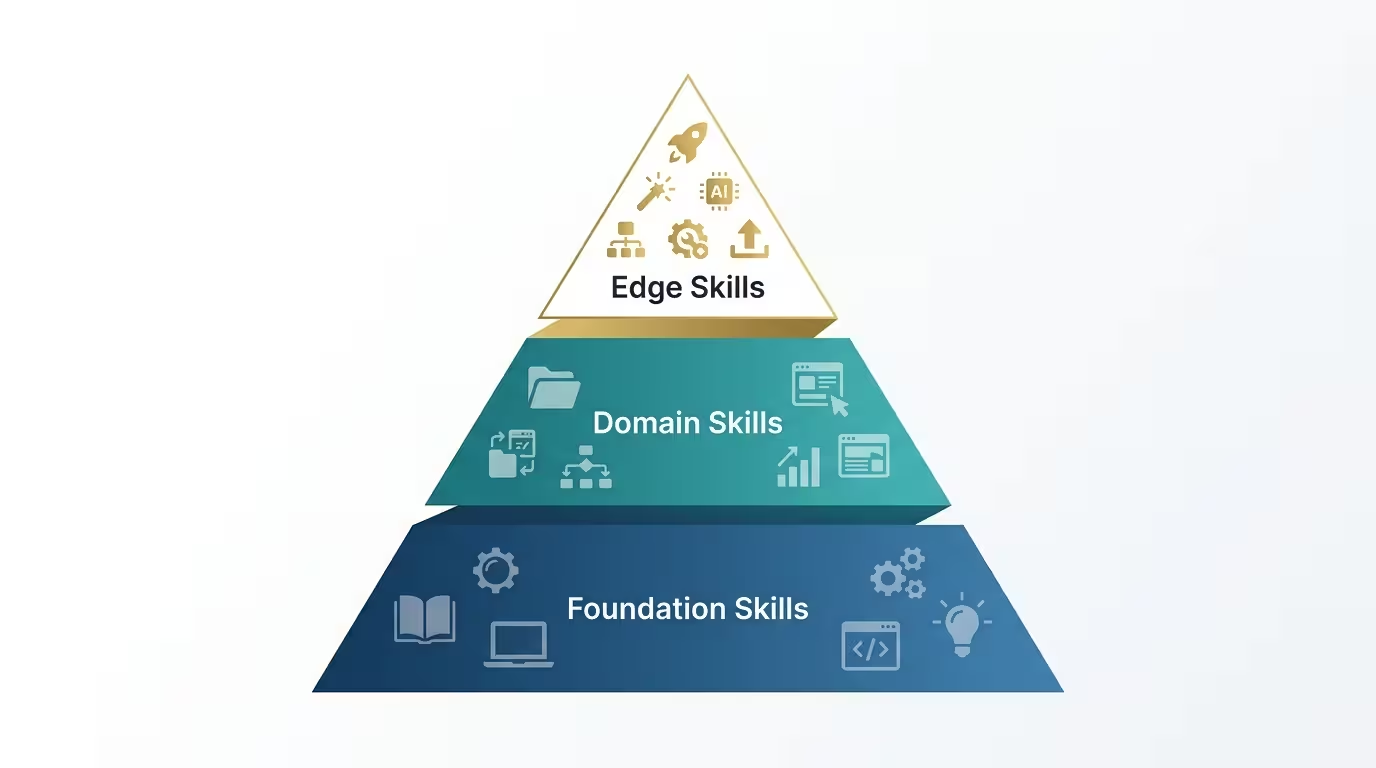
The 3-Tier Skills Pyramid
Tier 1: Foundation Skills (Always Worth Prioritising)
These are skills that compound across every area of your work and life. Investing here multiplies the returns of everything else you learn.
- Communication and persuasion
- Digital literacy and basic tech fluency
- Writing, structured thinking, and clear expression
- Time management and personal systems
- Financial literacy and money management basics
Tier 2: Domain Skills (Context-Specific, High ROI)
These deliver high returns within your specific industry, role, or business model. Your domain skills are the ones that clients, employers, and collaborators directly pay for.
- Marketing and content strategy
- Coding or no-code development
- Design and brand communication
- Project management
- Sales and business development
- AI tools and automation
Tier 3: Edge Skills (Differentiation and Long-Term Leverage)
These are the skills that most people in your field do not have, which means acquiring them separates you from the crowd. They take longer to develop but yield outsized competitive advantages.
- Systems thinking and process design
- Public speaking and facilitation
- Publishing and thought leadership
- Data analysis and insight generation
- Leadership and people development
Before selecting channels or building playlists, place your desired skills into this pyramid. Ask: “Is this a foundation skill I am missing, a domain skill I need to sharpen, or an edge skill that will distinguish me?” Your answer determines how much time you allocate and how urgently you prioritise implementation.
The 12 Upskilling Categories and the Best Channels in Each
Below are twelve skill categories, each with curated channel recommendations, the type of learning each provides, and who will benefit most.
Category 1: Business and Entrepreneurship
Why it matters: Whether you are building a consultancy, growing a service business, or scaling a startup, foundational business thinking is irreplaceable. YouTube is genuinely exceptional in this category.
Top Channels:
Alex Hormozi (@AlexHormozi): Hormozi is possibly the most practitioner-oriented business educator on YouTube today. He built and sold companies worth hundreds of millions before turning 40 and now gives away the frameworks publicly. His content covers offer creation, value engineering, sales systems, and scaling operational capacity. Every video is dense with actionable frameworks. Watch his series on “making your offer so good people feel stupid saying no.” Ideal for coaches, consultants, and service business owners.
Simon Sinek: Sinek’s work occupies the intersection of purpose-driven leadership and strategic clarity. His “Start With Why” framework remains one of the most-watched TED talks in history, but his YouTube channel goes much deeper. He covers trust in organisations, the infinite game mindset, and how leaders communicate with influence. Ideal for founders, managers, and anyone building a team or movement.
Gary Vaynerchuk (@GaryVee): GaryVee is a polarising figure, but his operational insight into attention, content distribution, and brand building is difficult to argue with. His Daily Vee series and keynote compilations offer raw, fast-paced strategic thinking. He is particularly valuable for understanding platform dynamics and the psychology of marketing. Best consumed in short bursts, not as your primary business education.
Valuetainment (Patrick Bet-David): Patrick Bet-David’s channel is a masterclass in analytical business thinking. His long-form interviews with entrepreneurs, investors, and strategists are exceptionally well-researched. His series on business history and competitive case studies is genuinely educational. A strong choice for consultants, business analysts, and strategic thinkers.
Y Combinator: The official YouTube channel of the world’s most prestigious startup accelerator. The content includes full recorded sessions from their Startup School, founder interviews, and talks from investors and company builders. For anyone building a scalable business, this is curriculum-grade material at no cost.
Category 2: Technology and Coding
Why it matters: Technical literacy is a non-negotiable asset in the digital economy. You do not need to become a developer to benefit from this category, but understanding how technology works will change the quality of your decisions and collaborations.
Top Channels:
freeCodeCamp.org This is the gold standard for self-taught programming. Their YouTube channel hosts complete courses, often eight to twelve hours in length, covering Python, JavaScript, web development, data science, machine learning, and more. Every course is taught by a real practitioner and structured for beginners to reach working competency. It is the closest free equivalent to a bootcamp curriculum.
Fireship: Fireship is the creator to watch if you want to understand modern web development culture, tools, and frameworks. His “100 seconds” series explains complex technical concepts with remarkable clarity and speed. For non-developers, his rapid-fire explanations of AI tools, cloud technologies, and programming languages are an outstanding way to build technical fluency without writing a single line of code.
Traversy Media (Brad Traversy): Brad Traversy produces some of the most thorough front-end and full-stack development tutorials available on YouTube. His project-based approach means viewers build real things as they learn. Particularly strong for HTML, CSS, JavaScript, and React.
CS50 (Harvard University): The official YouTube uploads of Harvard’s CS50 Introduction to Computer Science remain among the best free programming resources on the planet. Professor David Malan’s lectures are engaging, rigorous, and structured. If you have ever wanted to understand computer science from first principles properly, this is the starting point.
Corey Schafer: Corey Schafer’s Python tutorials are some of the most thorough and well-paced on the platform. His series covering Python OOP, Django, Flask, and data manipulation is particularly strong for those building tools for their own business or client work.
Category 3: Marketing and Content Creation
Why it matters: Attention is the currency of the digital economy. Marketing and content creation skills determine whether your expertise reaches the people it should. Every professional and business owner benefits from understanding this space.
Top Channels:
Neil Patel: Neil Patel’s channel covers SEO, content marketing, social media strategy, and paid advertising at a practitioner level. His tutorials are grounded in real data and tool demonstrations, making them particularly useful for consultants, coaches, and small business owners building their own digital presence.
Ahrefs: Ahrefs produces some of the most technically sound SEO education on YouTube. Their tutorials teach keyword research, backlink analysis, content strategy, and site auditing using their own tool, but the frameworks they share apply across every platform. Ideal for anyone doing content marketing or managing a website.
Adam Erhart: Adam is a marketing strategist whose channel focuses on practical, system-driven marketing. His content on marketing funnels, messaging strategy, and campaign structure is clear and applicable. Strong for consultants, coaches, and course creators.
HubSpot Marketing: HubSpot’s channel is an extensive library of tutorials covering email marketing, CRM management, inbound strategy, social media, and sales alignment. Given that HubSpot’s tools are widely used by businesses globally, their channel also serves as practical onboarding material for the platform itself.
Think Media (Sean Cannell): For those building a YouTube presence as part of their personal brand or business marketing, Think Media is the authoritative source. Their tutorials on video strategy, channel growth, and content systems are detailed and results-oriented. An excellent resource for coaches, educators, and consultants using video to build authority.
Category 4: Finance and Wealth Building
Why it matters: Financial intelligence is one of the highest-leverage skills any entrepreneur or professional can develop. Understanding money, investment principles, and business finance changes how you make every major decision.
Top Channels:
The Plain Bagel (Richard Coffin): This is methodical, trustworthy financial education. Richard Coffin is a Chartered Financial Analyst who explains investing concepts, economic principles, and personal finance frameworks without sensationalism. His videos on portfolio construction, asset allocation, and financial instruments are ideal for those building long-term wealth.
Two Cents (PBS): PBS’s personal finance series is produced with editorial rigour and pedagogical care. The content covers budgeting, debt management, investing basics, and financial psychology in an accessible, non-jargon format. A strong starting point for entrepreneurs who want to sort out their personal finances before scaling.
Graham Stephan: Graham covers real estate investing, personal finance, and entrepreneurship from the perspective of a practitioner who built a multi-million dollar property portfolio in his twenties. His content is honest, data-backed, and regularly updated to reflect current market conditions.
The Financial Diet: This channel focuses on the intersection of money and life design, covering topics like financial boundaries, career transitions, and the psychology of spending. Particularly valuable for freelancers, coaches, and solopreneurs navigating irregular income.
Category 5: Productivity and Systems Thinking
Why it matters: Productivity is beyond time management. It is a whole-system discipline covering energy, attention, decision-making, environmental design, and habit architecture. The people in this category are teaching the operating system behind high performance.
Top Channels:
Ali Abdaal: Ali Abdaal is arguably the most influential productivity educator on YouTube. A former NHS doctor, now a full-time creator and author, his content covers evidence-based productivity, the psychology of motivation, PKM (personal knowledge management), and building passive income systems. His series on “feel-good productivity” is particularly strong for those prone to burnout.
Thomas Frank: Thomas Frank’s channel covers study skills, note-taking systems (especially Notion and Obsidian workflows), task management, and building effective routines. His tutorials are meticulous, well-structured, and immediately applicable. Ideal for anyone building knowledge-intensive systems in their work.
Matt D’Avella: Matt D’Avella explores minimalism, habit formation, and slow productivity through beautifully produced documentary-style content. His approach is reflective and values-driven, making him particularly resonant for entrepreneurs who want to build meaningful and not just efficient work lives.
Keep Productive (Francesco D’Alessio): Francesco reviews and compares productivity tools with more depth and consistency than almost anyone on the platform. If you want to understand which apps, tools, and systems are worth your investment for task management, project planning, or note-taking, this is the channel to follow.
Category 6: Design and Visual Communication
Why it matters: Design literacy is beyond aesthetics. It is the ability to communicate clearly, establish trust visually, and position your brand with precision. Every creator, consultant, and business owner benefits from understanding how design shapes perception.
Top Channels:
The Futur (Chris Do): Chris Do is a two-time Emmy Award-winning designer who uses his channel to teach the business of design, brand strategy, and visual communication. His conversations with designers and business owners about pricing, positioning, and creative strategy are among the most valuable on the platform for consultants and brand builders.
Flux Academy (Ran Segall): Ran Segall’s channel is outstanding for understanding web design from a strategic and visual perspective. His tutorials cover UI/UX principles, Figma workflows, and the process of presenting design work to clients. Strong for freelancers and agency owners.
Satori Graphics: Satori Graphics covers graphic design principles, Adobe software tutorials, and typography with exceptional clarity. His work is practical and well-paced, making it a strong resource for entrepreneurs who want to improve the visual quality of their own brand communications.
Canva (Official Channel): Canva’s channel provides tutorials for non-designers who need to produce professional visual content consistently. Their walkthroughs cover social media graphics, presentations, pitch decks, and marketing materials, all within the Canva ecosystem.
Category 7: Leadership and Management
Why it matters: As your business or career grows, the skills that got you to your current level are rarely the skills that will take you to the next. Leadership and management competence become the primary differentiator between those who scale and those who stall.
Top Channels:
Simon Sinek (revisited): Beyond business strategy, Sinek’s deeper body of work on leadership is extraordinary. His content on psychological safety, the distinction between authority and leadership, and the cost of win-at-all-costs cultures is essential for anyone leading a team of any size.
Impact Theory (Tom Bilyeu): Tom Bilyeu’s long-form interview channel covers mindset, leadership, and high performance with exceptional depth. His conversations with scientists, athletes, business leaders, and philosophers create a rich, multi-disciplinary resource for ambitious professionals.
Harvard Business Review: The official HBR YouTube channel adapts its world-class management research into accessible short and medium-length videos. Topics cover emotional intelligence, negotiation, organisational culture, decision-making, and strategic thinking. This is peer-reviewed management education presented for a general audience.
Brian Tracy: Brian Tracy’s catalogue on goal setting, leadership, and sales psychology remains highly relevant despite being one of the older presences on the platform. His frameworks are clean, memorable, and practical, particularly for those newer to structured leadership thinking.
Category 8: Writing, Communication, and Storytelling
Why it matters: Every format of professional output, emails, proposals, presentations, books, social posts, and sales conversations, is a writing and communication challenge. The ability to express complex ideas with clarity and resonance is one of the highest-leverage skills in any professional’s toolkit.
Top Channels:
Brandon Sanderson (Creative Writing Lectures): Sanderson, one of the most successful fantasy authors alive, uploaded his full university creative writing lecture series to YouTube for free. While the content is framed around fiction, the principles of structure, narrative arc, character motivation, and reader engagement apply to every form of writing, including business content and thought leadership.
Charisma on Command: This channel analyses real-world communicators, politicians, executives, performers, and public figures to extract transferable principles of charismatic communication, body language, and conversational influence. The content is evidence-rich and immediately usable. Ideal for coaches, consultants, and anyone in a client-facing role.
The Write Channel (various creators): Search YouTube specifically for “copywriting tutorials,” “persuasive writing,” and “business writing”, and you will find a rich cluster of creator content. Particularly note channels from copywriters like Alex Cattoni, whose tutorials on writing for conversion are grounded in real campaign experience.
Category 9: Artificial Intelligence and Future Skills
Why it matters: AI literacy is the fastest-depreciating competitive advantage in history. The gap between those who understand and use AI tools and those who do not is widening at a rate that makes this category non-negotiable for every DSE reader.
Top Channels:
Matt Wolfe: Matt covers AI tools, news, and practical applications with consistency and clarity. His channel is one of the best for staying informed about what AI tools are launching, what they actually do, and how to integrate them into a workflow. His tutorials on prompt engineering, AI image generation, and automation are particularly strong.
AI Explained: This channel provides rigorous, research-backed breakdowns of major AI developments, papers, and releases. The content is more technical than Matt Wolfe’s but is accessible to non-engineers. Ideal for those who want to understand the “why” behind AI behaviour, not just the “how to use it.”
Tina Huang: Tina is a data scientist who teaches Python, data analysis, and machine learning through project-based tutorials. Her content bridges the gap between business thinking and technical execution, making her channel particularly valuable for consultants and analysts who want to build data skills.
Liam Ottley: Liam focuses specifically on AI automation and building AI-powered workflows and tools for business. His tutorials on n8n, Make, and custom GPT builds are practical and business-oriented, making him one of the more useful creators for entrepreneurs who want to automate without code.
Category 10: Education, Teaching, and Facilitation
Why it matters: For coaches, consultants, trainers, and educators, the ability to teach effectively is a core professional skill. YouTube has excellent resources for those who want to improve how they design and deliver learning experiences.
Top Channels:
Khan Academy: Sal Khan’s creation remains one of the most important educational projects in internet history. Beyond its content library, the channel models pedagogical clarity, mastery-based progression, and accessible explanation techniques that professional educators can learn from and adapt.
CrashCourse: CrashCourse produces high-quality educational series covering history, science, literature, psychology, and more. The production standards are high, the scripts are carefully crafted, and the pacing models how to compress complex ideas into digestible, engaging segments. Ideal for trainers and curriculum designers.
TED-Ed: TED-Ed’s animated explainer videos represent some of the finest examples of translating complex ideas into clear, visual, narrative-driven content. Every TED-Ed video is a masterclass in structure, analogy, and audience engagement. For facilitators and educators, they are worth studying as much as watching.
Category 11: Health, Energy, and Peak Performance
Why it matters: Your performance capacity as a professional is directly tied to your physical energy, mental clarity, and emotional regulation. Treating health as a productivity and leadership issue, beyond a personal one, is a significant mindset shift.
Top Channels:
Andrew Huberman (Huberman Lab): Dr Andrew Huberman is a Stanford neuroscientist whose channel covers the science of sleep, stress, focus, exercise, and nutrition with academic rigour and practical application. His protocols for improving focus, managing cortisol, and optimising sleep quality are evidence-based and widely adopted by high-performance professionals globally.
Dr Rhonda Patrick (FoundMyFitness): Dr Patrick’s channel focuses on longevity science, nutritional biochemistry, and health optimisation. The content is research-dense and presented for an educated general audience. For those who want to understand the science behind their health decisions, this is an authoritative resource.
James Worswick (and similar channels on movement and energy): Search specifically for channels covering movement, breathwork, and stress regulation. These functional health channels offer practical tools for managing the physical demands of entrepreneurship, which include sustained cognitive work, irregular schedules, and high-stakes decision-making.
Category 12: Faith, Purpose, and Kingdom-Aligned Work
Why it matters: For faith-driven professionals and entrepreneurs, the integration of spiritual conviction with daily work is beyond a personal preference. It is the foundation of sustainable motivation, ethical decision-making, and generational impact. This category addresses what most mainstream learning platforms miss entirely.
Top Channels:
Tony Evans: Dr Tony Evans is one of the most consistently clear and intellectually rigorous communicators in this space. His teaching on purpose, identity, and the Kingdom of God is grounded in Scripture and applied to everyday professional and relational life. His series on Kingdom business and Kingdom Men are particularly strong.
John Bevere: John’s channel covers topics including character, integrity, obedience to calling, and the fear of the Lord as a foundation for wise living. For faith-driven entrepreneurs navigating the tension between ambition and faithfulness, his content provides essential grounding.
Andy Stanley (North Point Ministries): Andy Stanley teaches with exceptional clarity on leadership, character, and wisdom. While his primary context is church leadership, the principles he teaches on integrity in systems, the role of trust, and the foundations of influence translate directly to business and professional life.
Transformation Church (Michael Todd): Michael Todd’s teaching on identity, purpose, and Kingdom positioning is particularly resonant for younger entrepreneurs and creatives who are navigating the intersection of faith and cultural relevance. His communication style is highly engaging, and his content is practically framed.
Who Is Worth Learning From: Creator Quality Criteria
With millions of channels available, how do you distinguish between a creator who will genuinely advance your skills and one who is performing expertise for algorithmic gain? Apply these five quality criteria before committing to any creator’s content.
1. Evidence of Practice
The best educators teach by doing, not by researching. Look for creators who have built the things they teach about. Alex Hormozi has the business exits. Andrew Huberman has a research lab. Chris Do has a design agency. Ran Segall has the client projects. Credentials and practice together create trustworthy educators.
2. Framework Density
High-quality educational creators give you mental models and frameworks, not just information. Information alone does not change behaviour. A framework gives you a repeatable tool. When a creator teaches you how to think about a problem, not just what to do about it, you are getting genuine education.
3. Consistency of Depth
One excellent video does not make a reliable learning resource. Look at a channel’s back catalogue. Is the depth consistent? Do they give away genuinely useful content, or do they use their videos as sales funnels for paid products? The best channels give so much away that you want to pay them more.
4. Respect for the Learner’s Intelligence
Condescension is a reliable signal of weak educational content. The best creators explain complex things simply without being patronising. They assume an intelligent, capable audience and build content accordingly. If a creator oversimplifies to the point of being misleading, or sensationalises to drive clicks, they are optimising for views, not your growth.
5. Community and Accountability Mechanisms
Some of the best YouTube educators also run communities, have comment sections that function as learning spaces, or create structured series that model progression. This does not disqualify standalone video makers, but a creator who thinks about their audience’s journey beyond individual videos is typically a more serious educator.
How to Build a YouTube Curriculum: Playlist Architecture for Continuous Learning
Watching random videos is browsing. Building playlists with intention is curriculum design. The difference between the two is the difference between information consumption and skill development.
The DSE Playlist Architecture Method
Step 1: Define a Specific Learning Outcome
Before creating any playlist, write a single sentence that completes this prompt: “After completing this playlist, I will be able to…” Vague outcomes produce vague playlists. “Learn marketing” is vague. “Build and launch a 3-email welcome sequence for a new subscriber” is specific.
Step 2: Structure Your Playlist in Three Phases
Every well-structured learning playlist follows a pattern:
- Phase 1: Foundation (20% of playlist) — Conceptual grounding. What is this skill? Why does it matter? What are the core principles? Use broad, introductory videos here.
- Phase 2: Technique (60% of playlist) — The practical how-to. Step-by-step tutorials, demonstrations, walkthroughs, and case studies. This is the bulk of your learning.
- Phase 3: Integration (20% of playlist) — Advanced applications, edge cases, expert-level conversations, and real-world examples. This phase connects the skill to broader strategic contexts.
Step 3: Cap Playlist Length
A playlist that exceeds 15–20 hours of content is a signal of poor curation, not thoroughness. Cap topic-specific learning playlists at 8–12 hours. This forces you to select only the highest-value content, and it gives you a complete learning unit that you can actually finish.
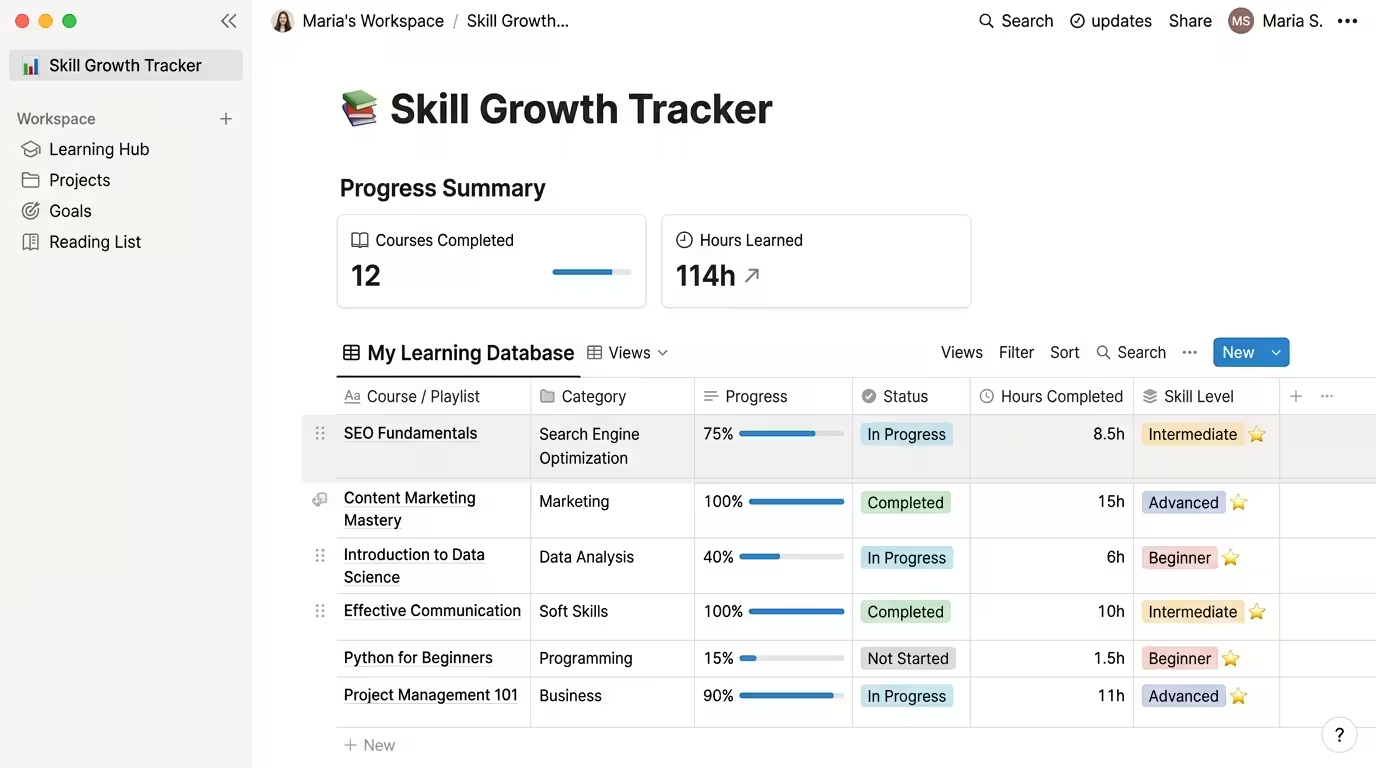
Step 4: Build a Master Learning Dashboard
Use a tool like Notion, Airtable, or a simple Google Sheet to track:
- Playlist name and learning outcome
- Total hours of content
- Completion percentage
- Key frameworks captured
- Implementation tasks generated from watching
This dashboard transforms casual watching into a trackable learning portfolio.
Step 5: Separate Your Watch-Later Queue from Your Learning Playlists
Your Watch Later queue is a graveyard. Almost nobody returns to it systematically. Keep it entirely separate from your intentional learning playlists. Use it for casual discovery, and only migrate content to a learning playlist when you have confirmed it meets your criteria.
Systems for Implementing What You Learn
This is the section that separates serious learners from professional video watchers. Implementation is where upskilling actually happens. Watching a tutorial on email copywriting does not make you a better copywriter. Writing fifty emails, testing them, and reviewing the results does.
The 4-A Implementation Framework
Every piece of educational content you consume should pass through four actions:
A1: Abstract (Capture the Insight). Immediately after watching, write a single-sentence distillation of the most important insight. Not a summary. One sentence. “The most important thing I just learned is…” This forces immediate synthesis and prevents passive consumption.
A2: Apply (Assign an Action). Every insight should generate at least one specific action. “I will apply this by… [specific task, with a deadline].” If you cannot think of a direct application, the content was either not relevant to your current stage or you have not connected it to your real work yet.
A3: Anchor (Store It in a Retrievable System). Insights that live only in memory are lost within 72 hours for most people. Use a second-brain system: Notion, Obsidian, Roam Research, or even a physical notebook to store your abstracted insights, linked to the source video and your planned action.
A4: Account (Build a Review Loop). Schedule a weekly fifteen-minute review of your learning log. Ask: What did I learn this week that I have already applied? What am I procrastinating on implementing? This review loop catches the gap between watching and doing before it becomes a habit of passive consumption.
The 24-Hour Rule
Implement one thing from every learning session within 24 hours of watching. It does not need to be the full application of a complex strategy. It can be: writing one paragraph using the copywriting framework you just learned, setting up one automation node from the tutorial you watched, or restructuring one section of your offer page using the positioning principle you just absorbed. The 24-hour rule keeps the momentum of learning connected to the rhythm of doing.
Spaced Application Practice
Research in cognitive science consistently shows that skills are consolidated through spaced, repeated application rather than massed practice (Cepeda et al., 2006). For every skill you are developing via YouTube:
- Apply it immediately after learning (Day 0)
- Apply it again in a slightly different context three days later (Day 3)
- Return to the source content and your notes after a week (Day 7)
- Attempt a more complex application after three weeks (Day 21)
This cadence is particularly powerful for skills like writing, coding, design, and systems building, where muscle memory and pattern recognition compound over time.
Peer Accountability and Teaching
Teaching what you learn is one of the most effective consolidation strategies available. The Protégé Effect, documented by researchers at the University of Illinois, shows that preparing to teach a concept increases comprehension and retention significantly. [Source: Chase et al., 2009, “Learning by Teaching Others Is Extremely Effective,” Journal of Educational Psychology].
Practical options for DSE readers:
- Share one insight weekly in a team meeting or community (such as a REDA Circle session or mastermind group)
- Write a short LinkedIn or blog post summarising what you learned
- Create a one-page cheat sheet of a new framework and share it with a peer
- Teach the concept to a mentee or junior colleague
The act of articulating what you have learned accelerates mastery faster than any amount of additional watching.
YouTube Features That Serious Learners Are Not Using
Most people use YouTube at approximately 20% of its learning capacity. Here are the underused features that transform the platform into a proper learning environment.
Chapters Navigation: Many high-quality educational videos include chapter timestamps in the description. These allow you to jump directly to the section most relevant to your current learning stage, rather than watching linearly every time. If you are revisiting a tutorial, use chapters to return only to the specific technique you need.
Speed Controls: YouTube allows playback at 0.75x, 1x, 1.25x, 1.5x, and 2x speed. For review sessions or familiar content, 1.5x maintains comprehension while cutting viewing time by a third. For new or dense technical content, 0.75x gives you time to absorb without constantly pausing. Adjust deliberately per content type.
Transcript Access: Every video on YouTube has an auto-generated transcript accessible via the three-dot menu below the video (select “Show Transcript”). For learning purposes, you can copy key sections, search for specific terms within a long video, and pull exact quotes for your learning notes without re-watching entire videos.
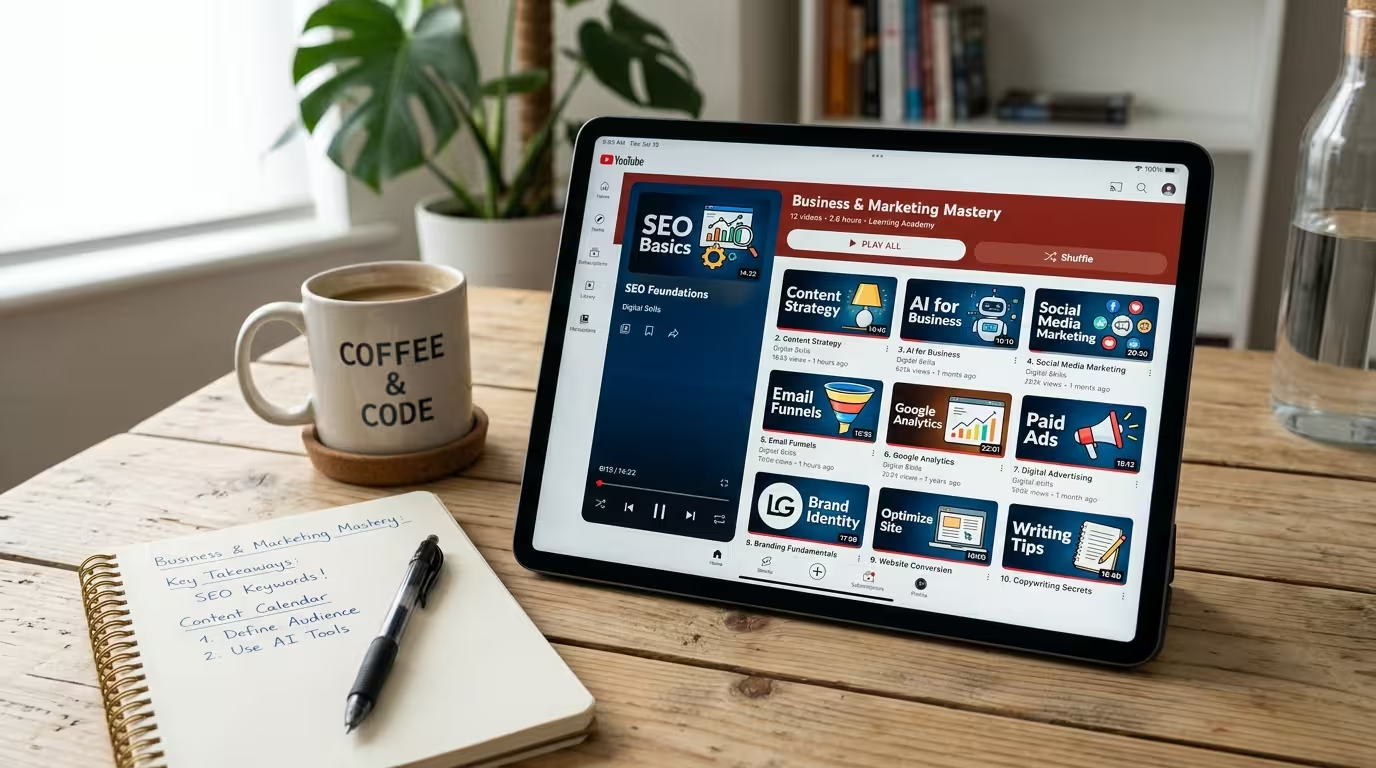
Saved Playlists as a Personal Library: You can create an unlimited number of private playlists on YouTube. Use these as curated topic libraries: one for copywriting, one for SEO, one for leadership, and one for AI tools. This is your personal educational library, accessible on any device, at no cost.
Offline Downloads (YouTube Premium): For those who travel frequently or have unreliable internet, YouTube Premium’s offline download feature allows you to save courses and tutorials for viewing without connectivity. For serious learners, the subscription cost is trivial relative to the productivity benefit.
Notifications for Specific Channels: Rather than following hundreds of channels and being overwhelmed, select five to eight channels that are genuinely core to your current learning priorities and enable the bell notification for them. This creates a curated learning feed rather than an algorithmic entertainment feed.
Common Upskilling Mistakes to Avoid
Mistake 1: Mistaking Watching for Learning. The most widespread mistake on this list. Video consumption produces information. Deliberate practice produces skill. If you have watched twelve videos on productivity systems and your work is still chaotic, you have been consuming, not learning. The fix is the 4-A Framework above.
Mistake 2: Learning Without Context. Some learners build playlists on topics they find interesting rather than topics they are actually using. Learning SEO while you do not have a website, or studying video editing before you have committed to creating video content, is low-leverage. Prioritise skills you will apply within the next 30 days.
Mistake 3: Curriculum Hopping. Moving between channels, topics, and teachers without completing a learning unit is the YouTube equivalent of never finishing a book. Finish what you start. Complete a playlist before beginning the next. Depth of understanding in one area creates more leverage than surface awareness across ten.
Mistake 4: Ignoring the Community. YouTube comment sections on high-quality educational videos are often filled with supplementary resources, questions, corrections, and alternative perspectives. The comment section on a Fireship video, a freeCodeCamp tutorial, or an Ali Abdaal productivity piece is a learning resource in itself.
Mistake 5: Optimising for Completion, Not Competence. Finishing a playlist should not be the goal. Competence is the goal. If you finish a ten-video series on copywriting but cannot write a compelling headline by the end of it, the learning has not landed. Measure yourself against the outcome, not the content consumed.
Building Your Personal Learning Stack
Your Personal Learning Stack is the organised set of resources, tools, and practices that support your continuous skill development. For YouTube upskilling specifically, here is a recommended stack architecture:
Layer 1: Your Primary Skills (2-3 maximum). These are the skills you are actively developing right now, mapped to a current project or goal. You should have active learning playlists running for each one.
Layer 2: Your Maintenance Skills (3-5 maximum). These are skills you have already developed to a working level and now maintain by following one or two authoritative channels. You watch their content selectively, not comprehensively.
Layer 3: Your Horizon Scan (open but filtered). These are channels you follow to stay aware of emerging trends, tools, and ideas without committing to deep learning. You check in monthly rather than weekly. AI news channels, trend analysis creators, and industry commentary fall here.
Recommended Supporting Tools:
| Tool | Purpose |
| Notion or Obsidian | Learning vault — store insights, frameworks, action items |
| Google Sheets | Learning dashboard — track playlists, progress, and implementation |
| YouTube (Private Playlists) | Curated learning library by skill category |
| Readwise | Capture and review highlights (works with browser extensions for YouTube transcripts) |
| Toggl or Clockify | Track actual learning time — awareness drives intentionality |
Frequently Asked Questions
1. How many hours per week should I dedicate to YouTube upskilling? Quality beats quantity decisively here. Two focused hours per week with deliberate implementation produce more skill growth than ten hours of passive watching. A realistic, sustainable minimum is three to five hours weekly, structured as two to three intentional learning sessions. Pair every session with at least one implementation task assigned before you close the browser.
2. Is YouTube a reliable source for professional-grade education? For the majority of practical, applied skills, marketing, coding, design, finance basics, productivity, and business strategy, YouTube offers content that meets or exceeds the quality of paid online courses. For academic qualifications or regulated professional certifications, formal credentials remain necessary. For professional competence, YouTube is entirely legitimate.
3. How do I avoid the rabbit hole of endless recommended videos? Go to a specific channel or playlist directly rather than starting from the YouTube homepage. Turn off autoplay in settings. Log in and use your personal playlists as your entry point. The algorithm is designed to maximise watch time, not your skill development. Your playlists are designed to maximise competence. Use them.
4. What is the best YouTube channel for learning business strategy? For strategic thinking broadly, Harvard Business Review’s channel, Simon Sinek, and Y Combinator each offer different but complementary perspectives. For practical business building, Alex Hormozi is exceptionally direct and framework-rich. The best channel for you depends on where you are in your business journey and what specific strategic challenges you are facing.
5. Can YouTube replace a formal business education or coaching programme? YouTube can replace the information component of formal education, and in many practical domains, it exceeds it for current relevance. What it cannot replace is the structured accountability, personalised feedback, and relational mentorship that formal education or coaching provides. For best results, use YouTube to build knowledge rapidly and invest in a coach or programme for accountability, feedback, and application support.
6. How do I evaluate whether a YouTube creator is actually credible? Apply the five Creator Quality Criteria: evidence of practice, framework density, consistency of depth, respect for the learner’s intelligence, and community mechanisms. Beyond that, cross-reference claims with independent sources. If a creator’s advice directly contradicts established research or the experience of credible practitioners in the same field, treat that content with scepticism regardless of their subscriber count.
7. What is the best way to retain what I learn from YouTube? Use the 4-A Framework: Abstract (capture the key insight), Apply (assign an action within 24 hours), Anchor (store it in a retrievable system), and Account (review weekly). The research on the testing effect and spaced repetition confirms that retrieval practice, attempting to recall and use information, cements retention far more effectively than re-watching content.
8. Should I use YouTube Premium for learning? If you are a serious learner who watches more than three to four hours of educational content weekly, YouTube Premium is worth considering. The removal of ads alone recovers significant time across a year. Offline downloads, background play, and the ad-free experience all reduce friction and improve focus during learning sessions.
9. How do I build a YouTube upskilling habit that actually sticks? Anchor it to an existing habit. Learning during a commute, over lunch, or as the first activity after a morning routine creates a reliable trigger. Keep your learning playlists ready and accessible. Remove algorithmic friction by bookmarking specific channels rather than starting from the home feed. And commit to the 24-hour implementation rule. Implementation is the reward system that makes learning addictive.
10. What are the best YouTube channels specifically for consultants and coaches? Alex Hormozi for offer design and client acquisition, Simon Sinek for leadership and purpose-driven positioning, The Futur with Chris Do for pricing and value communication, HubSpot Marketing for digital marketing systems, and Adam Erhart for marketing strategy. For those building thought leadership, Think Media and Neil Patel are particularly strong.
YouTube is a fully operational university. The faculty includes some of the most credentialed and experienced professionals in the world. The curriculum covers everything from foundational business thinking to cutting-edge artificial intelligence. The tuition fee is zero. The only thing standing between you and a genuinely transformed skill set is a system.
The system this guide has given you covers what to learn through the Skills Priority Pyramid, who to learn from across twelve curated categories, how to build a structured curriculum using Playlist Architecture, and how to close the knowing-doing gap using the 4-A Framework and the 24-Hour Rule. These are not theoretical tools. They are practical mechanisms that convert watching into competence.
What matters now is your next move. Choose one skill from the pyramid that is relevant to something you are working on in the next 30 days. Find one channel from the relevant category in this guide. Build one playlist with a specific outcome in mind. Watch with your notes open. Implement within 24 hours. That single cycle, repeated consistently, is how professionals grow.
Your competitors are watching the same YouTube. The ones who win are the ones who implement.
Ready to go deeper? Book a Transformation Clarity Call (TCC) with a DSE Consultant and let us build a custom learning and implementation roadmap aligned with your specific business and career objectives. You bring the ambition. We bring the system.